“He said to His disciples, ‘Therefore I tell you, do not worry about your life and what you will eat, or about your body and what you will wear. For life is more than food and the body more than clothing. Notice the ravens: they do not sow or reap; they have neither storehouse nor barn, yet God feeds them. How much more important are you than birds!” (Luke 12:22-24)
Okay. So it’s been more like 14 months since I landed a position in living history; my 1-year anniversary was August 14th. But c’est la vie! Better late than never…
That should be the battle cry of my life these days: a 40-hour work week; 2-hour daily commute; 15-20 hours a week devoted to college studies, and another 15-20 hours devoted to farm work/life = severe sleep deprivation and a perpetual race through life…followed by two days’ off catatonic in the easy chair, dozing, and wishing I could find the energy to get X,Y,Z done. In short, I’m a little over-extended on time, rundown and exhausted. My first reflection on a year in living history is that I’ve caught every cold, flu, and malady that walks through the museum. I’ve heard that it’s to be expected, especially this first year, when working with the public but that doesn’t make it any easier to bear; I get impatient with illness and a “rundown” diagnosis. In some ways, that’s a lament; in others, there’s still a side of me that feels privileged to have spent a little more than a year learning all sorts of unique skills and talents. Now, if we could just create a 28 hour day, I might get that 8 hours of sleep the doctors (and Mom!) are always yammering at me; 6 is more my average.
So, I guess that’s it for my first reflection. ZZZZzzzz……
(Chuckle)
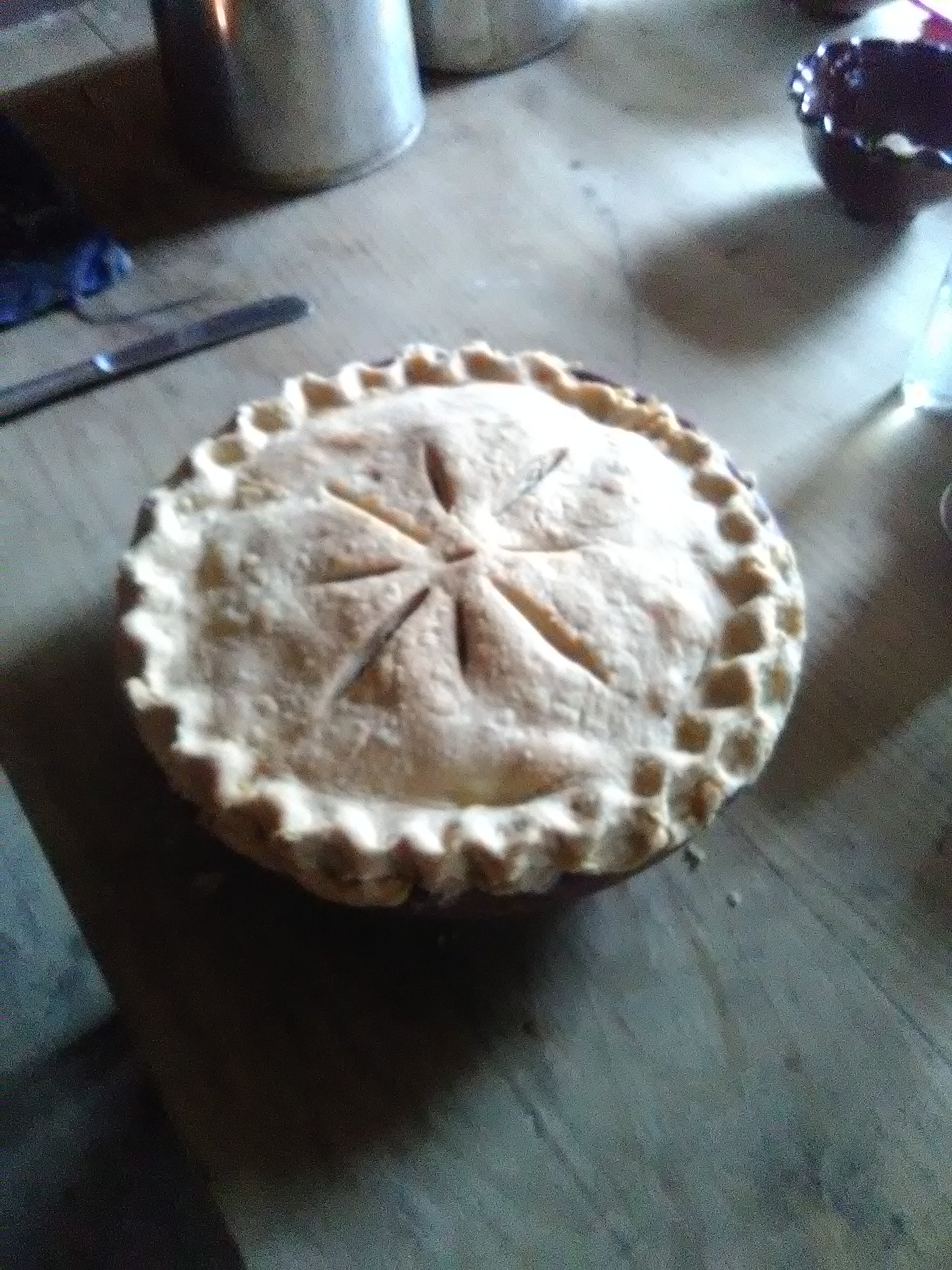
On a more positive note, I’ve learned to make some beautiful pie crusts. And I’m not at all modest about it. (grin) There’s something to be said for such humble accomplishments.
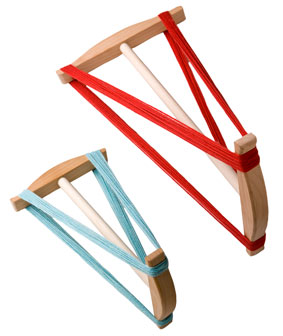
I’ve also learned how to spin on a Great Wheel, which, of course, is now on my wish list. The Walking Wheel/Great Wheel is so much easier than today’s modern treadle-powered models. Once I get going, it’s like zen time. Ditto for the loom. There is something very satisfying in seeing the yarn that you’re creating filling yet another spindle, increasing on the niddy-noddy:
Or the cloth that you’ve helped to weave being put into service as toweling in some of the buildings you work in. I dream of the day I have a loom of my own at home and can produce bedspreads, sheeting, towels, and fabric for clothing of my own. It may seem like “too much work,” to quote my beloved Aunt Margie, but, for me, it is immensely satisfying to work with my hands in such a way and see the fruits of that labor.
Spinning and weaving were kind of a given. I would’ve gotten down on hands and knees and begged to learn. Straw braiding has come as something of a surprise. Young women often braided rye straw to earn extra income. The straw is a by-product from growing rye in the fields, rye that eventually goes to the grist mill to be made into flour for making bread and pie crusts and such. The braiding was used to make straw hats, which were all the rage in the 19th century. I’ve discovered a knack for it and, while the braiding usually went to a local store to then be sold to a hat maker (i.e. the young ladies didn’t typically make the hats themselves), I find myself wondering if I could make a more modern straw sunbonnet from start to finish, from braid to the finished product adorned with flowers and ribbons. I have rye seed in the cupboard downstairs (great winter cover crop). Another humble goal, but a goal nonetheless.
“Period correct” is the answer and reason for everything…even in contradictions. “Ye women must not endeavor to learn tinsmithing or pottery; ’twas a man’s province ’twas. ‘Twouldn’t be ‘period correct’ to see a lady punching a pattern in a lantern nor shaping clay upon the potter’s wheel.” Of course, it wouldn’t be ‘period correct’ to see a lady behind the counter serving customers in the local country store either but we have the lasses in abundance at our store. Nor would it be ‘period correct’ to see a Christmas tree on the town common in the 1830’s. But we must not walk about without a bonnet, or with our sleeves rolled up, because it wouldn’t be ‘period correct’ for a lady to risk getting a tan, or a sunburn. (Gasp!)
And yet, I’ve found at least one unsung hero of the time period: Lydia Maria Child, who penned “Over the River and Through the Woods,” wrote numerous cookbooks, advice books and novels, campaigned to end slavery, the displacement of the First Nations’ peoples and fought for a woman’s right to vote. She was also the editor of a youth magazine called “The Juvenile Miscellany.” Her husband, an attorney, lost his practice once his anti-slavery views were made known, just as “The Juvenile Miscellany” went belly up for the same reason. Yet, David Lee Child continued to work with such notable figures as William Lloyd Garrison and Fredrick Douglass to end slavery. And, unusual for their time, Lydia Maria supported the couple through her continued writing and publishing. Her books on thrift and economy hold time-honored nuggets of wisdom that we could all learn from today. You may be hearing more about this extraordinary lady in the upcoming months, albeit spotty posts created in between the cat naps. (chuckle)
May God bless you & keep you!
REFERENCES
KnitPicks.com (n.d.) “Niddy Noddys from KnitPicks.com.” Image. Retrieved October 2, 2018 from: https://www.google.com/search?q=niddy+noddy+image&rlz=1C1OPRA_enUS563US627&tbm=isch&tbo=u&source=univ&sa=X&ved=2ahUKEwj-l9OFhejdAhVMoFMKHYHjAyIQsAR6BAgAEAE&biw=1366&bih=657#imgdii=hk0xviP0etfv0M:&imgrc=kIabqBrkBNwUFM:

 The Herbal Hare Tomestead and Animal Sanctuary
Lovely to see you here again. If you accomplish the sun bonnet, please post pictures. 😊
And, your pie crust is a work of art!
Hello, Kathy…it is lovely to be here again! And I certainly will post pictures if/when I accomplish the bonnet. Thanks for compliment! Making pie crust has become a labor of love.
Lisa