19th century, Abuse, Alcoholism, Chronic Epstein Barr, Chronic Fatigue Syndrome, Exhaustion, Faith, God/Jesus, Healing, Herbs, Holistic Health, Homesteading, Irritable Bowel Syndrome, Poverty, Prayer, Scripture, Writing, Yoga & Fitness

Convenience Over Quality

“And even as they did not like to retain God in their knowledge, God gave them over to a reprobate mind, to do those things which are not convenient.” (Romans 1:28)

Despite my longing for a 19th century style of life, unprocessed foods and clean soil with which to grow food, I live in the 21st century. When I’m feeling tired, rundown, or overwhelmed, it’s pretty easy to cave into temptation and reach for a package of Ramen noodles. Or a can of Campbell’s soup. Would that there were healthier options available in that time of need. Would that I still spent Sundays cooking and baking a mountain of food to freeze for such times again.

Convenience is the reward for either my laziness, or my lack of foresight, in planning ahead for such “rainy” days. The price is a body that feels stiff and tired, eyes that burn with fatigue, and a head that’s filled with so much fog, I might need a foghorn to warn any incoming data of potential rocks up ahead.

Of course, there’s a snowball effect here, too. As I reach for convenience, I also find myself sleeping later, but not feeling rested. Regular prayer life, yoga and Ayurveda practices, daily walks, and just some quiet time alone have fallen by the wayside. How did I get into this rut? Was it only from another snowball effect of job losses, injuries and toxic relationships that led me here? Or something more?

The campaign ads are correct that so many of our illnesses come from what’s in our food. I have Irritable Bowel/Inflammatory Bowel Syndrome, Chronic Fatigue Syndrome, and Chronic Epstein-Barr. Childhood trauma, and the stress that comes with it, certainly contributed to these conditions, but our food system played its part, too. Mom was a single mother for many years, struggling to get by. She married an alcoholic, who was forever losing jobs because he was hung over and “couldn’t” work before an injury permanently disabled him, so the struggle not only continued, but increased on the stress barometer. We lived on a diet of Campbell’s soup, Rice-A-Roni, Noodle Roni, Hamburger Helper, and white flour products.

We couldn’t afford better. And most families cannot afford better today. In fact, the campaign ads are also correct that it’s gotten worse since I was a kid in the late-60s and 70s.

The answer is to hold myself accountable for my choices, take baby steps, such as ordering a salad at a restaurant instead of “loaded” fries, or writing a blog post that doesn’t make a lot of sense…but doing it anyway. Taking these small steps, and slowly increasing, until I’m feeling more like myself again. And giving back by making healthier foods and supplements (i.e. herbs) not only a staple in my own life, but a cornerstone of this homestead.

Of course, prayer is the biggest answer. Giving it all to God, taking it to Jesus in prayer, giving Him my lazy, my lack of foresight, my tired, stiff body, and allowing Him to build a lighthouse to avoid those rocks in the fog is the best blueprint for success. He is the One “convenience” that gives the best quality of life. Ever.

May God bless you & keep you!

Abuse, Christianity, Chronic Epstein Barr, Chronic Fatigue Syndrome, Compassion, God/Jesus, Healing, Holistic Health, Homesteading, Human rights, Humanity First, Irritable Bowel Syndrome, Politics, Scripture

Right and Left

“A wise man’s heart inclines him toward the right, but a fool’s heart toward the left.” (Ecclesiastes 10-2)

Yeah, I confess, I might’ve been listening more to the little guy with the pitchfork seated on my left shoulder when I posted this line of Scripture on social media the other day rather than the guy with the angel’s wings on the right. I certainly heard a rather devilish snicker.

But it’s funny how He works.

The Lord can take even our less than stellar motives, actions, etc. and still use them for His good. Sometimes it’s just to shine the light on something.

You see, back in 2020, I often shared the most hateful and cruel memes designed to slander and poke fun at then-President Donald Trump. I had bought into the mainstream media narrative that he was the second coming of Hitler and he should be banished from all society. And every time, that man with the pitchfork not only snickered, but wrung his hands in glee. No, Mr. Trump is far from perfect. And he’s certainly done some questionable things.

But so have I.

And so have you.

We all fall short of the glory of God. Because we’re human, not God. We may strive to be Christ-like, and that’s truly worth striving for. In fact, it’s the only goal worth obtaining. But, as we take those steps closer to Him, it’s also important to remember that others are on the same journey…and we should be cheering them on, not tearing them down. Still more have never even started that journey and what example are we setting to lead them along with us? We’re all sinners. And He loves each. And every. One of us.

Including former-President Donald Trump.

Now, fast forward to 2024. After much reflection, and having watched countless interviews and speeches from Mr. Trump, I’m no longer with CNN and MSNBC when they crucify him daily for things they give others a Pasadena for. Heck, they even blamed him for getting shot in the ear. Seriously? How much of their hateful vituperative has led to, I think we’re at, three attempts on the man’s life? Words matter. And they can have deadly consequences. Whatever we think of Mr. Trump and his policies, he is somebody’s husband, father, grandfather.

Today, though I voted for her and Biden in 2020, I don’t believe Kamala Harris is the answer. She flip flops on too many issues that I believe she will flip flop back against if elected (gun buy backs, fracking, defunding the police). But I try not to sling any hate at her as I did Donald Trump in 2020. Do I succeed? Obviously not. The barely veiled snicker over a line of Scripture that was clearly used for political reasons proves it. Instead of memes, I try to share videos that shine a light on her record as a DA, an AG, and VP. What has she done? What hasn’t she done that maybe she should have? I.e. I try to keep it about policy, accomplishments and failures, not her person. Again, I don’t always succeed. But that is the goal I strive for. And I try to remain cognizant that she is somebody’s wife, stepmother, sister.

Words matter.

But here’s the thing: despite my recent lack of decorum, He’s using this to shine a light right back on my behavior from 2020. The same staunch Democrat friends who gloated and then waged an attack on my Republican friends and family members in 2020 when I shared memes that were insulting and hurtful to them, slapped back against me and my post with mockery, sarcasm, and in some cases, even verbal abuse. They *got* the dig for which the sharing of this line of Scripture was intended against the “Left” or Democrat party.

And that’s not what His word was intended for.

However, He is using this lapse, not only to shine a light on my behavior, but to point to the same insidious behavior that has plagued our society since the creation of social media: the lack of accountability and loss of humanity in our responses to people we cannot see on the other side of the keyboard. We forget that they are friends and neighbors, family and co-workers. And, even when others are ugly about things, the rest of us shouldn’t respond with more ugliness. No politician is going to step in and stop the divide. They want our votes. It is up to us to step up to the plate and remember the hearts and minds that have blessed our lives in the past, and continue to bless our lives today.

Because God loves each and every one of us. Always.

Does this mean I won’t share anymore memes? Probably not. But it’s about policy this time, not the person.

For me, I cheered when Roe v. Wade was overturned and the abortion issue was returned to individual states to decide. It’s a lie that the more conservative states won’t perform a D&C to save a mother’s life. But this is another blog post in the making…and I’ll never solve the dilemma on my own and will only stir up hatred and anger and even violence if I continue to pursue it. But that’s where I stand on the abortion “rights” issue.

I also cheered when both Robert Kennedy, Jr. and Tulsi Gabbard endorsed Donald Trump. I’m tired of seeing so many people struggling with chronic health issues (myself included) due to the poison that’s in our food, our water, our soil, our so-called “medicine”, etc. I hope Mr. Trump follows through in giving them each a place in his administration next January. I hope Mr. Kennedy, alongside Senator Rand Paul, does a thorough investigation into Dr. Fauci and the NIH regarding gain-of-function research once Mr. Trump is in office again. I also don’t want to have to place the word “organic” in front of my food anymore. I want cruelty-free and organic practices to be put into place throughout every aspect of farming. I would like to retain the right to grow and raise my own food and medicines, but I also want to see healthy, wholesome food available in the grocery store, or market, for every single person on this planet. And I believe Mr. Kennedy would do everything possible to make that happen if he’s allowed that place in another Trump administration.

Lastly, I see far too many parallels in this transgender movement that is targeting minors and the pedophilia I grew up as a child. Both ask children to make life-altering decisions about their bodies before they’re mature enough to truly understand the consequences. Yes, gender dysphoria is a real thing. But it’s also true that, depending on your source, 75%-90% of those diagnosed with it, outgrow it once they’re through puberty. It breaks my heart to see otherwise healthy young girls having full mastectomies…especially when I consider the trauma every woman who has ever had to have one to save her life from breast cancer experiences. How is mutilating young bodies an answer? How is rendering any child sterile from having children of their own someday an answer? Far too many who have detransitioned have found that they do not go into a late puberty but, for many young women, they go straight into menopause. How is that okay?

So those are the rocks I stand on…that, and I’d like to stop seeing Christians mocked and derided and denied the same 1st Amendment rights that other religions enjoy in this country. But He did say the world will hate us because we are His.

May God bless you & keep you!

Brothers & Sisters, Christianity, Environment, Faith, God/Jesus, Herbs, Holistic Health, Homesteading, Nature, Plants, Prayer, Self-esteem

Wednesday’s “Weed” Walk: A Re-Cap of My First “Live” Weed Walk

“For the Spirit God gave us does not make us timid, but gives us power, love, and self-discipline.” (2 Timothy 1:7)

On Saturday, June 3, 2023 I found myself staring down Imposter Syndrome with more resolve than real strength and conviction. I had prepared for this…but maybe not enough. Maybe I didn’t know enough herbs. Maybe I didn’t know enough about them. I took notes. Would they see me as more of a fraud if I had to use them? I didn’t study the notes enough. I didn’t memorize every fact, fable, or theory about each plant. I didn’t know every. Single. Plant. In the forest.

Dang! Who am I to call myself an herbalist?

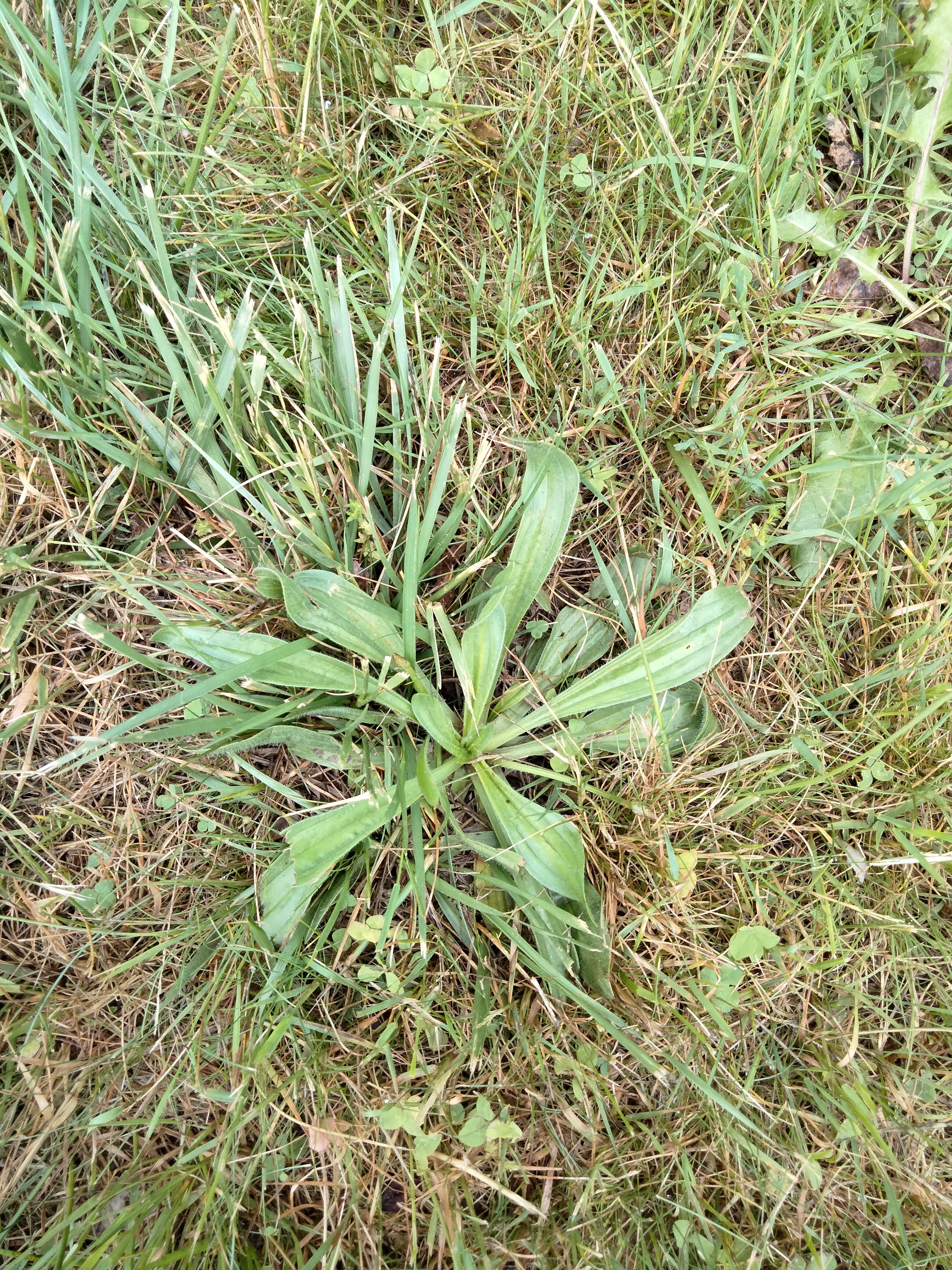
Salvation came whilst standing in the short strip of meadow while waiting for everyone to join me for this “weed” walk. There at my feet were two of my best known—and loved—herbs: a dandelion, and plantain. This last is not the banana-shaped fruit found in many grocery stores. It is a type of crabgrass. And the dandelion? There’s a reason my Jillian is holding a dandelion in her mouth as part of The Herbal Hare icon. I’ve been drawn to dandelions since the day I took my first steps…or near abouts. My mother and grandmothers all had little Dixie cups filled with dandelion blossoms lining their windowsills when I was a kid.

Plantain (Plantago lanceolata)

Relax. Breathe. I’ve got this…at least with these two.

From there, I led a small group of 6—counting the lovely Australian shepherd who joined us for the walk; she said she got all of this, too—through myriad forest paths, up steep inclines and over rocky, dried-out streambeds. And, while there were a few stretches where that Imposter Syndrome kept trying to creep in again (we had about a 10 minute walk along paths lined with nothing but poison ivy, jewelweed, and Virginia creeper), I found enough to keep it interesting. There was even a note of praise on the library’s Facebook page later that day for the fun everyone had learning about some of the plants that share our little corner of Connecticut.

Here’s a recap of what we saw: Plantain (Plantago lanceolate), Dandelion (Taraxacum officinalis), Multiflora Rose (Rosa multiflora), Jewelweed (Impatiens capensis), Cleavers (Galium aperine), Virginia Creeper (Parthenocissus quinquefolia), Hairy Solomon’s Seal (Polygonatum pubescens), Skunk Cabbage (Symplocarpus foetidus), Buttercup (Ranunculus acris), Dame’s Rocket (Hesperis matronalis) and Stinging Nettle (Urtica dioica). It might be fun over the next few weeks to feature each of these for a Wednesday’s Weed Walk—except the Dandelion and Plantain. I think I’ve done at least two blog posts for each; I’ll have to put a link to them in the coming weeks. 😉

May God bless you & keep you!

Brothers & Sisters, Emergency Preparedness, God/Jesus, Healing, Herbs, Holistic Health, Homesteading, Nature, Plants, Prepping, Scripture

Wednesday’s Weed Walk: (Toxicodendron radicans)

Then one went out into the field to gather herbs, and found a wild vine and gathered from it his lap full of wild gourds, and came and sliced them into the pot of stew, for they did not know what they were. So they poured it out for the men to eat. And as they were eating of the stew, they cried out and said, ‘O man of God, there is death in the pot.’ And they were unable to eat.” (2 Kings 4:39-40)

No, I’m not poisoning anyone. I’ve been poisoned…by poison ivy.

I spent the three day weekend doing yardwork with a friend. As many of you know, we’ve had both intermittent running water and an intermittent electrical line. Sometimes we have lights upstairs; sometimes, not. It seems to be most prevalent when it’s windy out. So our friend, who noticed some tree limbs hitting the power line coming into the house, decided to climb up the ladder and cut the offending limbs. I held the ladder…while standing in a patch of poison ivy.

So far, it’s not too bad. Itchy, yes. But it’s staying around the calf area only…unlike a few years ago when arms, legs, and even my face got nailed with it.

So what does an herbalist do?

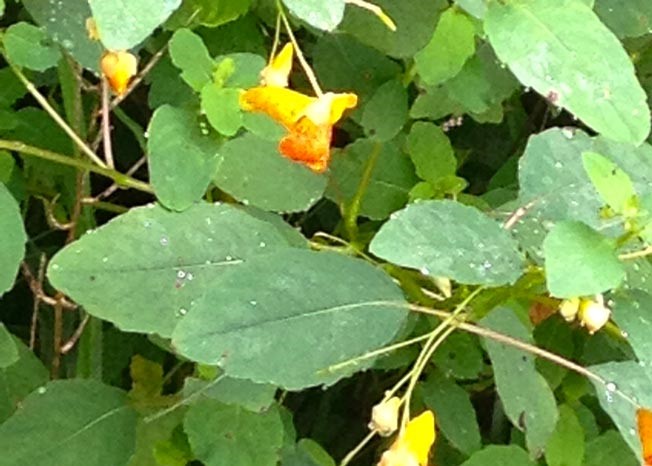
Most of you probably know this little beauty:

It is (Impatiens capensis) or, as it is more commonly known, Jewelweed. Jewelweed is quite the prolific spreader. It likes both woodland and moist areas, or so I’ve heard, though it seems just as content growing along roadsides, too. Interestingly, it is also often found growing alongside poison ivy; nature, when left to her own devices, often provides both the malady and cure side-by-side. But that’s neither here nor there. Inside it’s hollow stem is a watery mucilage. Just break it open and pat (do not rub) along any skin that may have come in contact with poison ivy (use a new stem for each area if more than one possibly infected). Often it is enough to prevent a breakout of the dreaded rash to begin with.

I, unfortunately, did not do that.

However, the stems can be chopped up, placed in a double boiler (see how to improvise without a double boiler Here) and slow simmered with a lid on for a couple of hours (keep a close eye that they do not scorch). Gently dab on the offending rash.

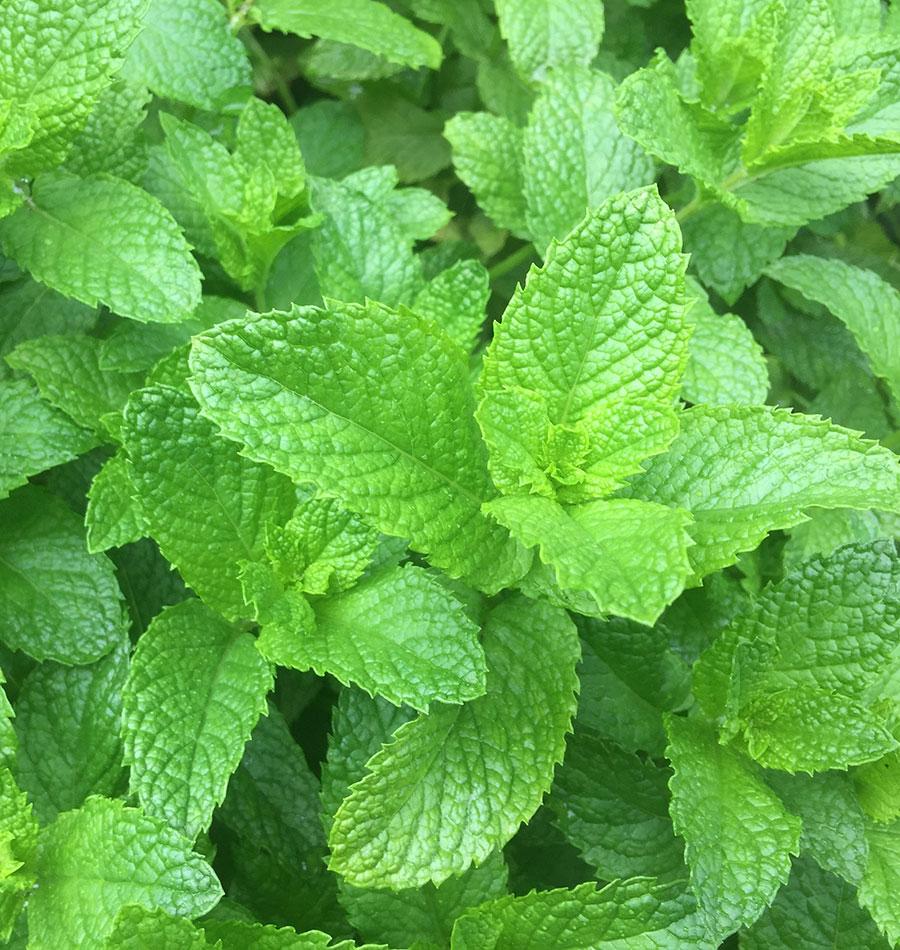
An alternative is to make an infusion (you can learn more about infusions at the same hyperlink above) of spearmint (Mentha spicata) leaves. You can gently dab the infusion on the same as with Jewelweed or, as I did this morning, I poured half of the infusion into a cup and added enough baking soda to make a paste. This keeps the infusion from dripping and the baking soda will help to dry it up the rash. Sadly, while this last will help clear it up faster, it has to be reapplied frequently to reduce the itch.

(Mentha spicata) Spearmint leaves

May God bless you & keep you!

Creativity, Emergency Preparedness, Faith, Folklore, Gaia, gardening, God/Jesus, Healing, Herbs, History, Holistic Health, Homesteading, Nature, Plants, Self-esteem, Self-improvement

A Saturday Weed Walk

“The Lord is my chosen portion and my cup; you hold my lot. The lines have fallen for me in pleasant places; indeed, I have a beautiful inheritance.” (Psalm 16: 5-6)

This one is live! As in, in-person…my first!

To say that I’m not feeling a bit of that “Imposter Syndrome” would be a lie. Yes, I am a certified herbalist…and a Master Gardener. Yes, I do know how to use herbs and make medicine, health & beauty aids. I know how to use herbs for scent and I have at least a rudimentary knowledge of how to make dyes with some. And, yes, there are certain ones I can readily identify in the wild.

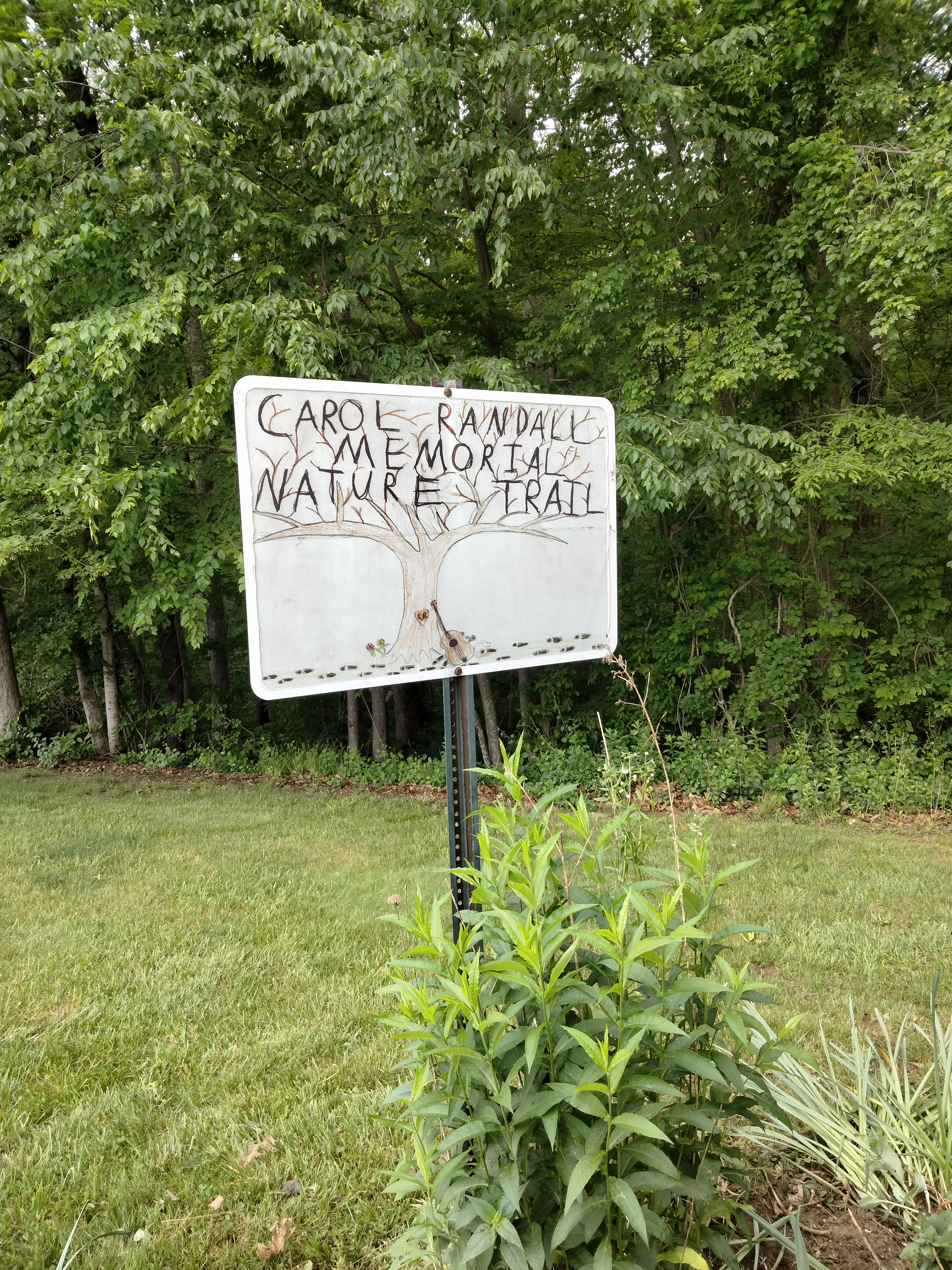
However, a recent walk through the nature trail that I will be working from at this live event revealed there are a lot of plants I don’t know. And, in this particular setting, there wasn’t a huge variety of plants…outside of some invasive species. That being said, I identified enough that I can put together an interesting walk.

At least I hope so…

Again, “Imposter Syndrome”–I am plagued with doubts. However, if I was too cocky and sure of myself, that would be the road to failure. A little nervousness is to be expected and, like all things, the more often I do this, the more comfortable I’ll get with it…and, in the future, I’ll make it a point to plan more “weed” walks through abandoned lots and sunny meadows rather than deep woods and dappled sunlight since most of the herbs I’m most familiar with are typically grown in sunnier locales. ;o)

Despite my nerves, I’m looking forward to the challenge of creating a fun and interesting experience for everyone who decides to join me on the walk.

If you live in northeastern Connecticut, the “weed” walk is part of an event being hosted by the Brooklyn Middle School in Brooklyn, CT between 10:00 a.m. and 12:00 p.m. on Saturday, June 3, 2023. Wear your walking shoes because the terrain is uneven, rocky in places, full of roots ready to trip you up, and steep in some areas.

May God bless you & keep you!

Animals, Christianity, God/Jesus, Healing, Herbs, Holistic Health, Homesteading, illness, Nature, Plants

Wednesday Weed Walk – Oils & Salves

“Then God said, ‘I give you every seed-bearing herb on the face of the whole earth and every tree that has fruit with seed in it. They will be yours for food.” (Genesis 1:29)

Another way you can use herbs is by decocting them in oil. This can be for culinary purposes to dress up some salad greens, or used topically to help heal cuts and scrapes, and moisturize the skin.

A few weeks’ ago I talked about using the double-boiler method to decoct herbs for medicine. Here we will use the same method but, instead of covering the herbs in the top pan with water, as we did in the previous post, we will cover them with some sort of oil.

Please do NOT use canola, sunflower, safflower, corn, or vegetable oil for this purpose; ditto for Crisco. All burn too hot and risk scorching the herbs, rendering them useless. The idea is to gently warm the oil, not fry the herbs. Olive, sweet almond, and grapeseed oils work best for this.

For those who may have missed the earlier post, if you don’t have a double-boiler, using a pair of sauce pans where one is slightly smaller than the other will suffice. You fill the larger pan about 1 1/2” – 2” with water then nestle the smaller sauce pan inside. There should be enough water in the bottom pan that the smaller sauce pan floats, but not so much that any water comes over the rim of it. You then measure your herbs into the smaller pan and, in this case, cover them with your oil of choice. Put a lid on it and slowly simmer for approximately 45 minutes, taking care that the oil doesn’t evaporate too much and the herbs do not scorch (as can happen even with these lighter oils); feel free to give them the occasional stir while they simmer, taking care to put the lid back on them as soon as you’re done. The medicinal properties will escape with the steam if the lid is left off.

As with a regular decoction, we also don’t use Teflon-coated pans, or cast iron, when making oils or salves. Both can leach into the final product. Teflon, if I remember correctly, has carcinogenic properties. It also flakes and chips and, even if new, there are chemicals in it that are best left out of either food or medicine. Cast iron is a great tool for cooking, but it can alter the medicinal properties of herbs, possibly changing their efficacy. I recommend either stainless steel, or enamel, when working with herbs.

If making an oil, simply strain the oil into a clean and sterile jar once it cools and store it in a cool, dark place until needed.

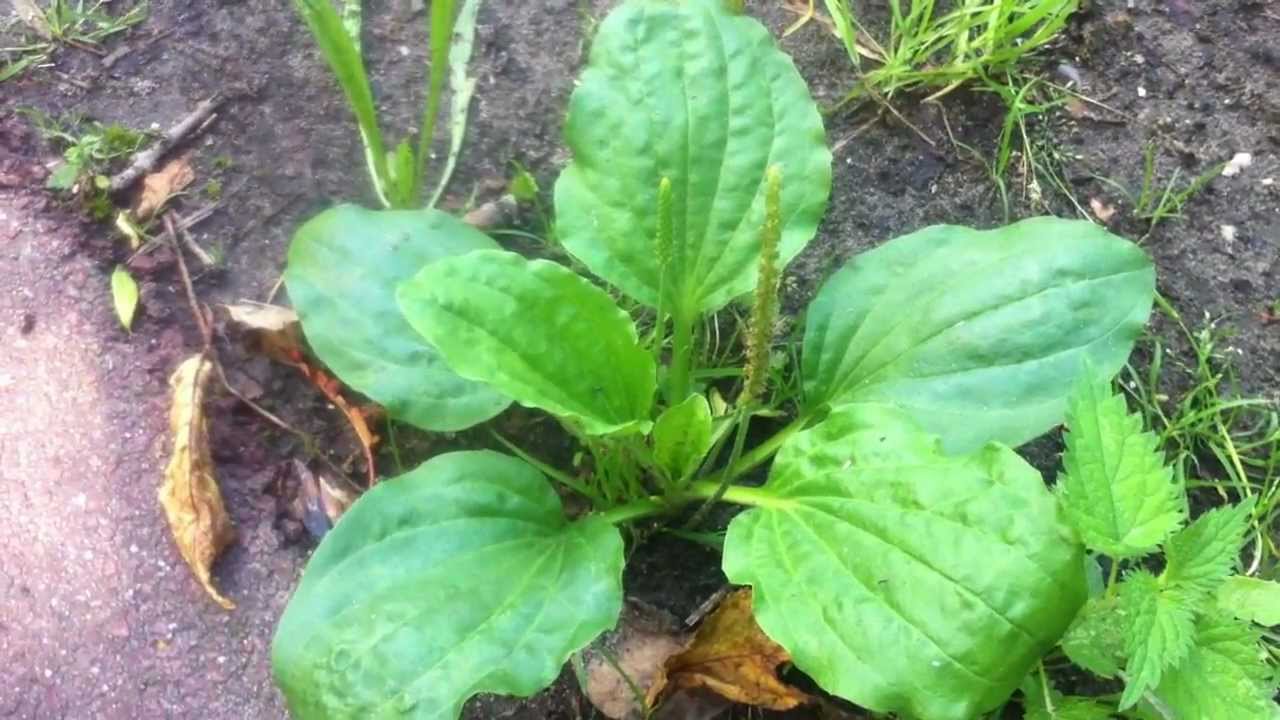
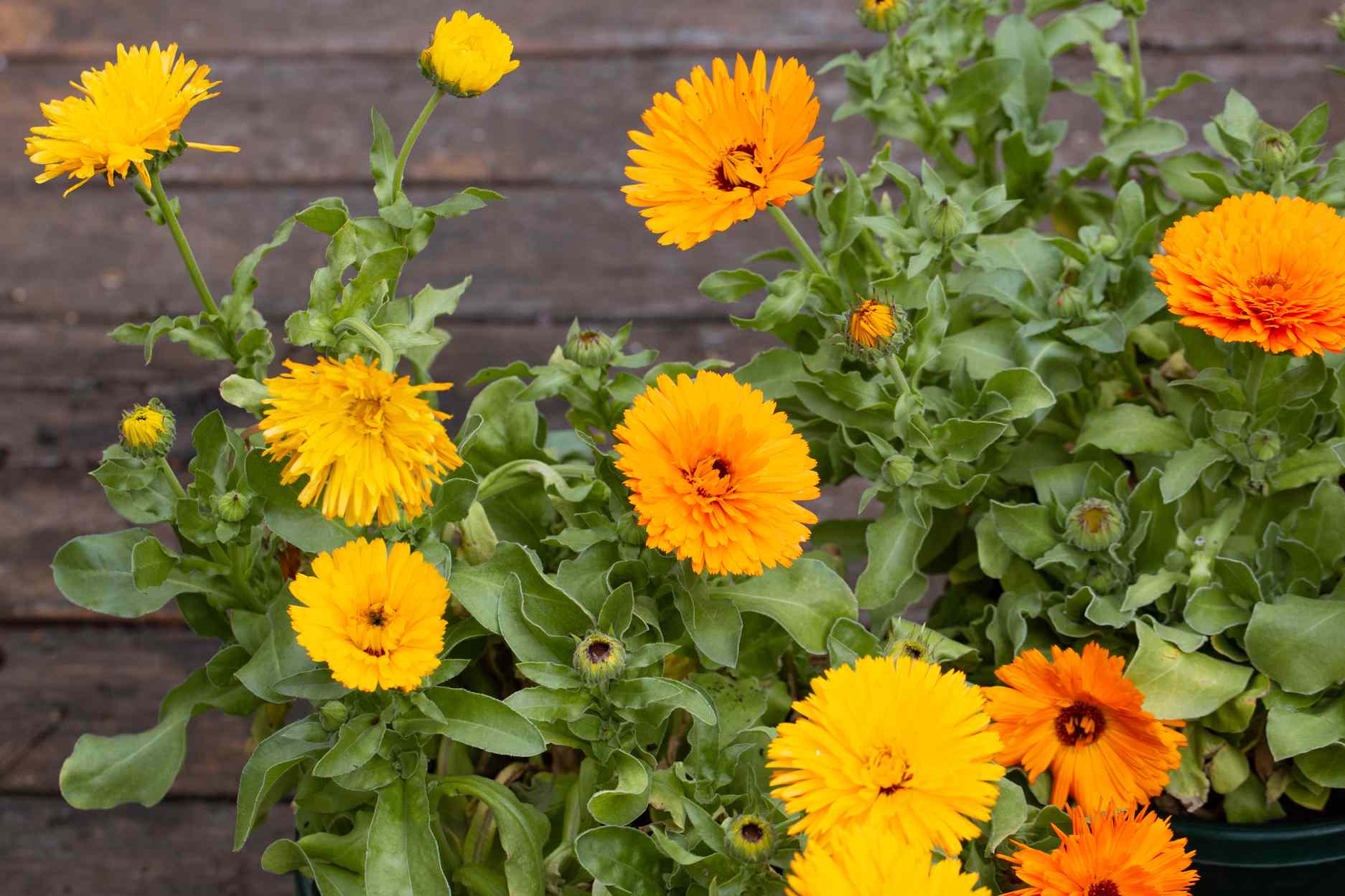
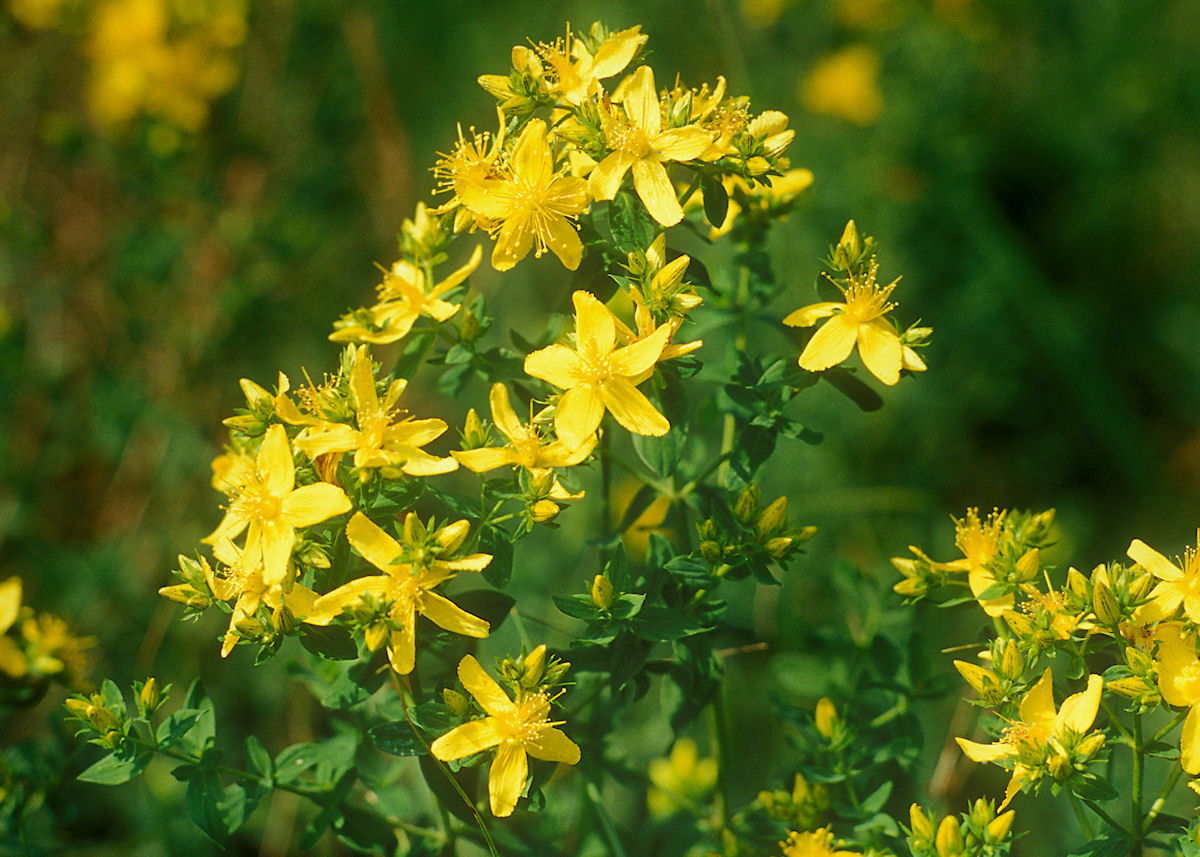
Herbs, such as plantain (not the banana-like fruit but the oft-mistaken-as-crab-grass) (Plantago major or Plantago lanceolata), are good for drawing out infection, slivers, and other foreign matter. Calendula (Calendula officinalis) works well for treating bruises, cuts and burns, as well as the minor infections they cause. St. John’s Wort (Hypericum perforatum) fights inflammation and has antibacterial properties; it’s also a good sunblock when used topically. Comfrey (Symphytum officinale) helps new skin cells grow, reducing scarring. Equal measures of each, simmered in an oil, and massaged into the skin before a shower, or bath, works as well as any spa treatment for combating dry skin, and even wrinkles, leaving your skin healthy, supple and glowing. The combination also works well for cuts, burns, scrapes, scratches, and rashes, including diaper rash, although you may want to take it a step further and make it into a salve, or ointment for this last purpose.

To turn your oil into a salve, once the oil has simmered for 45 minutes, leave it on low heat and melt approximately ¾” to 1” square of clean beeswax into the oil, stirring constantly to get a creamy consistency. Once the wax has melted completely, add a drop or two of vitamin E oil (2 capsules should suffice for an 8 oz. canning jar), stir, and pour it into clean jars (or tubes; you can make a great lip balm for chapped lips in winter this way, too).

A word of caution: do NOT pour any beeswax down your drain; you will stop it up. Do NOT wash any pans or utensils in the sink that have had beeswax melted in them; same reason. Take anything used for melting the beeswax outside and pour boiling water over it repeatedly until the wax has been scalded off. Beeswax is safe for the environment and will do no harm poured into the grass or dirt this way. Another thing to bear in mind is that beeswax is highly flammable. The little flame at the top of a candle is of little concern but, please pay close attention while heating on the stove. Put the phone down, avoid distractions. A friend of mine once burned his mother’s kitchen down because he left some beeswax melting unattended on the stove and went to answer the phone…back in the day when we still had push button and rotaries on the wall and were attached to a cord…(I’m showing my age…)

May God bless you & keep you!

PS You can modify the above salve to use for animals, too. Omit the calendula and St. John’s wort (they may lick the salve and these two should not be ingested by animals). Simply use equal parts of plantain and comfrey and follow the rest of the directions above. My Mom swears by it for our animals.

Plantago major (Plantain)
Symphytum officinale (Comfrey)
Calendula officinalis (Calendula) (Yahoo Images)
Hypericum perforatum (St. John’s wort) (Yahoo Images)

Works Cited

“Calendula.” Image. Yahoo Images, The Spruce, 2023. https://images.search.yahoo.com/search/images?p=images%2C+calendula&fr=mcafee&type=E211US0G0&imgurl=https%3A%2F%2Fwww.thespruce.com%2Fthmb%2Fya4XvTRXaP-lCwxTXQ89Zkmac7M%3D%2F1874x0%2Ffilters%3Ano_upscale%28%29%3Amax_bytes%28150000%29%3Astrip_icc%28%29%2Fgrowing-and-using-calendula-1402626-26-f3f6f07fcc594a79b1a792f863a4a8e6.jpg#id=19&iurl=https%3A%2F%2Fwww.thespruce.com%2Fthmb%2Fya4XvTRXaP-lCwxTXQ89Zkmac7M%3D%2F1874x0%2Ffilters%3Ano_upscale%28%29%3Amax_bytes%28150000%29%3Astrip_icc%28%29%2Fgrowing-and-using-calendula-1402626-26-f3f6f07fcc594a79b1a792f863a4a8e6.jpg&action=click

“St. John’s wort.” Image. Yahoo Images, Premier Seeds Direct, 2023. https://images.search.yahoo.com/search/images;_ylt=AwrNPwMJs2RkeVsfr.KJzbkF;_ylu=c2VjA3NlYXJjaARzbGsDYnV0dG9u;_ylc=X1MDOTYwNjI4NTcEX3IDMgRmcgNtY2FmZWUEZnIyA3A6cyx2OmksbTpzYi10b3AEZ3ByaWQDNXcyeVpSbWhUcmVGektGYlN2OENXQQRuX3JzbHQDMARuX3N1Z2cDMgRvcmlnaW4DaW1hZ2VzLnNlYXJjaC55YWhvby5jb20EcG9zAzAEcHFzdHIDBHBxc3RybAMwBHFzdHJsAzIzBHF1ZXJ5A2ltYWdlcyUyQyUyMFN0LiUyMEpvaG4ncyUyMFdvcnQEdF9zdG1wAzE2ODQzMjEyMjg-?p=images%2C+St.+John%27s+Wort&fr=mcafee&fr2=p%3As%2Cv%3Ai%2Cm%3Asb-top&ei=UTF-8&x=wrt&type=E211US0G0#id=5&iurl=https%3A%2F%2Fwww.premierseedsdirect.com%2Fwp-content%2Fuploads%2F2017%2F09%2F60501429.jpg&action=click

Alcoholism, Christianity, Cooking, Emergency Preparedness, Frugality, Healing, Herbs, Holistic Health, Homesteading, Organic, Prepping, Recipes, Religion, Scripture, Spices

Wednesday’s Weed Walk: Tinctures

“And God said, Behold, I have given you every herb bearing seed, which is upon the face of all the earth, and every tree, in the which is the fruit of a tree yielding seed; to you it shall be for meat” (Genesis 1:29)

Though it is a couple of weeks’ late, as promised, this week’s Wednesday Weed Walk isn’t so much about a specific herb but, about a way to preserve the herbs for future use when not in their growing, or harvest, seasons.

A tincture is, in my opinion anyway, the easiest way to make medicine. You can tincture a single herb, or blend them. I tend to do the latter…except when I’m making my own vanilla extract (recipe below).

To tincture herb(s), you need a clean, sterile container (repurposed glass Mason jars work well!) and, preferably, 100 proof alcohol of some kind. I use 100 proof vodka to tincture my herbs but other mediums, such as rum, would also work. You can use an 80 proof and broaden the selection of spirits but, you will need a few capsules of vitamin E oil added against spoilage, as anything less than 100 proof may mold. Apple cider vinegar (ACV), also with added vitamin E oil, will work for short-term storage. With ACV, you will have to store your tinctures in the refrigerator and they will only keep for 2 weeks, at best. When tincturing in 100 proof alcohol, your tinctures remain shelf-stable for up to 2 years. However, if you, or someone you love, is susceptible to alcoholism, or for young children, ACV may be the better option for you.

Tincturing is simple. You measure your herbs into a jar and pour the alcohol, or ACV, over them until they are covered with the liquid. Then you put a lid on the jar, label it with the contents, ingredients, the date you started the tincturing, and the batch #. This last isn’t 100% necessary but, if you decide to sell herbal products, having a running batch # is helpful should any adverse reactions occur. Depending upon the medium you used, you place the tincture into the refrigerator, or in a dark cabinet (too much light will destroy the healing properties), and shake it daily for two weeks. At the end of those two weeks, you can either leave the spent-herbs inside, and strain as you use it, or strain them now, at the two week mark, into another clean and sterile jar, or dark-colored bottle.

You can use fresh herbs, or dried. If using dried, remember the herbs will have a higher concentration of medicinal properties to them. 1/3 of the amount of dried herbs suffices. So, if you normally measure 1 tablespoon of, say, fresh chamomile, you would only use a teaspoon of the dried.

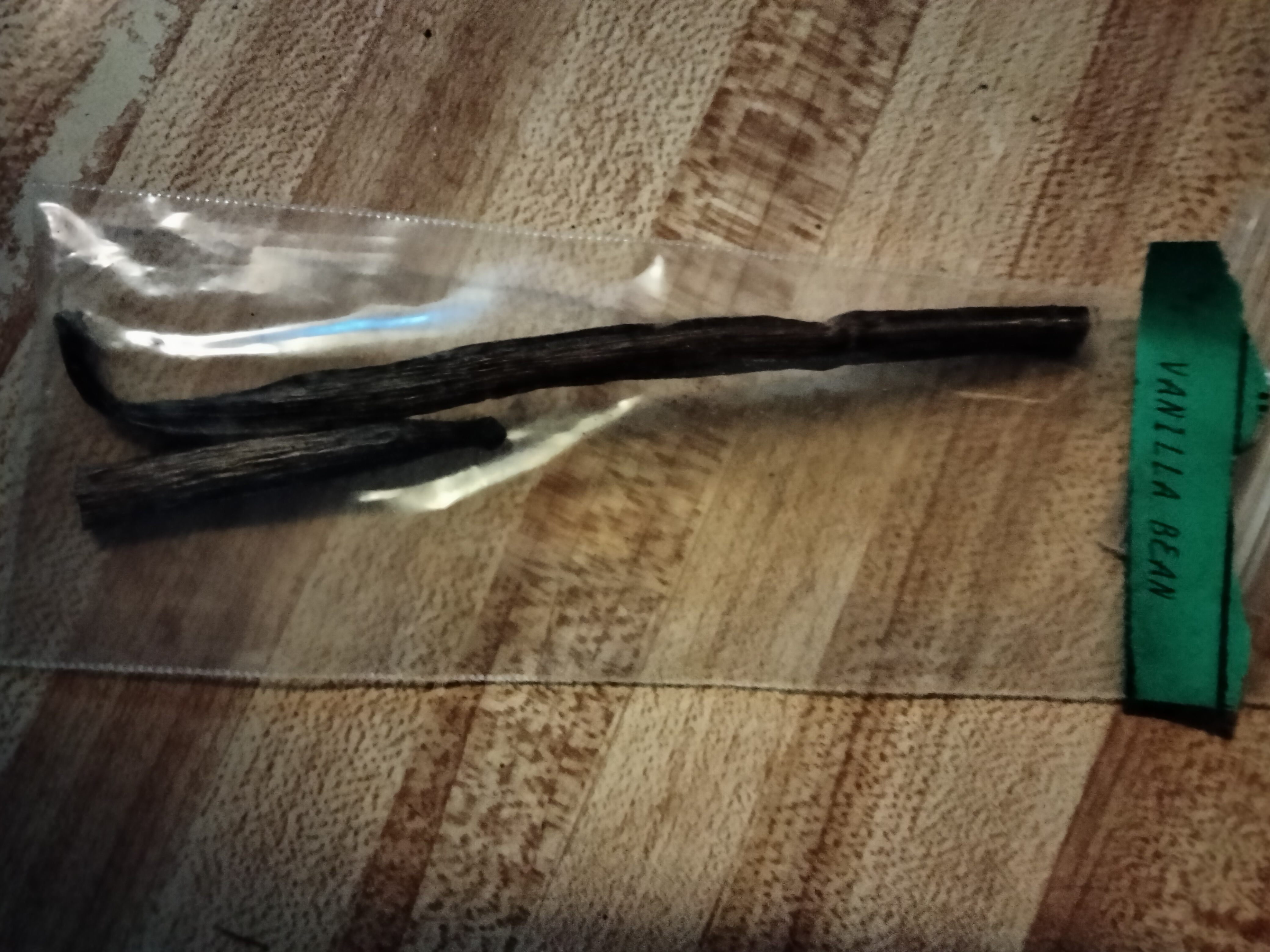
Making medicine is the part I like the best but, you can also use this method to create extracts for the kitchen, such as vanilla. To make vanilla extract, you will need a dark jar/bottle of some kind (you can find online, or many herb shops will sell them), or a dark cabinet to store them if using clear glass. It doesn’t need to be a large bottle. A couple of ounces suffices. Think of the tiny bottles that vanilla extract comes in at the grocery store. Anyway, take 2-3 vanilla beans, slice them in half lengthwise, and put them in the bottle (if bottle is short, you may also need to cut them in half the other way, too). Fill the bottle with 100 proof alcohol, screw on the cap, give it a shake and let it tincture for two weeks. Once the two weeks are over, however, in this case, you will NOT be straining the liquid into another container. Instead, keep the vanilla beans in the liquid. As you use it, you can simply top it off with more 100 proof alcohol, and/or add more vanilla beans over time. Also, in this case, the ACV will NOT work. However, any concerns over the alcohol content should be unfounded as the alcohol burns off in the cooking/baking process.

This same method will work for almonds, lemon peels, etc. too.

May God bless you & keep you!

Animals, Christianity, gardening, Healing, Herbs, Holistic Health, Homesteading, illness, Nature, permaculture, Plants, Wild Edibles

Wednesday’s Weed Walk: Wood Sorrel

“And God said, Behold, I have given you every herb bearing seed, which is upon the face of all the earth, and every tree, in the which is the fruit of a tree yielding seed; to you it shall be for meat.” (Genesis 1:29)

As with many of the plants I feature on this website, Yellow Wood Sorrel is often regarded as a weed (hence, the title I use whenever I write about a plant, or herb). Most gardeners consider it a scourge because the roots go pretty deep and it can be difficult to get rid of. However, as with most “weeds”, I let it stay.

Miller, “Yellow Wood Sorrel”, Pere Marquette Rail Trail Wildflowers, n.d.

Yes, you know this one. It is often mistaken for a clover because of the similar, shamrock-y leaves. Oxalis stricta, however, is in the Oxalideae family, not the Fabaceae family–or bean family–as clover is, so they’re not even cousins. Interestingly, they can both fix nitrogen in your soil so not a bad thing to have in your garden. Like clover, wood sorrel also helps eliminate soil erosion by providing a natural ground cover that helps retain moisture. Even an obnoxious “weed” has its function.

Wood sorrel’s main claim to medicinal use is its help at reducing fever and inflammation. It increases the flow of urine and is particularly effective at treating urinary complaints. It may also help externally for treating eye complaints and scrofulous ulcers (de Bairacli-Levy 166). And, while Ms. de Bairacli-Levy writes this in a herbal for animals, it has the same effect on humans.

Renowned herbalist, Juliette de Bairacli-Levy, goes on to say that “goats and sheep seek its foliage, enjoying its refrigerant properties” (166). I, too, enjoy nibbling a few leaves whenever I’m working outside on a hot summer day. Yellow wood sorrel is a wild edible. It has a tart, lemony flavor that adds a nice punch to a salad or sandwich. If you haven’t guessed by its name, yellow wood sorrel has oxalic acid in it, which gives it its tart flavor. Many of our dark leafy greens, like spinach, beet greens, and Swiss chard also contain oxalic acid. As with anything, moderation is the key. Large quantities of yellow wood sorrel is said to lead to kidney stones (Taylor 1), but the same is also true of spinach, especially in sensitive individuals (Spritzler 1). Yellow wood sorrel also has some toxic, lookalike cousins so be sure of identification before consuming (Taylor 1).

These statements have not been evaluated by the FDA. This information is for educational purposes only. It is not intended to diagnose, treat, cure, or prevent any disease.

May God bless you & keep you!

Works Cited

de Bairacli-Levy, Juliette. The Complete Herbal Handbook for Farm and Stable. Faber and Faber Limited, 1952.

Miller. “Yellow Wood Sorrel.” Pere Marquette Rail Trail Wildflowers, n.d. Image. https://www.peremarquettewildflowers.com/flower/yellow-wood-sorrel

Spritzler, Franziska. “Oxalate (Oxalic Acid): Good or Bad?” Healthline. https://www.healthline.com/nutrition/oxalate-good-or-bad

Taylor, David. “Common Yellow Wood Sorrel (Oxalis stricta).” Plant of the Week, USDA, n.d. https://fs.usda.gov/wildflowers

Christianity, Faith, Healing, Heavy Metal Music, Herbs, Holistic Health, Homesteading, Organic, Plants

Another Wednesday’s Weed Walk Revisited

“For I know the plans I have for you, says the Lord. They are plans for good and not for evil, to give you a future and a hope. In those days when you pray, I will listen. You will find me when you seek me, if you for me in earnest.” (Jeremiah 29:11-13)

I wrote the following weed walk several years ago. And, as I’m looking into voice over work as a possible supplemental income, having a tea blend that will soothe tired throats and keep the voice healthy is a blessing. Of course, any work, or hobby, that requires the use of one’s vocal chords can benefit from this tea: DJ, actor/actress, podcaster, TV host, newscaster, reporter, politician…the list could go on.

Singer’s Tea…no, that’s not actually a legitimate product, that I know of, but that’s what I call one of my favorite herbal tea blends.

I don’t sing professionally anymore. Or even semi-pro. While the vocal chords may get a bit of a workout on the weekends when I’m enclosed in my home office and working on the mural that is currently consuming me, rare do I get on a stage–or even in the choir loft at church–to sing. Some of it is time constraint. As a full-time (online) student, minister, herbalist, homesteader, writer, artist, holistic healthcare practitioner and part-time photographer/receptionist most evenings, I have a pretty full plate. But many years ago I fronted metal bands, both lead guitar and lead vocals. I didn’t know about this tea then; I learned about it years’ later. It might have helped in the metal years; however, no matter what genre you sing in–even if it’s only the shower–taking care of one’s vocal chords is important.

In 2007 I took Apollo Herbs’ “Herbal Apprentice” course with Michael Ford and Joanne Pacheco. It was during one of our weekend workshops that Mike mentioned this combination, primarily for sore throats, but he also mentioned that a student from one of his previous classes used this combination religiously. She was a singer, like me, and fronting a local band. I was singing regularly with the Folk Group at Our Lady of LaSalette Catholic Church in Brooklyn, CT at the time so I gave it a whirl.

The blend is equal parts of Echinacea purpurea (Echinacea, Purple Coneflower are common names) and Ulmus fulva, or Slippery Elm. “Equal parts” is just what it suggests. If you measure a teaspoon of Echinacea, you also measure 1 teaspoon of Slippery Elm; a tablespoon of Slippery Elm, a tablespoon of Echinacea, and so on. The combination has a pleasant flavor so it is also palatable rather than tasting “medicinal”. I typically use the dried herbs, purchased from a local and reliable herb shop (organic; responsibly harvested) but you may also use fresh herbs if you have them in your garden or from another reliable source (i.e. one without pesticides). As we are brewing roots and bark here, a standard infusion doesn’t quite cut it. You will need a decoction of the herbs. And how we do that is preferably through the use of a double boiler but a makeshift of setting a slightly smaller sauce pan inside a larger one that has at least an inch or so of water in it will do in a pinch. No non-stick pans for this. The coating may leach into your herbal tea; I don’t recommend non-stick pans for any purpose. Cast-iron will also leach into the herbs and affect the outcome. Stainless steel, or enamel, is preferable. Place the herbs in the smaller pan, cover them with water (about an inch higher than the herbs) and place a lid on the pan with the herbs in it. The idea is to simmer them, not boil them. And you will want to watch that the water is not evaporating too much as you don’t want the herbs to scorch. If you see the water level lowering too rapidly, you may add a little warm water and lower the heat a bit. This takes approximately 45 minutes on low heat. I always add honey to mine, which also acts as a mucilage to the throat but it is optional.

So how does it work?

Slippery Elm** (Ulmus fulva) is the inner bark of the slippery elm tree. This dried bark is rather stringy and may range from a light tan to a light beige in color. It has a sweet, spicy scent and it is a well-known demulcent. “Demulcent” means that it soothes and moistens, usually via mucilage. This particular demulcent is specific for sore throats, cough, bronchitis and for relieving the inflammation of the respiratory tract, including the mouth and throat (L. Tierra, 121). It is also good for soothing the intestinal tract, and relieving the pain and irritation from indigestion and colitis, but it is the respiratory tract that we are most concerned with here, for obvious reasons.

Echinacea** (Echinacea purpurea) is also good for relieving sore throats; all infections and inflammations, and swollen glands. A known sialagogue, it increases the flow of saliva in the mouth. It is also an immune enhancer, helping to prevent and cure colds and flus (Tierra 78-79),; for singers, it makes it a wonderful combination with Slippery Elm. Back in the metal years, it seemed I always came down with a cold and/or upper respiratory complaint whenever there was something important coming up in music. It is a singer’s nightmare. It could be because I tend to be a perfectionist and so pushed myself harder, practicing longer, and depriving myself of much-needed sleep in preparation for whatever I was doing but, regardless, whatever “bug” was lurking around always found its way to me. Again, I wish I’d had this tea in my arsenal then.

One last thought, as both of these herbs are now on the endangered list, please use only the cultivated herbs from a reliable and responsibly-harvested source. For more information about sustainable harvesting, please visit http://www.unitedplantsavers.org.

May God bless you & keep you!

**These statements have not been evaluated by the Food and Drug Administration. This article has been presented for educational purposes only; it is not intended to diagnose, treat, cure, or prevent disease.”

Works Cited

Tierra, Lesley. Healing with the Herbs of Life. Ten Speed Press, California: 2003.

Christianity, Frugality, gardening, Healing, Herbs, Holistic Health, Homesteading, illness, Irritable Bowel Syndrome, Nature, Plants, Prepping

Rebooting – A Wednesday Weed Walk

“And the Spirit of the Lord shall rest upon him, the Spirit of wisdom, understanding, counsel and might; the Spirit of knowledge and of the fear of the Lord” (Isaiah 11:2)

I wrote the following post in 2010. I’ve been doing a lot of soul-searching lately and I’ve realized that, especially with a possible economic depression looming, my posts about natural remedies and wild edibles, and frugal tips, may be needed more than ever. As I get back into blogging, I’ve started reading through older posts. While I encourage everyone to go back and read some of these earlier posts, I know that many will not have time to do so. So, to those who may have followed me in earlier times, my apologies for any redundancies but, they bear repeating. There will be more going forward.

May God bless you & yours as we traverse these uncertain times!

Enjoy:

It is the scourge of every landscaper, of every grumpy old man hoping to obtain that perfectly manicured lawn without the broken contrast of colorful, yellow blossoms. “This notable “weed” is often needed most by those who love to pull it–fiery, excitable and, often, angry folks–because it clears what in Traditional Chinese Medicine is regarded as Liver Heat, a congestion that causes this energy” (M. Tierra, The Way of Herbs, 1998).

I am talking about Taraxacum officinale…The Dandelion.  In Chinese medicine it is called Pu Gong Ying. In Ayurveda–or East Indian medicine–the Sanskrit word for dandelion is Atirasa. Other common names for this little “weed” have been Blow Ball, Cankerwort, Lion’s Tooth and Wild Endive so, perhaps, instead of lamenting the “dandelions” in your lawn, you can rejoice in your abundant crop of Lion’s Tooth?

The dandelion comes from the family: Compositae.

All parts of this plant are used medicinally and also, nutritionally.  Both the leaves and the roots have a cooling energy.  The leaves have a bitter flavor, the roots both sweet and bitter.

As a medicine, the healing properties of this little plant are as an alterative–or blood purifier, and as a chologogue, which means it aids digestion by discharging bile into the small intestine to relieve excess stomach acids.  It is a diuretic, an aperient–or laxative, a galactogogue, which means it promotes the flow of breast milk for lactating mothers, and it can be used as a tonic to promote the functioning of all systems in the body.

The main benefits of this plant are exerted upon the function of the liver.  It has the capacity to clear obstructions, to stimulate and aid the liver in eliminating toxins in the blood.  In this way, it is used as a blood purifier.  This is also due to its high mineral content.

The root can be used to also clear obstructions of the spleen, pancreas, gallbladder and kidneys.  It is of tremendous benefit to both the stomach and intestines. For stomach aches, dandelion root tea can be safely taken in doses of 1/2 cup every 1/2 hour until the stomachache is relieved.

For hepatitis, dandelion root tea may be taken in cupful doses 4-6 times daily with a light, easily-digested diet of vegetable soup broth, and rice and mung bean porridge.  Even the most serious cases of hepatitis have been rapidly cured using this treatment, sometimes within a week (Tierra, 1998).

Renowned herbalist and author of several books on herbal medicine–including “The Way of Herbs”, Michael Tierra, considers the root specific for hypoglycemia when it is combined with other tonic herbs such as ginseng and ginger.  And he states it can also be used to remedy the recent onset of diabetes when combined with huckleberry leaf in a tea.

Dandelion has been known to decrease high blood pressure, aid in the healing or curing of anemia; dropsy; PMS; urinary complaints; inward ulcers of the urinary passage; atonic dyspepcia; rheumatism; red, swollen and painful eyes; firm, hard abscesses; sores; breast abscesses; tumors; cysts; mastitis; gout; arthritis, and skin conditions such as rashes caused by measles, chicken pox, eczema, poison ivy and poison oak.  It relieves painful urination, promotes lactation, aids indigestion, Irritable Bowel Syndrome, jaundice, cirrhosis, constipation, urinary, bladder and kidney infections, in the treatment of both gall and kidney stones, scurvy and scrofula.

In Chinese medicine, its cooling properties are used to treat painful swellings, infections, inflammations, boils, abscesses, dental cavities, swollen eyes and throats, sore throats, fever and mumps.  It has a special affect on the breasts and is used as a breast cancer preventative.  Chinese medicine uses it to reduce tumors and cysts, mastitis and swollen lymph nodes.

Traditionally, Native Americans used the dandelion to treat snake bites.

Ayurveda–East Indian–practitioners use it for dysentary, fevers, vomiting and as an anti-poison.

Dandelion leaf tea is one of the finest diuretics known, equal to any known drug remedy.  It can be taken for fluid retention–i.e. edema, cystitis, nephritis and even as an aid in weight loss.

However, a word of caution here, the FDA has not evaluated these statements and, though I have a lot of faith in herbal medicine–more so than in most allopathic practices, the contents of this blog are not intended to diagnose, treat, cure or prevent any diseases and should not replace any treatment with your primary care physician.

That being said, nutritionally, dandelion root can be cut and dried, and combined with roasted acorns and roasted rye to make a fine alternative to coffee–without the harmful caffeine!

You harvest the leaves in spring before the flower heads bloom.  They can be eaten raw as a salad or steamed with other beneficial greens such as chicory and endive to help combat the onset of spring colds and flu.  Albeit, another word of caution, both dandelion and chicory can be quite bitter to some palates and might be better tolerated mixed with something like spinach or Swiss chard.

Dandelions are rich in natural protein, iron, calcium, phosphorus, inulin, potassium, vitamins C, G, all the B vitamins–especially B12 and contains more beta carotene than carrots.  They are also high in vitamin A, having 7000 units as opposed to the 1275 units contained in carrots.

I feed dandelion greens on an almost daily basis to my rabbits.  They are beloved by my ducks and chickens, guinea pigs, birds, dogs and, to a lesser degree, even my cats will sometimes nibble on a leaf or two.  They provide many of the same benefits to the liver and kidneys in animals as they do for humans.  In the documentary, “Juliette of the Herbs”, an autobiography of the life of revered herbalist, Juliette de Bairacli Levy, there is an interview with a breeder of Newfoundlands who tells of how feeding one of her prized Newfoundlands dandelion greens saved her dog’s life.  This was an animal who had been given only a short time to live due to kidney failure.  The owner had read one of Juliette’s books where it recommended a fast and then a diet of dandelion greens.  She didn’t think the dog would even try them; instead, she “licked the bowl clean” (Streeten, 1998).

Of course, the Christian witch in me had to look up the magickal properties of this little wonder.  I found, in my research, that dandelions were used by Early Americans to counteract impotence Hutchins, 1992).  Interestingly, the high vitamin A content in the dandelion is essential in the production of both male and female sex hormones so, perhaps, there’s something to this old wives’ tale…

Blow on a dried dandelion’s head (hence, the folk name “Blow Ball”…) and your wish will come true if you blow all of the seeds off in one breath.  This is said to be particularly effective as a love letter as dandelions provide a sort of magickal messenger service.  Allegedly, the seeds will carry loving messages and wishes to the one you love.  Focus hard on your hearts’ desire and blow…

Dandelion is, if you combine “white” witchcraft with astrology, a Jupiter plant.  Jupiter rules prosperity and money, health and good luck.  When picking dandelions on a Thursday–said to be a Jupiter day–in the moonlight, you will attract wealth and prosperity into your life.

Lastly, dandelions are said to be effective in summoning spirits.  I do not necessarily advocate this practice for myself but, for educational purposes, I am including the directions I found in a book I have on the subject:

1.  Place a cup of hot, steaming dandelion tea beside your bed just before you go to sleep.

2.  Watch the steam waft upwards as you call upon your desired spirits.

3.  When it cools, have a sip, turn off the lights and go to sleep.

4.  Take another sip of cold tea when you awaken and you may stimulate enhanced dream recall…(Dugan, 2003)

With all of this said, I believe every garden should have at least a small patch of Taraxacum officinale

Works Cited

Dugan, Ellen. Garden Witchery: Magick from the Ground Up. Llewellyn Publications, 2003.

Hutchins, Alma R. A Handbook of Native American Herbs: A Guide to 125 Medicinal Plants and their Uses. Shambhala, 1992.

Streeten, Tish. Juliette of the Herbs. Mobinogian Films, 1998.

Tierra, Michael. The Way of Herbs. Pocket Books, 1998.

If you can, please consider a donation to the link below. If you cannot, if you could share the link, I would greatly appreciate it:

https://www.gofundme.com/f/help-this-animal-sanctuary-grow-and-thrive