Animals, Healing, Herbs, Holistic Health, Homesteading, Nature

Wednesday’s Weed Walk with the Crazy Cat Lady

That title should make it obvious what herb I’m going to write about today: Nepeta cataria, or more commonly known as, Catnip.

Catnip typically conjures up cartoon images of helpless felines languishing about in the sun, looking like someone on a healthy dose of Cannabis…and, in this household, with 10 felines, that image is pretty accurate. I keep a quart-size mason jar in my pantry full of dried catnip; the moment I unscrew the lid, every feline comes running. And the effects are almost instantaneous as even my geriatric felines start rolling around like young kittens, only to nod off into dreamland shortly thereafter. They also like to eat the dried leaves and, as it is very good for them, I allow them to take all they want.

Catnip is a mild sedative and is an excellent remedy for nervousness and hyperactivity in children (m. Tierra 114). It is also a carminative (relieves gas and bloating) and a diaphoretic (induces sweating), helping to ease fevers and colds. However, it is the analgesic properties to which I have lately been putting Catnip to use (M. Tierra 32). Catnip relieves pain. And, as the mammary tumor grows under my Ariel’s right front leg, keeping her comfortable is important. At her age (she’s 16), surgery is no longer an option and, to be honest, I am not overly-confident it is the best course of action anyway. It is highly-invasive and extremely painful for them; I’ve witnessed it time and again. Ditto for many allopathic pain-relievers that eventually shutdown the major organs. Fortunately, our vet’s sister is an herbalist and he approves many of the herbal alternatives, carries many of their tinctures in his clinic. She is under his care, just not under the knife. And the Catnip does appear to ease her pain and discomfort. What’s more, it is a lot easier getting her to drink an eyedropper-full of Catnip “tea” than some of the more orthodox remedies with their medicinal tastes.

For humans, Catnip tea is very good for easing headaches, toothaches, and the deep-down body aches and pains of fever and flu (Tierra 114). It also tastes good so give it a try. Your cats will love you.

May God bless you & keep you!

**These statements have not been evaluated by the Food and Drug Administration. This article has been presented for educational purposes only; it is not intended to diagnose, treat, cure, or prevent disease.”

Works Cited

Tierra, Michael. The Way of Herbs. Pocket Books, New York: 1998

Healing, Herbs, Holistic Health, Organic

Wednesday’s Weed Walk: Do Re Mi…

Singer’s Tea…no, that’s not actually a legitimate product, that I know of, but that’s what I call one of my favorite herbal tea blends.

I don’t sing professionally anymore. Or even semi-pro. While the vocal chords may get a bit of a workout on the weekends when I’m enclosed in my home office and working on the mural that is currently consuming me, rare do I get on a stage–or even in the choir loft at church–to sing. Some of it is time constraint. As a full-time (online) student, minister, herbalist, homesteader, writer, artist, holistic healthcare practitioner and part-time photographer/receptionist most evenings, I have a pretty full plate. But many years ago I fronted metal bands, both lead guitar and lead vocals. I didn’t know about this tea then; I learned about it years’ later. It might have helped in the metal years; however, no matter what genre you sing in–even if it’s only the shower–taking care of one’s vocal chords is important.

In 2007 I took Apollo Herbs’ “Herbal Apprentice” course with Michael Ford and Joanne Pacheco. It was during one of our weekend workshops that Mike mentioned this combination, primarily for sore throats, but he also mentioned that a student from one of his previous classes used this combination religiously. She was a singer, like me, and fronting a local band. I was singing regularly with the Folk Group at Our Lady of LaSalette Catholic Church in Brooklyn, CT at the time so I gave it a whirl.

The blend is equal parts of Echinacea purpurea (Echinacea, Purple Coneflower are common names) and Ulmus fulva, or Slippery Elm. “Equal parts” is just what it suggests. If you measure a teaspoon of Echinacea, you also measure 1 teaspoon of Slippery Elm; a tablespoon of Slippery Elm, a tablespoon of Echinacea, and so on. The combination has a pleasant flavor so it is also palatable rather than tasting “medicinal”. I typically use the dried herbs, purchased from a local and reliable herb shop (organic; responsibly harvested) but you may also use fresh herbs if you have them in your garden or from another reliable source (i.e. one without pesticides). As we are brewing roots and bark here, a standard infusion doesn’t quite cut it. You will need a decoction of the herbs. And how we do that is preferably through the use of a double boiler but a makeshift of setting a slightly smaller sauce pan inside a larger one that has at least an inch or so of water in it will do in a pinch. No non-stick pans for this. The coating may leach into your herbal tea; I don’t recommend non-stick pans for any purpose. Cast-iron will also leach into the herbs and affect the outcome. Stainless steel, or enamel, is preferable. Place the herbs in the smaller pan, cover them with water (about an inch higher than the herbs) and place a lid on the pan with the herbs in it. The idea is to simmer them, not boil them. And you will want to watch that the water is not evaporating too much as you don’t want the herbs to scorch. If you see the water level lowering too rapidly, you may add a little warm water and lower the heat a bit. This takes approximately 45 minutes on low heat. I always add honey to mine, which also acts as a mucilage to the throat but it is optional.

So how does it work?

Slippery Elm** (Ulmus fulva) is the inner bark of the slippery elm tree. This dried bark is rather stringy and may range from a light tan to a light beige in color. It has a sweet, spicy scent and it is a well-known demulcent. “Demulcent” means that it soothes and moistens, usually via mucilage. This particular demulcent is specific for sore throats, cough, bronchitis and for relieving the inflammation of the respiratory tract, including the mouth and throat (L. Tierra, 121). It is also good for soothing the intestinal tract, and relieving the pain and irritation from indigestion and colitis, but it is the respiratory tract that we are most concerned with here, for obvious reasons.

Echinacea** (Echinacea purpurea) is also good for relieving sore throats; all infections and inflammations, and swollen glands. A known sialagogue, it increases the flow of saliva in the mouth. It is also an immune enhancer, helping to prevent and cure colds and flus (Tierra 78-79),; for singers, it makes it a wonderful combination with Slippery Elm. Back in the metal years, it seemed I always came down with a cold and/or upper respiratory complaint whenever there was something important coming up in music. It is a singer’s nightmare. It could be because I tend to be a perfectionist and so pushed myself harder, practicing longer, and depriving myself of much-needed sleep in preparation for whatever I was doing but, regardless, whatever “bug” was lurking around always found its way to me. Again, I wish I’d had this tea in my arsenal then.

One last thought, as both of these herbs are now on the endangered list, please use only the cultivated herbs from a reliable and responsibly-harvested source. For more information about sustainable harvesting, please visit http://www.unitedplantsavers.org.

May God bless you & keep you!

**These statements have not been evaluated by the Food and Drug Administration. This article has been presented for educational purposes only; it is not intended to diagnose, treat, cure, or prevent disease.”

Works Cited

Tierra, Lesley. Healing with the Herbs of Life. Ten Speed Press, California: 2003.

Environment, Herbs, Holistic Health, Homesteading, Nature, Spirituality

Friday’s Flora & Fauna: Basil

MMmmmm…

My first introduction to pesto sauce was atop a slice of gourmet pizza. Instead of the usual tomato sauce, or the sometimes “white” sauce many pizzerias provide, this particular restaurant slathered a rich and spicy pesto sauce over that crust. Spinach, broccoli and, of course, lots of cheese rounded it out. That first bite felt like a slice of heaven on earth; I’ve been hooked ever since.

And, of course, the main ingredient of this culinary miracle is sweet basil (Ocimum basilicum).

Basil = pesto sauce in my book. But even a little bit of basil sauteed in some olive oil with some fresh garlic and a little onion, then tossed with some pasta, makes a delicious, healthy and easy-to-prepare meal. And, of course, basil is a popular spice for more traditional pasta sauces as well.

I love basil. Even if it wasn’t a culinary miracle, that aroma is divine. I can’t help but brush my hands over the leaves whenever I see it, just to catch a bigger whiff. Amazingly, many bugs do not like the smell and, thus, it is pretty effective in keeping some of them away. Just grab a few leaves and rub them over any exposed skin. You may smell like an Italian restaurant but it beats the acrid stench of chemical sprays–and it’s safer for you, and for the environment.

I grow basil primarily for its culinary uses. It is easy to grow and it’s also an attractive plant. I’ve grown it both outside in the garden, and inside the house in a pot on the window ledge. It does need regular pruning or else it may grow quite “leggy” but this legginess doesn’t seem to affect either the flavor or the scent. However, “leggy” means there’s more stem, less leaves. And it’s the leaves you want for either pasta or pesto sauces. With regular trimming, the plant will bush out beautifully, adding a pop of bright green color, a sweet aroma, and a handy spice to any kitchen.

Medicinally, it is not a usual “go-to” for me but it does have some medicinal properties. It is said to be good for alleviating bad breath, headaches, and basil contains at least 6 compounds that help to lower high blood pressure (Duke 312). It may also be used as an expectorant, helping to expel excess mucus from the lungs and throat. I even found one reference for using basil to treat warts (Duke 549-550). This actually makes sense as basil also contains many antiviral compounds and warts, which are benign skin tumors, are caused by a family of viruses called papillomavirus. I confess, I have never tried using basil for this purpose but I also don’t have any warts to experiment with at the moment.

These statements have not been evaluated by the Food and Drug Administration. This information is provided for educational purposes only; it is not intended to diagnose, treat, cure, or prevent disease.

Whenever I think of warts, I associate them with witches and, as we are heading into the Halloween/Samhain season, I decided to look this herb up in Cunningham’s Encyclopedia of Magical Herbs. This book brings a touch of romance and whimsy to the art of herbalism and I love reading it. But the first thing that caught my eye was that it is said to “keep goats away from your property” (Cunningham 48). I’m not sure I like that use for it, as my goats are my life. They don’t seem to mind it in the garden, nor do they flee from home whenever I plant it, so maybe this is for wild goats–like in the Rocky Mountains–rather than beloved pets. Primarily, Cunningham talks about its use in love divinations and for exorcisms, the latter needing only to have basil strewn upon the floor to protect one from evil (Fr. Karras could’ve used this with Linda Blair; somebody should have told him about basil on the floor…). But, while I jest, there is a variety known as “Holy Basil” (Ocimum tenuiflorum) so maybe there’s something to it after all. Either way, at least the rooms will smell nice as you walk through them.

May God bless you & keep you!

Works Cited

Cunningham, S. Encyclopedia of Magical Herbs, 2nd Edition. Llewellyn Publications, Minnesota: 1985.

Duke, J. The Green Pharmacy. St. Martin’s Press, New York: 1997.

Animals, Environment, Herbs, Holistic Health, Homesteading, Nature, Organic

Friday’s Flora and Fauna: Eat Your Weedies!!

I’m talking about Chenopodium album, of course…or more commonly known as Lambs’ Quarters. This stuff pokes up all over the place, being almost as common as the dandelion (Taraxacum officinale). And just as nutritious:

(Values based upon a 2000 calorie diet)

Potassium………..12%
Vitamin A……….232%
Calcium………….30%
Vitamin C……….133%
Iron……………..6%
Vitamin B6……….15%
Magnesium…………8%*

As I tend to let the yard overgrow, I always have a number of these “weeds” growing wild. I often pick the leaves while weeding the garden beds and eat them straight off the plant (as always, before doing so, please be sure that no pesticides or herbicides have been used in the area). They have a mild taste, similar to spinach, kale or Swiss chard and they make a nice addition to any salad. The leaves do contain oxalic acid so raw consumption should be done in moderation. However, all of the aerial parts (leaves, stems, flowers) may be steamed; thus, removing the risk of the oxalic acid. A little pat of butter, a light sprinkling of salt and/or pepper–or perhaps a pinch of garlic powder/salt and you’ve got a nice little pot-herb to serve beside any main dish. A Google search for recipes will provide some delicious dishes as well.

Of course, you will want to be certain of positive identification.

lambs-quarters2

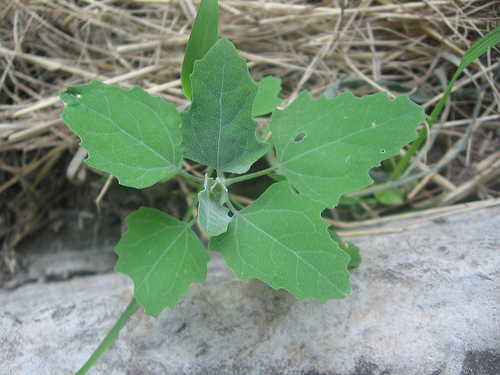
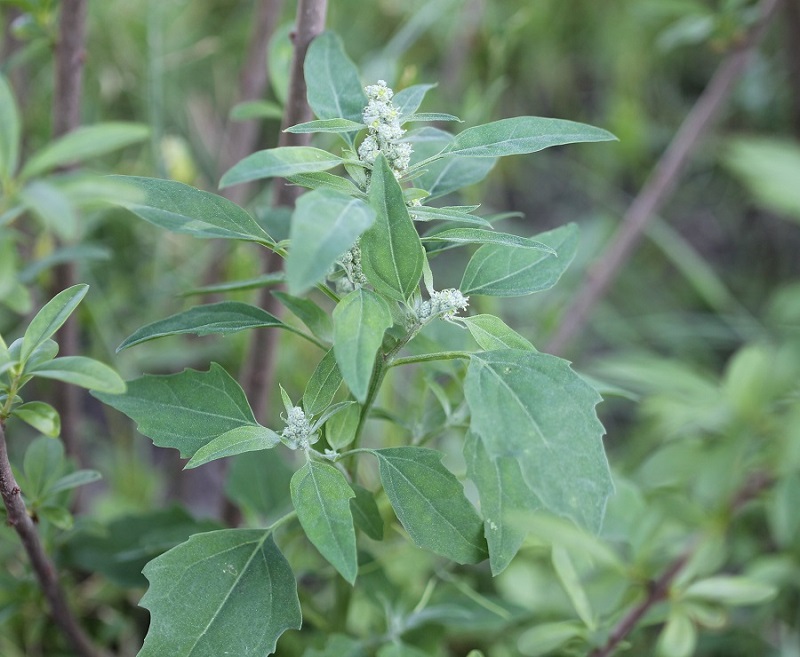
Lambs’ Quarters has grey-green leaves that closely resemble a goose foot. From a distance, they appear dusty and the plant may grow many feet tall. The flowers grow in spiky clusters of what looks like small balls of pale green (de Bairacli Levy 95-96). And, while the young plants tend to be full and lush-looking, as they mature they become more ‘leggy’. A good field guide will provide more of the particulars; I am including some photos to aid in identification.

lambs-quarters

Lambs’ Quarters gets its name from being a good fodder for sheep but other livestock enjoy it as well, including goats, chickens and geese. I often cut back some of its growth and toss it over the fence. My goats, chickens and ducks go wild over it; they know its many health benefits. Lambs’ Quarters may be used as a “pasture tonic herb” and may improve digestion as well as provide an anemia remedy (de Bairacli Levy 95-96).

As it is good for us, and for the animals, it is also good for your soil and a homesteader/gardener’s friend. Lambs’ Quarters tends to spread rather quickly wherever the soil has been contaminated by car fumes, pesticides, etc. It restores much-needed nutrients. Though we often lament its invasiveness, Lambs’ Quarters in the garden is a sign of a healthy garden bed, of soil rich in vitamins and minerals. It tends to grow wherever Gaia decides it is most needed but I’ve actually been considering creating a bed just for Lambs’ Quarters as, knowing its virtues, I can appreciate it better. I’m hoping everyone will decide to find a spot for it in their garden, too.

May God bless you & keep you!

*These statements have not been evaluated by the Food and Drug Administration (FDA). The information shared is intended for educational purposes only; it is not intended to diagnose, treat, cure or prevent any disease.

Works Cited

de Bairacli Levy, J. The Complete Herbal Handbook for Farm and Stable, 4th Edition. Faber and Faber, New York: 1991.

Wild Edible Food. Lambs’ Quarters. 16 September 2016. Retrieved from: http://www.ediblewildfood.com/lambs-quarters.aspx

Photos retrieved from: http://www.google.com

Environment, Herbs, Holistic Health, Nature, Organic

Positive ID

After writing “Friday’s Flora and Fauna” piece last week, I realized that, for the sake of safety, I should include some references for working with herbs.

First and foremost, a good field guide is an herbalist’s friend. If you grow herbs in your own garden, then you can be fairly certain of the plant identification because you know what you’ve planted but, in the wild, you can never be too careful. Some benign species may have some close-looking cousins that could make you very ill if you consumed them–they can even be deadly. Take, for instance, Queen Anne’s Lace (Daucus carota) and Yarrow (Achillea millefolium). These dainty, white, umbrella-shaped flowers grace nearly every roadside–so much so that one would think it is easy to identify them. Of course, they each have a distinctive leaf pattern to tell them apart, and both are benign. However, their close cousin (in looks anyway), Hemlock (Conium maculatum) is poisonous. So much so, that even touching the plant with your hands, and then touching your lips with those hands, may have a deadly reaction. So plant identification is extremely important. I recommend Peterson’s Field Guides as they are ranked above most.

Roger Tory Peterson wrote many field guides, starting with birds, but including “The Peterson’s Field Guide to Medicinal Plants and Herbs” and “A Field Guide to Edible Wild Plants”. They are both worth the investment. There are others; please look them over thoroughly for references of distinctive marks, colors, leaf-patterns, etc. that are unique to the plant you are looking for. Also, make sure there are notations for size and what sort of growing conditions they prefer. If we’re looking for Black Cohosh (Cimicifuga racemosa or Actaea racemosa), which prefers a moist, heavy soil, you’re probably not going to find it growing in the desert.

Another good rule of thumb is to learn the correct botanical names. My herb instructors, Michael Ford and Joanne Pacheco, were death on using botanical names–and for good reason. What I may call a dandelion, another person may call Lion’s Tooth, so common names can be confusing when wild harvesting. (And, though I am going off subject a bit here, when wild harvesting, please don’t take everything; leave some quantity of herbs for others and, more importantly, for further propagation; over-zealous wild crafting–i.e. depleting whole stands of an herb or edible, puts plants at risk for extinction; take only what you need and leave the rest. Google “United Plant Savers” for more information about responsible harvesting) For safety’s sake, it is especially important to know your botanical names when purchasing herbs from a local nursery. I mentioned Yarrow earlier; there are ornamental varieties that are quite beautiful but they may not have the medicinal properties you’re looking for. And, as with improper identification in the wild, these ornamental varieties may be poisonous. If the botanical name on the variety in the nursery doesn’t match what you know is correct for that herb, don’t use it; you never know.

As for working with herbs, and learning those correct botanical names, some recommended herbals are “The Way of Herbs” by Michael Tierra, “Healing with the Herbs of Life” by Lesley Tierra, “The Green Pharmacy” by James A. Duke, as well as anything written by either Rosemary Gladstar or Juliette de Bairacli Levy. These should give you some good starting points and have you brewing and simpling in no time at all.

Warning: once you start, it’s a little bit like that slogan for Lay’s Potato Chips “Bet you can’t eat just one!” Well, not exactly eating but, bet you can’t stop with only one. Herbs have a way of getting under your skin–in a good way. Knowing you have the knowledge and the tools to help keep your family and yourself in good health is empowering, and it gets to be habit-forming. Not a bad addiction though if you ask me.

May God bless you & keep you!

Creativity, Herbs, Holistic Health, Homesteading, Nature

Friday’s Flora and Fauna: Violets are More Than Just Blue.

When I was a little girl, violets were second only to dandelions. Oftentimes, I picked both together, enjoying the striking contrast between dandelion’s fuzzy, yellow flower head and violet’s soft, velvety petals. I would bring them in to my grandmothers’ kitchens, or to my Mom’s, place them in a Dixie cup or an old tea cup of water, where they would grace the windowsill for the rest of the day; by morning, they’d be dead.

I’ve blogged about dandelions before; now it’s violet’s turn.

I don’t remember how old I was when I first learned about sugared violets. I didn’t grow up with “green” living, or even living off the land, so this was foreign information to realize that certain flowers and/or leaves may be eaten–especially the ones that much of the population considers weeds. But sweet violet (Viola odorata) is indeed an edible flower. And, being curious about how they are “sugared”, I googled it. I found this recipe from Martha Stewart: http://www.marthastewart.com/350345/sugared-flowers; next spring, I will have to harvest them and give it a try. The leaves are also supposed to be good steamed, much like spinach or kale.

Medicinally, I have found two separate references–one from Juliette de Bairacli Levy and another from Michael Tierra, both renowned herbalists worldwide–for the use of violets to treat tumors. According to “The Complete Herbal Handbook for Farm and Stable” by Juliette de Bairacli Levy, both the leaves and the flowers may be used…both internally and externally. Despite my love affair with herbs, I can’t help wondering how effective they are in such a treatment. If they are effective, why doesn’t the American Cancer Society incorporate them into their healing regime? Or do they? Has some part of the violet been isolated and made into a drug to be used in cancer treatment, similar to the pain relieving compounds in willow bark being isolated to make aspirin? Or is it simply because violets are considered by most a weed, and fall under the category of “folk medicine”, that perhaps they are pooh-poohed by orthodox medicine? Regardless, it is worth further research.

Violets have other medicinal uses, mostly involving the upper-respiratory system. They may sooth a sore throat, alleviate dry mucous membranes, ease chronic coughs and asthma symptoms (Tierra 203-204). They may also be taken internally for the treatment of inflammed liver, kidneys, bladder, and for gallstones (de Bairacli Levy 159-160). Though the latter book is aimed at the farm, they are also said to be effective for the same ailments in humans. Externally? Being emollient, they make a nice skin oil or lotion to help ease dryness and inflammation. Who knew?

Our natural world is so full of wonders, I am sometimes amazed to find myself reeling in shock over a new discovery. Violets haven’t been part of my pharmacopoeia before so it was fun doing a little research on them today. In so doing, I may have found a new friend to add to the home apothecary…or, at the very least, a new addition at the dinner table. And, if they don’t appeal to the palate? At almost 50, they still look great standing next to the dandelions on the windowsill.

May God bless you & keep you!

Works Cited

de Bairacli Levy, J. The Complete Herbal Handbook for Farm and Stable, 4th Edition. Faber and
Faber, New York: 1991 (original printing was with Faber and Faber of London, 1952…)

Tierra, M. The Way of Herbs. Simon & Schuster, Inc., New York: 1998.

Environment, Frugality, Holistic Health, Minimalism, Yoga & Fitness

20 by November 20th

That’s my goal…20 pounds, that is.

Though I am rapidly reaching the point of no return as “middle-aged”, I refuse to give in to the legendary middle-aged spread. I have about 30 pounds of unwanted spare tire around my middle right now, but I’m shooting for 20; it’s a little less daunting. No, I’m not going to start some fad diet. Making healthier eating choices and incorporating some much-needed cardio into my daily routine will help me take it off slowly and, hopefully, help me keep it off. I’ve chosen my 50th birthday in November as my deadline to keep me from putting off taking it off.

With all this in mind, I elected to walk to work yesterday instead of driving. It’s better for me and it’s better for the environment. It also saves wear and tear on the vehicle, and saves some money on gasoline. It’s a win-win situation all around.

Driving I can leave my home 5 minutes before my shift starts and still arrive on time. Walking? It takes about 30 minutes depending on my pace. So I left the house at 8:32 a.m. and reached the dealership at 8:59 a.m. I confess to being a little winded. I’m woefully out of shape–despite the daily yoga routine–but I also enjoyed the walk. Yes, traffic was heavy on Route 6 and I probably traded some of the physical benefits of the walk with a not-so-healthy dose of carbon inhalation, but it felt good to be moving. As I normally work late afternoons, early evenings, and also Saturdays, this will likely be a Saturday only routine due to my aversion of walking a busy interstate after dark; I’m taking advantage of the track at the local ballpark for the rest of the week (I switched with a co-worker to get a much-needed 3 day weekend; I worked her Friday shift in exchange).

You walked??!?

Well, I do work at a dealership where they sell cars so maybe my fitness walk doesn’t exactly jive with the image of luxury they’re trying to promote.

You walked??

Sad that this is such an earth-shattering occupation…

And then the expected call from my Nervous Nellie, Mom. Yes, expected. I did mention the evening before that I was planning on walking to work but I could also tell during the mentioning that she wasn’t really paying attention. I had planned to leave a note to remind her but, in the mad dash to get out the door on time, I nixed the note. The call came in around 11 a.m.

“Welcome to (insert dealership name here). This is Lisa speaking. How may I direct your call?”

“Lisa, it’s Mom. Why didn’t you take the car?”

Of course, the owner was in the building so I couldn’t talk–especially on the business phone–so I had to keep it brief. She and Max the Blue Heeler were waiting for me at the foot of the driveway. Poor Mom! She thought something was wrong with the car. Now what? As Yours Truly just paid to have some major work done on it at the beginning of August, I totally understand her concern but, of course, I had to give her some gentle ribbing for being the Nervous Nellie.

“Selective Hearing? Or Selective Memory?”

She admitted to the latter. After she called me, she then remembered my telling her the evening before about the walk.

“You should have called me,” she scolded, “I could’ve picked you up from work.” (??!!?)

I think 20 pounds instead of 30 by November 20th is going to be enough of a challenge. Don’t you?

May God bless you & keep you!

Faith, Gratitude, Herbs, Holistic Health, Homesteading, Nature, Organic

Friday’s Flora and Fauna: Chamomile

Chamomile (Matricaria recutita) has been a staple on this homestead for many years. Diagnosed with Irritable Bowel Syndrome in my early 20’s, chamomile quickly became a valued friend. It is an effective carminative and considered by many herbalists to be specific for any and all digestive complaints. In fact, it has been proven to be “a good remedy for a number of diseases ranging from the common cold and flu to digestive disorders, diarrhea, menstrual cramps, nervousness and insomnia” (Tierra 110) During my herbal apprenticeship with Michael Ford and Joanne Pacheco of Apollo Herbs in Lincoln, Rhode Island, I came up with what I call my “Digest Tea” as a part of my herbal roadshow–the practical half of our final exam where we actually used herbs to make certain medicines, health and beauty aids and/or herbal products. Chamomile was the main ingredient. I’ve been making this tea on a regular basis for almost 9 years. Yes, it is a very effective tea for someone with digestive complaints, but chamomile also tastes good; not at all like a “medicine”.

I also suffer from Chronic Fatigue Syndrome. Again, chamomile, with its nervine and calmative properties is the herb of choice. I don’t think it has ever made me so drowsy that I’m a threat to society behind the wheel of a car–but I’ve also never put it to the test and, with tongue in cheek, would advise: DO NOT DRINK AND DRIVE! Instead, it is best enjoyed sitting by the fire on a cold winter’s night or else curled up in bed just before bedtime with a good book.

The aforementioned uses for chamomile are fairly common–even for those not as familiar with herbs. Quite a number of commercial tea manufacturers/distributors have a Sleepy Time Tea (or an equivalent) and, again, chamomile tends to be the main ingredient. However, a recent reading in James Duke’s “The Green Pharmacy” brought to light another effective use for chamomile–one that is proving timely for me.

Every summer my legs break out in this itching, burning rash. It is more of a nuisance than anything else, but I refuse to wear shorts or short skirts outside of the house even in the hottest temps because of its unsightliness. It almost looks like poison ivy but a.) I’m one of those weirdos that usually doesn’t react to poison ivy and b.) in this infernal heatwave that I’ve been complaining about ad nauseum in previous posts, I’m not doing anything to come into contact with poison ivy. It seems most prevalent behind the knees, and around the ankles and feet. Many years ago my doctor gave it a name but it escapes me. However, it is a dermatological reaction caused by the sap from weeds and tall grasses when weed whacking. Another electric weed whacker died earlier in the summer; this rash, once it erupts, stays most of the season. Anyway, I have tried everything–both common anti-itch methods such as hydro-cortisone creams and Calamine lotion to holistic approaches such as a spearmint leaf decoction, which works great for poison ivy rashes but, apparently, not any other kind of foliage-based rashes.

Anyway, in “The Green Pharmacy”, James Duke writes “Aromatherapists, especially in Europe, recommend massaging with camomile preparations to treat skin allergies such as hives and itching”. Yesterday I was desperate. This rash is extremely itchy and I have all of the self-control of a 5 year-old child. If it itches, I scratch it (don’t go there…). I know it doesn’t help the unsightliness of my legs to have bloody runnels everywhere but that is the usual effect after a good scratching. So I decided to give chamomile a try. I brewed a standard infusion of chamomile (1 tablespoon of dried chamomile leaves and flowers in a cup of hot water (turn off the heat just before the water comes to a full boil; boiling water may destroy some of the healing properties of the herb); cover, and allow to steep for 20 minutes) and, after it had cooled, dipped a cotton ball in it and began bathing my legs with it.

Almost instant relief. It was amazing. Of course, I also took a bath in Epsom salt prior to the application and I’m sure that had a hand in helping, too. But it was the chamomile that seemed to provide the most soothing relief. Within moments there was a visible reduction in inflammation. It was wonderful. And I am so grateful that He led me to this passage in James Duke’s book; it is truly a godsend. Like any other treatment, you will need to re-apply it. It stayed with me for about 5 hours and then a few of the worse areas started itching again–not quite as bad as before the first application but enough that it was time to re-apply.

Hopefully, this will help others in a similar situation. I do need to add a few words of caution: chamomile is a member of the ragweed family. If you have a sensitivity with ragweed, you may want to proceed with caution before using chamomile, especially taking it internally. If using it topically, apply the chamomile infusion in your bathroom where there is a shower or faucet where you may quickly wash it off. As with all things, seek professional medical attention if the rash gets worse.

These statements have not been evaluated by the Food and Drug Administration. This presentation is intended for informational purposes only; it is not intended to diagnose, treat, cure or prevent any disease, nor be taken as medical advice.

Works Cited

Duke, J. The Green Pharmacy: The Ultimate Compendium of Natural Remedies from the World’s Foremost
Authority on Healing Herbs.
Rodale Press, PA: 1997.

Tierra, M. The Way of Herbs. Simon & Schuster, Inc, New York: 1998.

Environment, Holistic Health, Organic

Gluten Free

I watched this video this morning (the link is below…) and felt a nagging little tug. I have many of the symptoms of gluten sensitivity but, as the video describes, sometimes the tests come back negative and, even when they come back positive, switching to a gluten-free diet doesn’t always completely solve the problem (though it is a huge step in the right direction). I also went to this physician’s website and, when I can afford to, I may become a certified gluten practitioner–I can’t think of a better service to offer as a holistic healthcare practitioner. Our diets are killing us. And, while no one achieves immortality, I think enjoying a better quality of life while we are on this planet is worth striving for.

I think it was Confucius who said, “You are what you eat.” We eat a lot of garbage. Some of it comes from the food industry itself with its packaged this and processed that, and its long list of preservatives few can pronounce without babbling. It is in our water and our soil, both necessary for growing the foods our bodies need to eat, from chemical fertilizers and pesticides. There is also something in the process of even so-called natural foods that can affect our health adversely. No, please don’t give up eating entirely but more and more we are hearing about gluten sensitivity. Gluten is found in most breads, cereals and pastas–even whole wheat varieties that are considered healthier for us. And it is being linked to autoimmune diseases such as Celiac’s Disease, Crohn’s Disease, Lupus, even Alzheimer’s and Diabetes (O’Bryan). And, while the media tends to link it primarily to wheat, it is also found in rye, barley and triticale.

So what is gluten? I found two separate definitions online. One: A substance present in cereal grains, especially wheat, that is responsible for the elastic texture of dough. A mixture of two proteins, it causes illness in people with Celiac’s Disease (pretty generic). And two: The tough, viscid, nitrogenous substance remaining when the flour of wheat or other grains (barley, rye, triticale) is washed to remove the starch. In other words, if this latter definition is correct, it is already naturally in grains but it can also be purchased separately for the creation of greater elasticity in breads and pastas, and is often added to our processed, packaged diets. I actually bought a box several years ago–before I knew what it was–for bread making. It was right there on the shelf in the baking section of the supermarket. So it is a common ingredient. The danger is that our modern diets have been inundated with it so much that our bodies cannot handle the overload. It all comes back to that old adage: Everything in moderation. Of course, if you’ve already been diagnosed as gluten-sensitive, or worse, with Celiac’s Disease, going gluten-free is now the more sensible choice.

Dr. Tom O’Bryan has written a book entitled, “The Autoimmune Fix”. I have not read it yet but it will definitely be on order soon. Does this mean that it will suddenly become gospel? No. But knowledge is power. And it doesn’t hurt to learn as much as we can about what we are putting into our bodies.

May God bless you & keep you!

http://www.mindmovies.com/inspirationshow.php?episode=461
http://www.theDr.com (this is his website with more information on this subject)

Animals, Creativity, Gratitude, Herbs, Holistic Health, Homesteading, Nature, Spirituality, Writing

Monet I Am Not

I added a brief blurb to one of last week’s posts about starting a mural on the wall of my home office. This is the one room of the house I have never painted in all the years I have lived here. I’m not sure why–and it certainly could use a coat of paint–but somehow the unpainted, unfinished walls add a sort of creative aesthetic to the room. A blank but less-than-perfect slate upon which to feed the creative genius. Last week, I painted the sky and the grass. This week I added details.

I am painting my dream life, my dream property in Maine. You see, I’ve been doing a lot of reading about manifesting, using creative visualization to manifest what you hope to achieve. I have several vision boards in the office, on the refrigerator, and even on the cork board next to my desk at work. For those of you unfamiliar with vision boards, a vision board is a collage of images of your heart’s desire. Mine have a wild assortment of goats, sheep, rabbits and Border Collies, as well as an array of antique furniture, spinning wheels, looms, beehives, and herb and vegetable gardens. You can add affirmations to them, too. The idea is to surround yourself with these constant reminders of where you want to be. I even have one with the image of a manual typewriter with an affirmation beside it that reads: I am a professional writer. Eh, whatever motivates you. And the mural is simply a larger vision board–one that I am putting a lot of passion and creative energy into as I improve upon my drawing and painting skills. (I read somewhere that this really helps with the manifestation process; it doesn’t hurt to try)

Painting a wall a single color is actually kind of boring to me. I know many contractors and house painters who find it meditative but I need more detail. Painting a scene on a bit of canvas is meditative for me–as long as I can still the inner critic. But that’s actually not hard to do as I paint simply for enjoyment. When I write, the critic comes out. Though I enjoy writing, too, I tend to forget the rule of thumb about not expecting your first draft to be bestseller material. It won’t be. Accept it. When I paint, though most of the details I’ve added to the mural are pretty easy to figure out, I am definitely not a Monet. And that’s okay…even if it is occupying the whole wall in my home office. Though not a Monet, it does look like a bit of folk art, with a whimsical willow tree over a sea cliff, and some fruit trees that look like they stepped out of a Tim Burton movie. Once I add some leaves and the actual fruit, these skeletal monsters will look a bit more benign. As for the animals? I think I am going to have to find some “how-to” books or websites; my artistic skills need a little honing before I add them to the wall. I can do a passable cat, rabbit, sheep and even a horse but my chickens, ducks and goats leave a lot to be desired.

All in all, it was a great way to spend an afternoon. I went into that proverbial “zone” for a few hours and found true relaxation, something that is often sadly lacking with me as I tend to be moving in 20 different directions at once. It’s nice to be able to focus.

May God bless you & keep you!