Healing, Herbs

Wednesday’s Weed Walk: Infusion vs. Decoction

“Then God said, ‘Behold, I give you every seed-bearing herb on the face of the whole earth and every tree that has fruit with seed in it. They will be yours for food.” (Genesis 1: 29)

I often get asked what the difference is between an infusion and a decoction when working with herbs. Both use hot water (not boiling) to extract the medicinal properties from the herb(s). However, depending on the strength you require, may determine which one you use.

An infusion is much like a tea. You’re pouring hot water over the herbs in your cup, or teapot. The difference is, where your bag of Lipton tea leaves get brewed 3-5 minutes, tops, the infused herbs are steeped for 15-20 minutes. You’re also putting a cover of some sort over the cup as soon as you’re finished pouring the water so the medicinal properties do not get lost in the steam wafting up.

A decoction uses a double boiler or, if you don’t have one, two saucepans where one is slightly larger than the other so the smaller of the two can nestle inside the larger. About an inch deep of water goes in the larger, bottom pan. The herbs go into the smaller, top pan and more water is poured in to just covering the herbs. Then we place a lid on it and slowly bring it to a simmer, being careful not to let the water evaporate and scorch the herbs. If that happens, we have to start all over again. Decoctions are typically simmered for 45 minutes.

I tend to think of an infusion as a sort of maintenance–like exercise, and a decoction for when you mean business in healing whatever ails you. However, that’s not entirely true. We also decoct certain tougher parts of the herbs. An infusion works fine for just the leaves and blossoms but, it won’t do much to extract the healing properties of woody stems or the inner cambric bark of something, like, slippery elm (Ulmus rubra), for instance. You can, of course, decoct all of the aerial parts together (stem, cambric, flowers and leaves).

For seeds and roots, we tincture the herbs but, that is a topic for the next post.

Note: I mentioned above that the water for an infusion should be hot, not boiled. If the water is too hot, it will destroy those healing properties. If you do bring your water to a boil, allow it to sit 5-10 minutes to cool from boiling to merely hot before pouring it over your herbs.

Also, when working with herbs, it is best to stay clear of Teflon-coated pans, or even cast iron. Teflon should be avoided at all costs. Cast iron is fine for most things but, the iron can leech into your decoction, or infusion, and alter those properties. Stainless steel, or enamel, work best with herbs.

May God bless you & keep you!

19th century, Animals, Christianity, Exhaustion, Faith, Family, God/Jesus, Gratitude, Healing, Herbs, History, Homesteading, Memories, Nostalgia, Prayer, Religion, Sleep Deprivation, Writing, Yoga & Fitness

Getting Back To My Roots

“O Lord, our Lord, how majestic is your name in all the earth! You have set your glory above the heavens.” (Psalm 8:1)

Sunday was Palm Sunday. I went to Mass and served as Lector, reading through Judas’ betrayal of our Lord and Savior, Jesus Christ. It’s one of those rare moments when Mass becomes almost a play, with Father Ben reading the words of Jesus; Lectors, like myself, reading the parts of the narrator and “voice”, and the rest of the congregation reading the parts labeled “crowd”.

I sometimes kick myself for not pursuing a career in acting. I studied acting in high school and, again, in community college. I’m quite good at it. And, after several years of serving as Lector, my knees no longer knock together in front of a crowd.

But I wasn’t really thinking about acting as I stood in front of the congregation on Sunday and read for the “voice”. My mind was reflecting over the last 5 weeks of Lent. I gave up junk food, at least the more popular definition of it (candy, sweets, chips, etc.). Living with the definitive junk food junkie (Mom), it’s tough to resist. However, as a measure of Mom’s sweetness and solidarity, she also gave up junk food for Lent so it wouldn’t be so hard for me. She didn’t want to eat chips and cookies in front of me.

Less mindful after Mass, I took Mom out for Chinese food and broke that Lenten vow by eating a fortune cookie (sigh!)

I also vowed to get back to reading a chapter of the Bible each morning and focusing more on my prayer life.

I’ve failed miserably on that score.

It’s amazing how hard it is to rekindle a habit once it’s been broken. It’s also amazing these epiphany moments.

Earlier blog posts have often sung the praises of working for a living history museum. It was the dream job come true. And, in many ways, that statement was true. I learned all sorts of things that will aid me on my homesteading journey, things that have been a major blessing already. Perhaps the sin of pride, but there was recognition as a herbalist…because that was my title: Herb Garden Lead. And, in many ways, I got to act. There were “scripts” to memorize (i.e. historical facts) when interpreting for visitors to the museum. There were skills to learn so we could demonstrate life in the 19th century.

It was also a very demanding position.

Prior to getting this job, I had a habit of rising everyday at 3:30 a.m. I blogged, prayed the rosary, and hit the yoga mat. Then I headed downstairs and outside to the barn to take care of the animals. I didn’t have to be to work until 3:30 in the afternoon at the dealership so I spent late-morning, early-afternoon writing. If the dealership had been a full-time position, it would’ve been ideal for this writer. I got home at 7:30 in the evening, spent some time caring for my animals again, and then went to bed.

Living history, however, demanded swing shifts. Evening programs on a Saturday didn’t see me driving over an hour home until after midnight…only to have to get up again a few hours’ later to work Sunday morning. 3:30 a.m. and writing became an impossible dream. The rides into work each morning found me playing “beat the school bus” because every route into work seemed to be a school bus route…no matter what time I left for work. I spent my mornings literally running through the barnyard, 19th century skirts hiked up over my knees as I threw hay and feed at the animals and yelled at them to get out of my way (we had to be fully dressed in period attire walking into the museum). Even changing the animals’ feeding time didn’t help because of how late I often got home at night.

And then I got my wrists slapped a few times for what few blog posts I still managed to create. I wrote about something unethical I witnessed in regard to the animals kept at the museum. I lamented being unable to attend Mass on a Sunday morning because of a conflict of hours. I own my bad on the first but, the lamentation over Mass was simply that: a lamentation. Not a dig against the museum.

I remember coming home from one of those evening programs, collapsing in the easy chair in the living room, still fully dressed in period garb, getting up 4 hours’ later and going back in, rumpled plaid still hanging from weary shoulders. I drove home the following evening praying, telling Him how I simply couldn’t do this anymore. As much as I loved interpreting, as much as I loved wearing the period clothing and learning all of these antiquated skills, I simply couldn’t devote every ounce of my being to it, as it seemed to be required.

I slipped while shoveling snow the following Tuesday so I could go into work on Wednesday and fractured my shoulder. The rest is history.

I may not have kept my Lenten vows as well as I would have liked this year. However, this Lenten season has been a time of reflection. How did I stray so far away from all that I hold dear? Writing, herbs, animals and homesteading…the things that make me, well, me. More importantly, family, friends, and above all, faith. I feel like this has been a long lesson in the sin of idolatry.

Because I truly idolized what seemed an idyllic job. If I had lived closer, if I didn’t have farm animals and pets, if, if, if…it might’ve remained a dream job–despite the grueling work schedule. But, perhaps, it was also a lesson that I’m not Supergirl. Like every other human being, I am gifted with 24 hours each day. How am I spending them?

As I continue to reflect during this Lenten season, I’m starting to go deeper. I feel like Job, questioning the why and the how. Maybe it’s time to re-read that book from the Bible.

However, for the moment, I seem caught up with the Psalms, finding balm for my spirit in shorter verses that always seem to pack a punch. It’s a reflection on my life these days: slow and steady, short and sweet. Baby steps forward, learning to take those steps and not being too hard on myself for being unable to handle anything bigger these days; it’s too overwhelming because of how far I’ve fallen behind in, well, everything. The good habits will return, or morph into something better. The life I dream of living will become a reality…or He will mold and shape it into something beyond my wildest dreams.

Amazingly, He’s been using my work at the library to teach me this very valuable lesson in taking things one step at a time. Rome isn’t built in a day but, those baby steps make a difference. It’s time to apply them at home. I can’t twitch my nose and do it all in a blink. But, each baby step will take me that much closer to that dream life…and maybe I’ll finally have time to enjoy some of that journey doing what I love, sharing it with those I love, and above all, praising Him whom I love above all else. In short, getting back to my roots.

May God bless you & keep you!
19th century, Christianity, compost, Culture, Emergency Preparedness, Faith, Frugality, Homesteading, Minimalism, Prepping, Spinning, Straw Braiding, Tradition, Weaving, Zero Waste

Living in an Amish Paradise?

“Whatever is has already been, and what will be has been before, and God will call the past to account.” (Ecclesiastes 3:15)

A year ago November, the hot water tank blew a hole. We had a major flood in the basement and I got the equivalent of sticker shock when my electric bill, which is normally around $80-$90 a month, shot up into the thousands. With the hole in the tank, my well-pump was perpetually running, trying to fill the tank…until I discovered the flood and mitigated the loss of water. We’ve been heating water on the stove to bathe ever since. The damage, besides just being an old unit, was further impacted by the water softener, which had also died a slow, watery death (no pun intended). The build-up of too much iron on pipes and fittings had hastened its end.

Well, all that added wear and tear from perpetually running may have escalated the well-pump’s rumble towards its eternal death, too. Since last fall, we have had intermittent periods where all of a sudden, you go to turn on a tap and nothing comes out. However, within a couple of hours, we have running water again. It’s been touch and go.

Wednesday night, I went to fill a couple of gallon jugs to run through the water purifier before I went to bed…and nothing. As it was late, I went to bed assuming it would be back on in the morning.

It wasn’t.

36 hours later, we are still without running water. I’m thinking Wednesday night’s last run was, well, it’s last. However, I have done some trouble shooting online. It may also be a tripped circuit breaker. As my basement is a dark, dusty crawl space, I am waiting for the sun to fully rise and Mom to come downstairs with our only working flashlight so that I may go check. Recommendations also suggest shutting off the circuit breaker and then flipping it back on. We do have some electrical repairs that need to be done so, that could also be the issue. I had an electrician out to inspect but, he will have to take out a few walls to find out what it is…which will be a costly repair.

Ugh! It’s all happening at once.

I had a moment the other day where my nostalgia for the place got under the skin and I started thinking about repairs and remodels and landscaping projects, etc. I’ve had 20+ years of imagining how much this place could shine if I could finally get the needed repairs done. There’s the added bonus that I can walk to work. I can walk to the super Walmart if needed. I can walk to church. Six years’ ago, for anybody who has been following that long, walking was all I did due to not having a car for several months. In short, despite it’s derelict state of affairs, this house is centrally located to everything relevant to my life.

Of course, there’s still a zoning issue to consider…but I was doing just that. Can I find that attorney who can pull the proverbial rabbit out of a hat?

And, lo and behold, the pump gave out. Clearly, He is telling me, it is time to move on. It’s time to take up my cross and follow Him to wherever He leads. I don’t know where that is. Or how it will happen. I think it’s called walking by faith. I suspect, when the right place/situation comes along He’ll let me know…even as I flounder with uncertainty that such a place even exists.

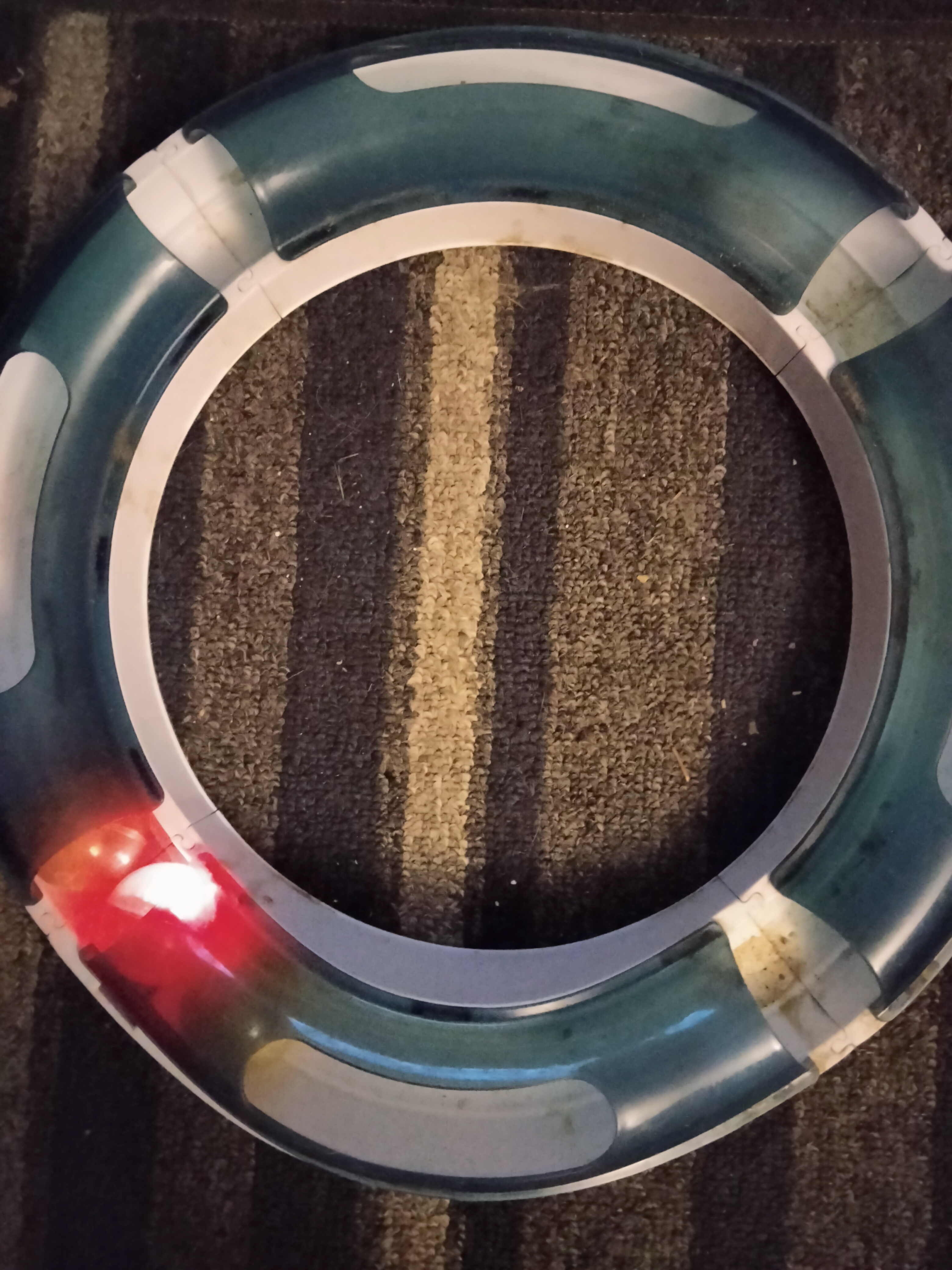
It is incredibly quiet in the house now…except for a bunch of juvenile felines batting around their ping-pong track (not sure what else to call it; donut-shaped apparatus with tracks for blinking ping-pong like balls).

Apparatus with flashing ping-pong balls; don’t look too closely, a lot of dust and grubby paw prints, needs another scrubbing!

Amazing how quiet a home can be without the modern white noises running incessantly in the background.

That was one of the things that I loved about my job in living history museums: the peace and tranquility inside the antiquated houses. Like here, there was still the occasional pop-on of a furnace (the heat is needed to preserve the old houses) but, the incessant buzz of all the other modern-day “guts” was absent. Hence, my romanticization of 19th century life was reaffirmed.

Of course, in the 19th century, homes may not have had running water (unless they lived in a valley and could situate their well at the top of a hill…). Instead, they had a hand-pump to get water from their wells. There’s a company in Kidron, Ohio called Lehman’s that sells mostly Amish, and definitely American, made products. One of those products is hand-pumps. If I was staying, or if I’m ever lucky enough to obtain that backwoods home in Maine/New Hampshire/Vermont (Missouri?), there will be a hand-pump installed. If for no other reason, then for power outages when the electric pump does not work. While modern “conveniences” are nice, we have grown too dependent upon them–in my opinion anyway–and go into a panic every time a natural disaster, or other hiccough in the system, comes along.

However, even lacking the necessary infrastructure, so many water-saving lessons that I learned in living history museums are being put to use. I used to laugh that not too many modern employers would look at a resume and think, “Let’s hire this girl!” because my previous duties included spinning, weaving, straw braiding, and cooking on a hearth. But life–home life–appears to benefitting from those lessons.

Who knew?

Yesterday I set up the pitcher and wash bowl so we could brush our teeth and wash our hands. We actually use much, much less water that way. A couple of wash tubs filled with hot water to wash and then rinse dishes also saved more water than turning on a tap to rinse. Granted, a shower would be nice but, bowl baths will suffice in this pinch. And, while we’re using 19th century practices to conserve, from a financial standpoint, this won’t be sustainable in the long-run as, without the hand-pump, we are buying in water again. But we can get by for now…until I call around to some of the energy assistance facilities to see if there’s any help available to resolve some of this. (Please send lots of prayers!)

Of course, I can almost hear the elephant in the room: without water, you also cannot flush. Composting toilets are the new thing today, especially with tinyhouse owners. We have a crude, 19th century “composting toilet” (bucket with an old toilet seat atop it), with a bag of sawdust/shavings beside it to sprinkle over the top after we use it. Amazingly, any odor is quickly doused and less offensive than the flushing toilet. We have a canister out back for composting it later. Where there’s a will, there’s a way. This, too, shall pass.

May God bless you & keep you!

Animals, Christianity, gardening, Healing, Herbs, Holistic Health, Homesteading, illness, Nature, permaculture, Plants, Wild Edibles

Wednesday’s Weed Walk: Wood Sorrel

“And God said, Behold, I have given you every herb bearing seed, which is upon the face of all the earth, and every tree, in the which is the fruit of a tree yielding seed; to you it shall be for meat.” (Genesis 1:29)

As with many of the plants I feature on this website, Yellow Wood Sorrel is often regarded as a weed (hence, the title I use whenever I write about a plant, or herb). Most gardeners consider it a scourge because the roots go pretty deep and it can be difficult to get rid of. However, as with most “weeds”, I let it stay.

Miller, “Yellow Wood Sorrel”, Pere Marquette Rail Trail Wildflowers, n.d.

Yes, you know this one. It is often mistaken for a clover because of the similar, shamrock-y leaves. Oxalis stricta, however, is in the Oxalideae family, not the Fabaceae family–or bean family–as clover is, so they’re not even cousins. Interestingly, they can both fix nitrogen in your soil so not a bad thing to have in your garden. Like clover, wood sorrel also helps eliminate soil erosion by providing a natural ground cover that helps retain moisture. Even an obnoxious “weed” has its function.

Wood sorrel’s main claim to medicinal use is its help at reducing fever and inflammation. It increases the flow of urine and is particularly effective at treating urinary complaints. It may also help externally for treating eye complaints and scrofulous ulcers (de Bairacli-Levy 166). And, while Ms. de Bairacli-Levy writes this in a herbal for animals, it has the same effect on humans.

Renowned herbalist, Juliette de Bairacli-Levy, goes on to say that “goats and sheep seek its foliage, enjoying its refrigerant properties” (166). I, too, enjoy nibbling a few leaves whenever I’m working outside on a hot summer day. Yellow wood sorrel is a wild edible. It has a tart, lemony flavor that adds a nice punch to a salad or sandwich. If you haven’t guessed by its name, yellow wood sorrel has oxalic acid in it, which gives it its tart flavor. Many of our dark leafy greens, like spinach, beet greens, and Swiss chard also contain oxalic acid. As with anything, moderation is the key. Large quantities of yellow wood sorrel is said to lead to kidney stones (Taylor 1), but the same is also true of spinach, especially in sensitive individuals (Spritzler 1). Yellow wood sorrel also has some toxic, lookalike cousins so be sure of identification before consuming (Taylor 1).

These statements have not been evaluated by the FDA. This information is for educational purposes only. It is not intended to diagnose, treat, cure, or prevent any disease.

May God bless you & keep you!

Works Cited

de Bairacli-Levy, Juliette. The Complete Herbal Handbook for Farm and Stable. Faber and Faber Limited, 1952.

Miller. “Yellow Wood Sorrel.” Pere Marquette Rail Trail Wildflowers, n.d. Image. https://www.peremarquettewildflowers.com/flower/yellow-wood-sorrel

Spritzler, Franziska. “Oxalate (Oxalic Acid): Good or Bad?” Healthline. https://www.healthline.com/nutrition/oxalate-good-or-bad

Taylor, David. “Common Yellow Wood Sorrel (Oxalis stricta).” Plant of the Week, USDA, n.d. https://fs.usda.gov/wildflowers

19th century, Abuse, Animals, Appreciation, Christianity, Creativity, ecosystems, Faith, Global Warming, God/Jesus, Herbs, Homesteading, Prepping, Religion, Understanding, Writing

Two Out of Three Ain’t Bad

“Let love and faithfulness never leave you; bind them around your neck, write them on the tablet of your heart. Then you will win favor and a good name in the sight of God and man.” (Proverbs 3:3-4)

I’ve been working on that third website and still questioning the wisdom of it. Yes, there’s been a desire to branch out a little, defend the innocent when it comes to abuse and neglect, defend Mother Earth, tackle those few social issues that capture my interest enough to comment. But I’ve been completely stymied by the purpose of the assignment.

We were asked to pick a subject, research it, and then use this subject to help build our brand. Not a single topic had anything to do with herbs, homesteading, prepping, animal husbandry or rescue, 19th century living, frugality, fiber arts, or faith.

That’s my brand.

I chose “social media research”. As a writer, I can recognize the importance of researching sources of information. I’m just not sure how creating multiple posts about how to fact-check and verify an article will prove interesting to anyone else on a live platform. Do I even want it to? And, while this post has nothing to do with herbs, homesteading, prepping, animal husbandry or rescue, 19th century living, frugality, fiber arts, or faith either; still, I reckon most of my readers here are used to my rambling detours by now.

As I write this, and as I continue to build the other page, I’m also struck by how He works.

I’m not exactly kicking and screaming against this other page. In fact, I can even see the merits of separation between this blog and the new one, especially if I decide to tackle some meatier subjects. But, despite the fact that I will probably take the other site down once class is over, the effort of building a new site (something I actually enjoy) has given me some ideas for this blog. As I seek to define this other site, what it will contain, what it’s about, my intention for this blog is becoming clearer. So He’s brought about a blessing even in the midst of something as mundane as “social media research”.

What are some of the unexpected blessings He’s brought to your life? I’d be delighted if you’d share.

“I come in the little things, saith the Lord” — Evelyn Underhill

May God bless you & keep you!

Abuse, Alcoholism, Appreciation, Brothers & Sisters, Christianity, Gratitude, Herbs, Homesteading, Politics, Prepping

Snow Days

“He took a little child and had him stand among them. Taking him in His arms, he said to them, ‘Whoever welcomes one of these little children in my name welcomes me, and whoever welcomes me does not welcome me but the One who sent me’.” (Mark 9:36-37)

I feel like a little kid today. It’s the first “real” snowfall of the season. I say “real” because the few light dustings we’ve had earlier in the year don’t count, do they? I mean, you can’t build a snowman, or have a proper snowball fight, with barely an inch of snow on the ground. However, winter storm Anthony, as the meteorologists are calling it, is a bit more substantial. I haven’t properly measured, or consulted the news’ stations but, merely by eyeballing it, I’d say we have 4-5 inches on the ground.

And, no, I didn’t spend the day building a snowman. Instead, I stayed in my pajamas all day, read a book, drank lots of Chai tea, and now I’m focusing on some homework…albeit, with this brief detour into blogging.

I have to build another website/blog for this term’s class: New Media. Another website/blog in addition to this one, and my author’s page. I’ve been questioning the wisdom of trying to keep up with 3 separate sites when I often drop the ball on the two I already have but, c’est la vie! I want a passing grade. And the only way to do that is to comply. If it proves to be too much, once the class is over, I’ll take it down. Sorted…

Of course, having another page also means coming up with enough content to support another page. I recently went through this site and tried to remove as much of the social/political stuff as I could. As this website was started as a place to share about herbs, homesteading and prepping, really, the social/political stuff doesn’t belong here.

Nor does it belong on my author’s page.

But there are social issues that I do care about that I’d like to write about from time to time. I’ve spoken a time or two about my childhood growing up with alcoholism, and having a father who wanted nothing to do with me…and a stepfather who wanted a little too much to do with me. I see some social issues in the news today that are all too reminiscent of that childhood and, lo and behold, a new site may be born.

However, when I started this new class a few weeks’ ago, I decided to go to a different platform to start this website. We use Wix at work so I am growing familiar with it. And, I figured, if I’m on a totally different platform, it’ll be harder for any social/political views to accidentally wind up on the wrong blog…and potentially alienate any longtime followers who do not share my views, or appreciate the research I hope to do to support my views.

And here I have to put in a plug for WordPress. Wix has got to be the most finicky, pain-in-the-@$$ website I have ever encountered. It looks like I may be starting from scratch creating this third website/blog…here on WordPress after all.

Who knew?

And, incidentally, it was my decision to close the library today. That feels so weird. The little kid in me delighting in the first “real” snowfall of the year is trying to reconcile this adulting thing where I have to make informed decisions for the greater good of my team. It was the right decision, given the snowfall and the slippery, sloppy roads. It just feels very weird–in a good way–to be the one called upon to make such a decision.

I am grateful. I am grateful for the new position. I am grateful for the responsibility entrusted to me. But it still feels weird. Maybe I should reconsider the snowman after all.

May God bless you & keep you!

PS Once this other blog is up and running, I will post a link somewhere for others to follow.

Brothers & Sisters, Christianity, Faith, God/Jesus, Gratitude, Holidays, Scripture

Happy Valentine’s Day to All of My Peeps!

“Like an apple tree among the trees of the forest is my lover among the young men. I delight to sit in his shade, and his fruit is sweet to my taste. He has taken me to the banquet hall, and his banner over me is love. Strengthen me with raisins, refresh me with apples, for I am faint with love. His left arm is under my head, and his right arm embraces me.” (Song of Songs 2:3-5)

The good Lord has given me the sweetest of gifts this morning. For those of you who have been following here a while, you know about my financial difficulties since January 2019. The good news is the mortgage company accepted my application for modification. They’ve put me on a trial run of three months. If I can make the payments each month, then I can be reinstated completely. Barring any unforeseen calamities, the new payment should be doable. Praise the Lord! For He truly is good.

I hope everyone else has as good of a day as I am having today and that He blesses your lives even more richly than He’s blessed mine.

May God bless you & keep you!

Christianity, Cooking, Creativity, ecosystems, Emergency Preparedness, Frugality, gardening, Homesteading, Human rights, illness, Minimalism, Nature, Politics, Poverty, Prayer, Prepping, Self-improvement

The Best Investment Made on the Homestead

“The Mighty One, God, the Lord, speaks and summons the earth from the rising of the sun to the place where it sets. From Zion, perfect in beauty, God shines forth. Our God comes and will not be silent; a fire devours before Him, and around Him a tempest rages.” (Psalm 50:1-3)

In an earlier blog post, I talked about how when under extreme amounts of stress we often get “stupid”. Or, perhaps a better way of putting it, the feeling of being overwhelmed becomes so great that staying on top of even the littlest thing becomes a challenge. Translation: yours truly has been seriously off her game for way too long.

I didn’t check the level of oil in the furnace this weekend past. My bad!

Yesterday, Mom thought the house was starting to feel a little chilly. She fired up the woodstove, which is fine. Temps are supposed to be minus zero this weekend and I had purchased some bundles of wood to supplement the oil. Prices are ridiculous, which is probably why some part of me didn’t check the gauge: avoidance. This is the first year in a long time without full heating assistance. With my new salary, we no longer qualify. That’s not a lamentation; I am extremely grateful, especially after so many years of want. But this winter is an adjustment…and yes, I dropped the ball.

We are out of oil.

I called George at the local oil company and he will deliver later this morning. However, unlike so many others who would be in dire straits in such brutal cold, we weathered it just fine because we are not bound by one source of heat. The woodstove I purchased back in 2011 has been the best investment into this homestead that I have made so far. Power outages, extreme temperatures, and yes, even human error have proven to me time and again what a valuable investment it was. It has more than paid for itself in the last 12 years. When I can’t afford cords of wood, deadfall, bio-bricks, which you can make yourself (more on that in another post…), or even old pallets cut up will do in an emergency. I can even heat water, or cook, on it in a pinch.

We are also not 100% reliant on “the system”.

This is the real reason why so many people turn to homesteading and prepping. I know this last is often associated with negative connotations. “Prepper”, to some, may conjure up images of some guy in camo, fully armed, living off roots and reindeer carcasses in the wilderness. Sure, this stereo-type is ready for anything–supposedly–but, prepping is just homesteading taken a step beyond. We’re not just reducing our dependency on modern systems, such as food, heating, and transportation; we’re also planning and preparing for a total system shutdown. And, if that last word conjures images of 2020 2.0, you would be right.

The pandemic should’ve be a lesson to us all. Systems break down. Supplies don’t always get through on time. Illnesses, injuries, and natural disasters happen. There is no way of knowing when, or for how long, these things will last, the toll that they may take. Inflation, and a potential world war, may be our next breakdown of systems; prepping, to my mind, is the only sensible course to take.

That being said, financial difficulties in recent years have put me behind on my prepping. Prepping kept me solvent for over 2 years after losing all 3 jobs that I had been working when the Great Recession hit. Unless your last name is Gates, Fauci, or Schwab, no human being’s finances will last them forever…no matter how carefully we plan, save, or how frugally we live. But careful planning, frugal living, and saving will serve you well for much longer than any government assistance that may, or may not, be forthcoming in a crisis.

For those who rent, no, installing a woodstove may not be an option for you. However you may be able to create a small grocery budget for, say, $10.00 extra each month to purchase extra canned and frozen foods. No, not the healthiest options but, it’s always good to have them around. Organize them by expiration dates. Those that will expire first, place at the front of the cabinet, drawer, or closet. Add new products to the back so you don’t take them first and allow older food to spoil. Even if you don’t garden, learn how to can and ferment food. When able, take advantage of sales and can, or ferment, whatever your family won’t eat before it all spoils. You can do this with food donations from a food pantry, too, if you are in such dire straits as to need them. It’s nothing to be ashamed of; Mom and I have had to rely on such extra ourselves in recent years. It falls under the heading of “sh** happens”. And, as much of the gifts received from a food pantry may be day-old and won’t last so long, canning or fermenting will extend the shelf life. You can also extend the life of canned goods nearing their date. Heat them up, or pre-cook meals, and freeze them in serving-sized bowls to be re-heated at a later date. Be sure to label them and, like the canned goods on your shelves, place newer additions to the back of the freezer. They should be fine for up to 3 months in the freezer. Peruse army/navy surplus stores for cold weather gear. Purchase a small tent that can be put up in your living room, or bedroom, to help you conserve heat should systems fail. Keep a supply of bottled water, extra pet food, candles and/or oil lamps with their oil, and matches on hand.

And don’t vote for anyone who wants to take away your right to grow and/or preserve food for yourself and your family, or heat your home with a fuel that grows naturally and can be found by a quick walk through nature. This isn’t conspiracy theory; it’s common sense. It is much easier to hold onto the freedoms we already have than to get back any we’ve lost. Government may make it look more attractive, such as with these 15 minute cities where everything is conveniently within a 15 minute walk from home, but the cost is always higher than the convenience is truly worth.

When all else fails, pray without ceasing…in fact, pray without ceasing before it all fails.

May God bless you & keep you!

Christianity, Cooking, Creativity, Frugality, Homesteading, Minimalism, Poverty

Learning to Live on Less

“Sing praises to the Lord, enthroned in Zion; proclaim among the nations what he has done. (Psalm 9:11)

I’ve talked a lot about my financial difficulties over the last couple of years (probably ad nauseum for many!) If this is your first visit here, I fractured my shoulder in 2019 and lost my job due to time missed recovering. For those who have been following for a while, you also know the extent of those difficulties. It’s been stressful and frustrating and downright scary at times; still is. But, the significant number of missed mortgage payments notwithstanding, how have we been surviving? We is my mother, a small farm complete with livestock and pets, and myself.

For starters, the wi-fi I’m using right now is the only “luxury” we have. If it wasn’t for my classes (50-something returning for my Masters in Creative Writing), I could eschew wi-fi, too. We don’t have cable or satellite (i.e. no paid TV). We don’t pay for any streaming services. And, since coming to work in a library, I seldom buy books…unless I’ve already checked it out a few times and know I’ll read it again. Neither of us is fond of movie theaters or sports.

So what do we do for entertainment?

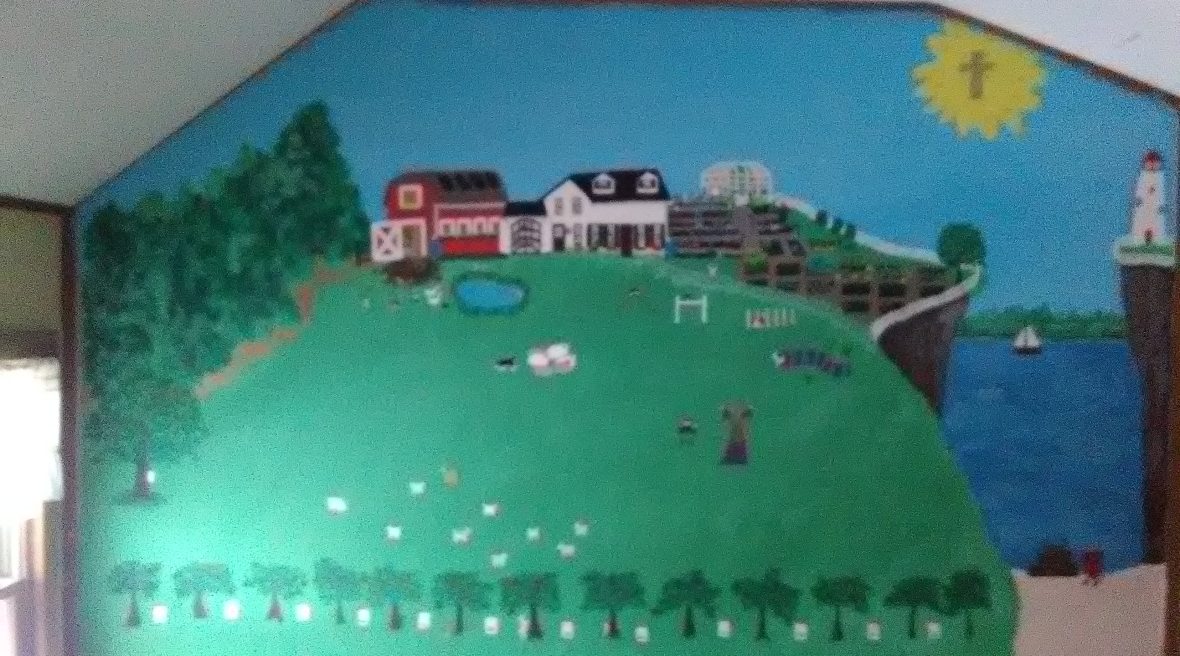
Well, we read a lot. We play board games. Scrabble is our favorite. We play cards, mostly Rummy. We took a $10 art class through the church a couple of years ago and painted our first acrylic landscapes. I came home thinking I was Monet and painted a mural on the wall of my office.

In short, living on less means getting creative and also, connecting with others. Sure, we still do a lot of screen time. Mom has a lot games downloaded onto the tablet she got for either Christmas or her birthday. I, of course, write.

Entertainment is a big chunk of expense for many people.

We don’t have a washer and dryer. I take everything to the laundromat. Yes, the machines are a bit pricy. However, my electric bill is lower. If I had town water instead of a well, my water bill would be significantly less, too. We hand wash many things, especially in the summer when they can dry outside on a line, or on a clothing rack.

We don’t have a dishwasher either. I know many so-called “experts” claim it uses less water than doing it by hand. That’s only true if you leave your faucet running non-stop instead of turning it off between rinses. What a waste of water and resources! It may seem like pennies but, those pennies add up. They’re better off in you pocket, or in an old jar to turn in at the bank when it’s full.

I save bread wrappers. I rinse them out and allow them to air dry. Then I use them for wrapping sandwiches to take to work for lunch. And, yes, I brown bag it. Unless your employer provides free lunch every day, those lunches out can add up pretty quick.

Ditto for the coffee and donuts on the way into the office. Give yourself time in the morning to eat a good breakfast and brew extra at home to pour into a travel mug. Speaking of which, that fancy Keurig machine? I won’t even allow one in the house. Ditch it. It’s costing you too much for coffee. A 40.3 oz. canister of Folger’s coffee costs $11.97 at Walmart. Each canister makes approximately 380 cups. Divide 11.97 by 380 and you get a little over .03 per cup. A 48 pack of Folger’s K-Cups costs $26.72 at Walmart. Divide $26.72 by 48 and you get around .56 per cup. Or, another way to figure it is to get the same number of cups of coffee from the K-Cups, you would have to purchase 7.9 cases of 48 at a grand total of $211.62. That’s almost $200 more for the same amount of coffee. You’re paying all that extra for convenience. A heaping tablespoon of coffee for every cup you’re brewing will produce a great-tasting cup.

When you’ve mastered freshly-brewed coffee, move onto cooking and baking from scratch. I believe there’s another blog post in the archives where I break down the savings on a loaf of homemade bread. It came out to, like, .30 per loaf.

These are just some of the things we do, or have done, to live on less. Your wallet will thank you. And, in these uncertain times, those few pennies really do add up.

May God bless you & keep you!

Animals, Bereavement, Brothers & Sisters, Christianity, Climate Change, Community, Cooking, Culture, Emergency Preparedness, Faith, Family, Fashion, Fiber Arts, Fleece, Frugality, gardening, God/Jesus, Healing, Herbs, History, Homesteading, Human rights, Humanity First, Introvert, Minimalism, Nature, Politics, Prepping, Wool, YouTube

The Call to Homestead

“I will lie down and sleep in peace, for you alone, O Lord, make me dwell in safety.” (Psalm 4:8)

The need to become more self-sufficient has moved from yearning to this almost panic-filled need. We’re running out of time. Both economic depression and the threat of nuclear war loom, and our leaders fly off to Davos to plot how to take everything away from the average working class citizen. There have been countless headlines quoting Mr. Schwab as saying we will own nothing and we will be happy about it. I’m probably paraphrasing a bit but, the overall gist is there. Yes, I can play devil’s advocate here a moment and say, sure, maybe it’s propaganda, a conspiracy theory. But, what if it isn’t? What if the goal really is a 15 minute city where we will own nothing for ourselves?

Would we be happier without ownership?

First of all, as a Christian, anything I own I do so by the grace of God. What I have truly belongs to Him. Would I be happier having those gifts taken away?

Despite the new position at the library, I’m still staring foreclosure in the face. It’s a lengthy and stressful process and there’s no guarantee that I will be successful in my endeavors. One could argue that, if I wasn’t a homeowner, this stress would not exist. I wouldn’t be fretting about losing everything that I have worked for in my life up to this point. And that is true. There’s also the multitude of repairs that fall on my shoulders as homeowner…repairs that have gotten out of hand in recent years. There’s the zoning issue still hovering over me like a black cloud. In short, the more you have, the more you stand to lose.

But, let’s spin this around a bit.

If we don’t own anything, what is the point of working, of setting goals? Whether we own a house, a car, etc. doesn’t change the fact that we still have to have food to eat. That is also true. But isn’t the purchasing of food a form of ownership? If you don’t own the place where you live, it is likely your landlord will not allow you to put in a garden. You won’t be able to raise livestock for eggs, for dairy, for meat…if you eat such things. I was a vegetarian for over 20 years. I know one can survive without consuming animal flesh. However, the loss of certain B vitamins, especially B-12, wreaks havoc with your nervous system. Stress, anxiety, depression often stem from a lack of these vitamins. And supplements are expensive. The purchase of such is also a form of ownership.

Now let’s go back to the garden. You can’t have one. You don’t own the land upon which your leased/rented home sits. What if you truly enjoy gardening? And what if you’re an introvert, like me, and the thought of a community garden makes you feel physically ill at times? If it’s not YOUR garden alone, you may be limited by what you can plant there. If you’re a herbalist like me, growing purely medicinal plants would likely be prohibited. Big Pharma doesn’t like competition, or a loss of control. So you don’t own the land. You can’t garden, which brings you joy. You can’t grow the types of food you enjoy eating. You can’t grow and make your own medicines, or even health and beauty aids. You’ll have to buy from big box stores, or online retailers. What’s in that food? That medicine? That skincare supplement?

Okay. You’re not a gardener. Maybe you like swimming in a pool, hosting backyard barbecues. Guess what? You can’t do that either. It’s not your land. And the people at Davos, who fly around in their private jets, just decreed that barbecues are environmentally unfriendly. The smoke produces too much CO2. As do cows. No steak. No hamburgers. No cheese to melt over that petrie dish substitute.

What if you’re not an outdoors kind of person at all? You don’t own your home. The landlord doesn’t allow pets. He/she doesn’t want you painting the walls. Your place isn’t big enough for a workshop to build things, like furniture. And your kitchen only consists of a microwave and a single induction burner. Baking, canning what you grew at the community garden, or cooking healthy meals is next to impossible (microwaves destroy all of the wholesome goodness in the food cooked in them). You can’t knit. Raising livestock is outlawed (that CO2 thing again) so no wool, angora, or mohair to work with. Acrylics will disappear, too, since we’re no longer drilling for oil.

Maybe you like taking the occasional long drive in the country. Yes, improvements in batteries for electric vehicles (EV) are happening all the time these days. But at what cost to the environment? No, oil and gasoline are not infinite resources. Neither are cadmium or nickel, or any other precious metal. Yes, drilling for oil does tremendous harm to the environment. But so does mining for these metals. Like coal, mountains are dug out, and run-off from the mining pollutes the soil and water. However, to get back on subject, you want to take that drive. But you don’t own a vehicle–EV or otherwise–and the EVs left at the community garage are all in use today. Sorry.

Does this sound like a happy existence?

If we own nothing, we also cease to own our joy. By owning nothing, we give up our right to choose for ourselves. I don’t know about you, but I don’t want some wrinkled up prune in Davos telling me I can’t pick a few dandelion leaves to feed to my rabbits, or even a salad for myself. I don’t want anyone telling me I can’t take a road trip someday to visit my brother in Tennessee because he’s outside of my 15 minute zone. I don’t want to eat synthetic, processed foods, or wear plastic clothing. I want the freedom to make truly healthy choices for me, my family, my pets, and my community.

I also don’t want to be at the mercy of the “system”. What happened in 2020 will last in my memory forever. The walk into the grocery store and seeing aisles of completely empty shelves. Companies, stores, libraries completely shutdown. Places of worship closed until further notice. Loved ones denied the right to say a proper “goodbye” to those they lost. The loss of employment for so many because they refused to become human guinea pigs in their real-world experiments. And now, watching so many young people–healthy, young athletes–dropping after accepting a jab to the arm as part of that experiment.

The less dependent on that “system” we are, the less that fabricated shortages, shutdowns, and experiments will hurt us. Even a window box will produce some food and reduce some of that dependence. It may not be enough to sustain you completely, but start there. Learn how to can food and pick up produce at a farmer’s market. Or even on sale at the grocery store. Learn how to make pet food from scratch. If you can, invest in a chest freezer. Find someone in your community who knows how to find and identify wild edibles. Visit your local library and check out books on the Great Depression. Or comb YouTube for videos on the same. What did our ancestors do to make it through? There is a sense of pride that comes with being able to make your own way in the world, in being able to cook from scratch, grow a few tomatoes and herbs in a pot, split wood for a fire in a stove.

There is a sense of pride in owning a home, too. Yes, you can become a slave to that ownership, especially during hard times. And there’s no denying the cost. Not everyone can afford homeownership and that is the real tragedy in our society today. Houses have gotten progressively bigger and more expensive. At the risk of sounding like one of those conspiracy theorists, perhaps that’s part of the plan from some of our leaders. But the freedom to live as one chooses is worth the fight.

Even Jesus gives us the right to choose.

May God bless you & keep you!