19th century, Abuse, Addiction, Alcoholism, Animal Rights, Animals, Appreciation, aquaponics, Art, Bereavement, Biodynamic, Birthday Wishes, Books, Brothers & Sisters, Christianity, Chronic Epstein Barr, Chronic Fatigue Syndrome, Climate Change, Compassion, compost, Cooking, Creativity, Culture, ecosystems, Emergency Preparedness, Enlightenment, Environment, Exhaustion, Faith, Family, Fashion, Fiber Arts, Fleece, Forgiveness, Friendship, Frugality, Gaia, gardening, Ghosts, Global Warming, God/Jesus, Gratitude, Grief, Hauntings, Healing, Heavy Metal Music, Herbs, History, Holidays, Holistic Health, Homesteading, illness, Irritable Bowel Syndrome, Lasagna Gardening, Lent, LGBTQ, Love, Memories, Minimalism, Mother Mary, Music, Nature, No-dig Gardening, Nostalgia, OCD, Open-mindedness, Organic, permaculture, Politics, Prayer, Reading, Recipes, Reflexology, Reiki, Religion, Rock & Roll, Scripture, Self-esteem, Self-improvement, Sleep Deprivation, Social Media, Sophia, Spinning, Spirituality, Straw Braiding, Supernatural, Touch for Health, Understanding, vermicomposting, Weaving, Wicca, Wool, Writing, Yoga & Fitness, Zero Waste

One Day At A Time

“He will keep in perfect peace all those who trust in Him, whose thoughts turn often to the Lord! Trust in the Lord God always, for in the Lord Jehovah is your everlasting strength.” (Isaiah 26:3,4)

I’m holding onto these words of encouragement. As I navigate through this forced convalesce, and watch the bills pile up, and receive letters from the new mortgage company threatening foreclosure, and the bank account getting smaller, the above passage from Scripture reminds me that He really is in control…and my faith tells me He has a plan.

Even if I can’t see it.

I’ve been on the fence about whether to sell and find land/farm in another location, somewhere a little more manageable from a financial standpoint, but also more acreage, less house. The logical, human side of my brain says, if I do default, what are my chances of being able to purchase again? I need to keep up on everything to build my credit score up. Yes, I can see that dream farm somewhere in upper-state New York, or Maine. But my “day” job is in Massachusetts. Logic is saying it’s all beyond my reach. That I need to really push back, commit to staying. And trust that He’ll get me over this rapidly-growing bump in the road.

My faith says to trust in Him…regardless of the outcome. Though it all looks impossible, nothing is impossible with God. He is not bound by human rules of equity and credit scores. And, if the opposite is His will for me, then He’ll provide whatever I need to make the next mortgage payment, car payment, etc.

He’s teaching me patience…I say this while I rail and chafe against both my limited mobility–and my limited cash flow.

More importantly, He’s teaching me to truly put my trust in Him. I have too much of a grasping nature, holding on too tightly to what I have. In short, He’s teaching me to let go.

Can I do it? This one’s a tough one. I don’t like not being in control (as if!)…or at least feeling as if I’m in control.

So, I take a deep breath…

And wait…

And fret…as only I know how to do.

And keep reminding myself that, even if I can’t see the outcome at all, He’s got this. And His ways are always perfect.

May God bless you & keep you!
https://www.gofundme.com/9fymzf-medical-leave&rcid=r01-15506107597-500376eb83394fe0&pc=ot_co_campmgmt_w

19th century, Christianity, Compassion, Culture, Enlightenment, Faith, Healing, Holidays, Love, Open-mindedness, Religion, Spirituality

Yes, It IS Merry Christmas…

“And while they were there, the time came for her baby to be born; and she gave birth to her first child, a son. She wrapped Him in a blanket and laid Him in a manger, because there was no room for them in the village inn.” (Luke 2:6-7)

In sooth, we do not know the date of Jesus’ birth. The Bible does not give a date. Not even a month to narrow it down a bit. The date of December 25th was chosen centuries ago by Rome to bring some of the pagan folks into the fold of the Church. It coincides closely with the Roman festival of Saturnalia from December 17th-23rd. For that reason, our Puritan forefathers did not keep Christmas. Nor did their Congregationalist and Baptist descendants. It was a Papist festival. And, because it tied so closely to the date of Saturnalia, they did not even acknowledge the date as anything special. Diaries and journals kept by New Englanders up until the mid-19th century recount business as usual on December 25th (Kelliher).

That being said, in other parts of the U.S., Christmas celebrations did take place. In the larger cities, like New York, Philadelphia, and even Boston, congregations of Episcopals and Catholics held Christmas services/Mass and many rural New Englanders would venture into their parishes to witness the festivities…even if they didn’t participate themselves. So New Englanders knew about Christmas. They just didn’t keep it. Not until waves of Irish Catholics, Italian Catholics, French Canadian Catholics, German and Scandinavian Lutherans, and the Dutch, who brought with them Santa Claus, arrived did we find a greater number of Christmas celebrations. This is, roughly, around 1850 or so…a whole 230 years’ after the Pilgrims first set foot on Plymouth Rock.

So, now that I, a born-again Christian, have debunked the argument for “Merry Christmas” as being part of the foundation of our country, let me go on to explain why, despite these much later traditions, December 25th is “Merry Christmas”.

First of all, while New Englanders may have been slow to embrace any Christmas remembrances, other parts of the world did celebrate it. Again, the Roman Catholic Church decreed December 25th as the birth of Christ hundreds of years’ before this country was settled. It is a holy day within the Christian community and, as such, should be respected. Our modern tendency to substitute a greeting of “Merry Christmas!” with “Happy Holidays!” is not just disrespectful, but actually hurtful to those who still keep Christmas. Of course, I can hear the inclusion/exclusion argument coming out: What about those who don’t share your/my beliefs?

What about them?

What if Hanukkah couldn’t be called Hanukkah anymore? Or Ramadan, Ramadan? What if it wasn’t a Yule log anymore but a holiday log? We can wipe away any direct reference to any holy day within any belief system with that inclusion/exclusion argument. Maybe instead of reading an offense in these direct references, we could take the time to learn about each other, our beliefs and our traditions, without feeling threatened by them. Everybody is Irish on March 17th–even if no Gaelic blood runs in your veins–and greetings of “Happy St. Patrick’s Day!” ring out along every main street in America as the annual St. Patrick’s Day parade marches by. What is it about Christmas that makes it so offensive?

Is it the name “Christ” within it?

Why?

He came to save the world. He took the sins of the world onto His shoulders and died for us. Maybe to the person reading this, that seems incredible, unbelievable. How? Because maybe that’s not what you believe, or were taught, within your community. Maybe to you, Jesus is simply a prophet but not the Son of God; I respect that view. Maybe you don’t believe in any Supreme Being at all; I respect that, too. When I wish you a “Merry Christmas!” I am not trying to convert you to my way of believing. The greeting of “Merry Christmas!” is simply a wish for peace, joy, and hope to the person being greeted with “Merry Christmas!” There is no requirement to be Christian to be wished a “Merry Christmas!” the same as everyone is Irish on St. Patrick’s Day. When I greet you with “Merry Christmas!”, I am wishing you all of the best that life has to offer. There is no offense intended.

Yet, today I, and fellow Christians, are greeted with offense, with contempt, with downright hostility for wishing someone joy, peace, hope, and even love. If I ever had any doubt that the Adversary is present in this world, it flies out the window in the face of such contempt and ridicule. It is the same sort of hate and ignorance that murdered 11 people in Pittsburgh this past October and all but annihilated the First Nations’ tribes of this country for their beliefs and traditions. In the end, we all bleed and we all hurt.

Wishing you peace, hope, joy and love sounds infinitely better.

Merry Christmas!

Works Cited

Kelliher, Tom. “Christmas by Candlelight Training Materials. Old Sturbridge Village.
19th century, Appreciation, Brothers & Sisters, Christianity, Compassion, Creativity, Culture, Faith, Fiber Arts, God/Jesus, Gratitude, Healing, Memories, Politics, Religion, Straw Braiding

Not So Very Different After All

“The Angel: Hagar, Sarai’s maid, where have you come from, and where are you going? Hagar: I am running away from my mistress. The Angel: Return to your mistress and act as you should, for I will make you into a great nation. Yes, you are pregnant and your baby will be a son, and you are to name him Ishmael (God hears), because God has heard your woes. This son of yours will be a wild one–free and untamed as a wild ass! He will be against everyone, and everyone will feel the same towards him. But he will live near the rest of his kin.” (Genesis 16:8-12)

I have wanted to share this experience for some time now. I had the most amazing experience this summer, one that has left me with so much hope and peace in my heart, that it will stay with me wherever I go.

Though I took the position of horticultural/herb garden lead at a local museum in August 2017, I spent most of the growing season in one of the households, cooking and baking on the hearth, and straw braiding. I have never considered straw braiding at all but have found that I have a natural aptitude for it. I spent most of this summer also showing others how to straw braid.

For a little background on straw braiding, this skill was typically perfected by young ladies and housewives of the 1830’s. Straw hats and bonnets were the rage and the raw material–the braided rye straw and palm leaves–was in big demand. A yard of this braided material might fetch anywhere from 1 – 3 cents per yard. Once you get the hang of this straw braiding, it doesn’t take long to reach a yard of material. And, in a time period where, due to transportational challenges (no autos; even horses weren’t owned by everyone due to expense…i.e. most people walked everywhere), you may not run to the local store every day…or even every week. In the weeks in between visits, you could easily grow a fairly long braid of, say, 100-200 yards. Especially if multiple family members worked on it in between their other chores each day. That’s anywhere from $1 to $4 in a time period where a pound of wheat flour might be 5 cents. The start-up cost was also low. Many farmers in the day grew rye for the flour to make bread; the straw was a by-product and, likely, discarded if not for being put to use for the manufacture of hats and bonnets. So many families straw braided.

It was an afternoon in early summer when I had my amazing experience. It started out like any other afternoon with me in the sitting room of the house I was working in. I remember it was a fairly busy day. I had an intern with me (student worker) and we were braiding. A young mother came in with her two teenage daughters. They were obviously of Middle Eastern descent and, upon seeing what we were doing, grew very excited and asked if they could learn how to braid. So I started a braid for each of them and demonstrated the braiding technique (7 strand braid). They caught on easily and soon had a good length started. The mother later explained that they had a business making baskets that they took to different craft shows, etc. throughout the country. We spent a good amount of time with each other.

And then the amazing thing took place.

Another family, this one obviously Orthodox Jewish, also came into the room. This time a grandmother and her three teen and pre-teen granddaughters. They, too, wanted to learn. Before long, I had one Jewish, one Muslim family, and one Christian minister (moi) all working together peacefully for a common good. In this case, the very humble endeavor of braiding straw.

Who would have thought?

In our current political climate, it seems the most amazing experience. Our media, whether you’re with “fake” or “faux” news, seems bent on keeping all peoples in separate little boxes. The idea of Christians, Muslims and Jewish peoples all getting along as the brothers and sisters we are, is toted as something impossible. I can’t think of anything sadder. Or less faith-based. But I carry forever the memory of that afternoon and feel the grace of hope that, while our leaders may never be able to bring peace and security to our lands, as always, it is the common people who will pull together as one.

May God bless you & keep you!

19th century, Appreciation, Christianity, Exhaustion, Gratitude, Homesteading, Writing

Yep, I’m Definitely a Morning Person!

“Let me sleep a little longer! Sure, just a little more! And as you sleep, poverty creeps upon you like a robber and destroys you; want attacks you in full armor.” (Proverbs 6:10-11)

My mornings can be absolutely manic: writing (both work on one of the two novels I’m writing and this blog), yoga, farm work, and the usual routine we all adopt getting ready for work work. When I give in to the temptation to “snooze” a few more minutes, that usually turn into “well, I can nix yoga today” and sleep in an extra 1/2 hour, everything in my life gets backed up. I rush around. I run through my morning. I run LATE.

Even to work work.

Not good.

I’ve tried pushing writing, farm work (and bunny playtime here (time when the rabbits come out of their cages and stretch their legs a bit)), etc. to evenings but it doesn’t seem to work that way. The truth is, after playing the part of a walking encyclopedia on the 19th century (not a lament, just what I do for a living…lol!), I am BURNT!

Write?

Yeah, I might be able to string a few words together that make sense. But work out a particularly difficult scene? Surely, you jest.

More importantly? I simply DON’T in the evening. I’m not 100% sure why that is but I simply don’t. Even on my days off, I’ve discovered, if I don’t get moving before the sun rises, I don’t get moving at all and I waste the day. So I’m back to my 3:30 a.m. rising time. (Yes, you read that right)

And it feels GREAT!

Yesterday morning, I worked on my neglected adult novel for almost an hour, hit the yoga mat, took care of my “15 minutes” task that I blogged about in an earlier post, took care of all my animals, let the buns out of their cages for awhile…and managed to get to work early. How’s that for being on top of one’s game? I even enjoyed a cup of tea while I wrote and prayed the rosary on my way to work. Definitely an improvement over my usual stressed out drive, glancing frantically at the dashboard clock as time rapidly slips away, and praying by some miracle that I’ll make it into the parking lot by 8:25 instead of 8:30; thus, giving myself time to walk the distance into check in. (And, yes, that run-on sentence was intentional…) That’s been the story of my life for the last several months and probably the biggest reason I’ve been rundown. It’s been eat, sleep and race ahead to work work with no semblance to the life that I lived prior to my latest career move. Writing and homesteading are what makes me whole; without them, I’m not really me. I’ve been neglecting myself, my personal needs. I’ve even been neglecting Him a bit lately. Talk about chaos…

It’s good to be back.

May God bless you and keep you!

19th century, Appreciation, Cooking, Exhaustion, Fiber Arts, Frugality, History, Homesteading, illness, Sleep Deprivation, Spinning, Weaving

Reflections: A Year in Living History

“He said to His disciples, ‘Therefore I tell you, do not worry about your life and what you will eat, or about your body and what you will wear. For life is more than food and the body more than clothing. Notice the ravens: they do not sow or reap; they have neither storehouse nor barn, yet God feeds them. How much more important are you than birds!” (Luke 12:22-24)

Okay. So it’s been more like 14 months since I landed a position in living history; my 1-year anniversary was August 14th. But c’est la vie! Better late than never…

That should be the battle cry of my life these days: a 40-hour work week; 2-hour daily commute; 15-20 hours a week devoted to college studies, and another 15-20 hours devoted to farm work/life = severe sleep deprivation and a perpetual race through life…followed by two days’ off catatonic in the easy chair, dozing, and wishing I could find the energy to get X,Y,Z done. In short, I’m a little over-extended on time, rundown and exhausted. My first reflection on a year in living history is that I’ve caught every cold, flu, and malady that walks through the museum. I’ve heard that it’s to be expected, especially this first year, when working with the public but that doesn’t make it any easier to bear; I get impatient with illness and a “rundown” diagnosis. In some ways, that’s a lament; in others, there’s still a side of me that feels privileged to have spent a little more than a year learning all sorts of unique skills and talents. Now, if we could just create a 28 hour day, I might get that 8 hours of sleep the doctors (and Mom!) are always yammering at me; 6 is more my average.

So, I guess that’s it for my first reflection. ZZZZzzzz……

(Chuckle)

On a more positive note, I’ve learned to make some beautiful pie crusts. And I’m not at all modest about it. (grin) There’s something to be said for such humble accomplishments.

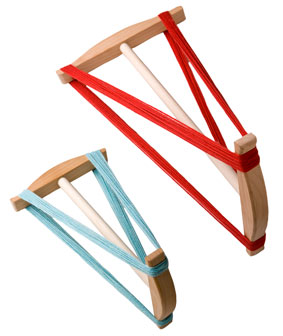
I’ve also learned how to spin on a Great Wheel, which, of course, is now on my wish list. The Walking Wheel/Great Wheel is so much easier than today’s modern treadle-powered models. Once I get going, it’s like zen time. Ditto for the loom. There is something very satisfying in seeing the yarn that you’re creating filling yet another spindle, increasing on the niddy-noddy:

Or the cloth that you’ve helped to weave being put into service as toweling in some of the buildings you work in. I dream of the day I have a loom of my own at home and can produce bedspreads, sheeting, towels, and fabric for clothing of my own. It may seem like “too much work,” to quote my beloved Aunt Margie, but, for me, it is immensely satisfying to work with my hands in such a way and see the fruits of that labor.

Spinning and weaving were kind of a given. I would’ve gotten down on hands and knees and begged to learn. Straw braiding has come as something of a surprise. Young women often braided rye straw to earn extra income. The straw is a by-product from growing rye in the fields, rye that eventually goes to the grist mill to be made into flour for making bread and pie crusts and such. The braiding was used to make straw hats, which were all the rage in the 19th century. I’ve discovered a knack for it and, while the braiding usually went to a local store to then be sold to a hat maker (i.e. the young ladies didn’t typically make the hats themselves), I find myself wondering if I could make a more modern straw sunbonnet from start to finish, from braid to the finished product adorned with flowers and ribbons. I have rye seed in the cupboard downstairs (great winter cover crop). Another humble goal, but a goal nonetheless.

“Period correct” is the answer and reason for everything…even in contradictions. “Ye women must not endeavor to learn tinsmithing or pottery; ’twas a man’s province ’twas. ‘Twouldn’t be ‘period correct’ to see a lady punching a pattern in a lantern nor shaping clay upon the potter’s wheel.” Of course, it wouldn’t be ‘period correct’ to see a lady behind the counter serving customers in the local country store either but we have the lasses in abundance at our store. Nor would it be ‘period correct’ to see a Christmas tree on the town common in the 1830’s. But we must not walk about without a bonnet, or with our sleeves rolled up, because it wouldn’t be ‘period correct’ for a lady to risk getting a tan, or a sunburn. (Gasp!)

And yet, I’ve found at least one unsung hero of the time period: Lydia Maria Child, who penned “Over the River and Through the Woods,” wrote numerous cookbooks, advice books and novels, campaigned to end slavery, the displacement of the First Nations’ peoples and fought for a woman’s right to vote. She was also the editor of a youth magazine called “The Juvenile Miscellany.” Her husband, an attorney, lost his practice once his anti-slavery views were made known, just as “The Juvenile Miscellany” went belly up for the same reason. Yet, David Lee Child continued to work with such notable figures as William Lloyd Garrison and Fredrick Douglass to end slavery. And, unusual for their time, Lydia Maria supported the couple through her continued writing and publishing. Her books on thrift and economy hold time-honored nuggets of wisdom that we could all learn from today. You may be hearing more about this extraordinary lady in the upcoming months, albeit spotty posts created in between the cat naps. (chuckle)

May God bless you & keep you!

REFERENCES

KnitPicks.com (n.d.) “Niddy Noddys from KnitPicks.com.” Image. Retrieved October 2, 2018 from: https://www.google.com/search?q=niddy+noddy+image&rlz=1C1OPRA_enUS563US627&tbm=isch&tbo=u&source=univ&sa=X&ved=2ahUKEwj-l9OFhejdAhVMoFMKHYHjAyIQsAR6BAgAEAE&biw=1366&bih=657#imgdii=hk0xviP0etfv0M:&imgrc=kIabqBrkBNwUFM:

19th century, Appreciation, Chronic Fatigue Syndrome, Fiber Arts, Fleece, Gratitude, Healing, History, Homesteading, Self-improvement, Weaving

Cycles of CFS

“I will fix a place for my people Israel; I will plant them so that they may dwell in their place without further disturbance. Neither shall the wicked continue to afflict them as they did of old, since the time I appointed judges over my people Israel. I will give you rest from all your enemies. The Lord also reveals to you that He will establish a house for you.” (2 Samuel 7:10-11)

Rest.

When you’re dealing with Chronic Fatigue Syndrome, the need for rest, or the ability to sleep on a dime, can creep up on you at any given moment. Changes in daily routine, work schedules, etc. can wreak havoc very quickly. And it takes forever to “catch up”, as if we ever can.

Knowing better, I still stayed up a little later than usual last week. I think I went to bed around 11:30 Sunday evening. For someone who habitually gets up between 3:30 and 4:30 each morning, that is definitely NOT enough sleep time. So, as I was off work Monday, I slept in until 7:30-ish. It’s been a few days of insomnia, trying to get back on an early to bed routine…and a struggle to get out of bed even before 5 a.m. Of course, then there’s the frantic push to get goats, cats, rabbits, chickens, ducks and Smoky the Cockatiel fed and watered for the day…while “skating” across the rink that is my barnyard in this week’s deep freeze.

Why do I torture myself this way???

I had my second lesson in textiles this week, too. Thursday was weaving. I loved it, loved everything I was learning. And both instructors made it interesting and fun. Every time we sat down to go over something in our binder of notes, whether it was terminology or learning to read weaving patterns from the 1830’s, I was struggling to stay awake. I hope neither instructor thought it was a fault of her teaching; far from it! A part of me was pumped to learn everything and anything; the sick side of me dealing with Chronic Fatigue Syndrome, and the brief moment of insanity that decided to play Pyramid Solitaire for an extra hour or two Sunday night, left me nodding. It’s the nature of the beast.

There are days when I can’t help but cry out, “Lord, please slay this beast!”

But, if I had listened to that little voice that said, “Hello? It’s time for bed” a few hours’ earlier, the beast would’ve never reared it’s ugly head. Praise the Lord for this storm; there’s a lesson in managing this beast better.

May God bless you & keep you!

19th century, Appreciation, Art, Creativity, Fiber Arts, Fleece, Gratitude, History, Homesteading, Scripture, Spinning, Weaving, Wool

Spinning Wheels Got to Go Round

“Now in Joppa there was a disciple named Dorcas. She was completely occupied with good deeds and almsgiving. Now during those days she fell sick and died, so washing her, they laid her out in a room upstairs. Since Lydda was near Joppa, the disciples, hearing that Peter was there, sent two men to him with the request, ‘Please come to us without delay.’ So Peter got up and went with them. When he arrived, they took him to the room upstairs where all the widows came to him weeping and showing him the tunics and cloaks that Dorcas had made while she was with them. Peter sent them all out and knelt down and prayed. Then he turned to her body and said, ‘Tabitha, rise up.” She opened her eyes, saw Peter, and sat up. He gave her his hand and raised her up, and when he had called the holy ones and the widows, he presented her alive.” (Acts 9:36-41)

In the Catholic faith, when you make your Confirmation, you choose a new name. This isn’t a legal name. It’s usually a name from either Scripture or one of the saints. And, in essence, by choosing the name, you are choosing your patron saint.

I chose Tabitha.

In a world where churches are lucky to be half-full on a Sunday morning, and everyone spends more time in front of the boob tube than reading the Bible, you can imagine the quandary this choice created. Even my own mother thought I was choosing a “witch name,” as she called it. In her defense, some translations of the Bible do not mention the name “Tabitha” when recounting the story of Dorcas. And, of course, Elizabeth Montgomery immortalized the name when, as Samantha Stevens in the old sitcom, “Bewitched”, she and husband, Darren, christened their daughter, Tabitha. Who, of course, like her mother, could twitch her nose to make things happen.

I chose the name because the story represented to me a rebirth, much like the one that occurs when you accept Jesus Christ as your Savior. And Dorcas received a new name just like I was in being confirmed.

However, just as some translations don’t mention Tabitha, the Catholic Bible I quoted from at the beginning of this post, only touches on the fact that Dorcas/Tabitha was a seamstress. She sewed and spun and wove fine garments for people in need. This translation has the widows showing Peter some of the garments she made for them, but the translation states instead that she “was completely occupied with good deeds.” I like the other translation better. And, maybe it’s not just the story of rebirth but the humble tasks this dear lady used to help those in need that won my heart and led me to choose her for a patron saint.

Thursday I had my first lesson on the Great Wheel, the Spinning Wheel, the Walking Wheel at work. It has many names; all of them correct. Wool did not traditionally get spun on the little treadle fed spinning wheels we see at the local “Sheep to Shawl” competitions at our local Ag fair. Those portable little wheels more closely resemble a flax wheel. And flax may “Someday” become a crop here at The Herbal Hare Homestead…definitely if this homestead eventually relocates, which is a tentative plan on the horizon (more on that later…). But, for now, I’m spinning wool.

On a Great Wheel.

And loving it.

I’ve tried my hand a few times on the more modern pseudo-flax wheel; I much prefer the Walking Wheel. First of all, it’s a simpler rhythm. And I chose the word rhythm on purpose because the “walk” is almost like a dance as you step to the left while angling the roll of wool away from the spindle, pull it out to thin out the clumps, give the great wheel a turn with your right hand to strength those thinner areas on the roll then give it another gentle stretch. A couple of more turns of the great wheel then we step to the right, turn the wheel slightly in the opposite direction to bring the now yarn up onto the “cone” of the spindle (wound yarn that has built up on the opposite end of the spindle from where we spin it; best way I can describe it) and then slowly step forward while turning the wheel clockwise again to roll the yarn up and back to the left again. Your feet form an almost perfect triangle.

It’s all in the feel, as the wonderful ladies who have been teaching me tell us. Us, because there are 5 of us learning this wonderful art. What wonderfully encouraging instructors we have, too! I was prepared to beg for some practice time towards the end of the day yesterday but I need not have worried. Both ladies were willing to accommodate. And one of them told me yesterday that I was doing very well; I hope so. This is one skill, this and next week’s weaving class, that I really want to master. I suspect every spare moment, if possible, I will be trying to sneak in some practice. I may have to comb some estate sales and auctions. I am envisioning a Great Wheel here at The Herbal Hare Homestead…albeit, I’ll be doing this spinning “dance” to some music. I’m not sure yet what effect spinning yarn while listening to Megadeth will have…

May God bless you & keep you!

19th century, Appreciation, Fashion, Homesteading, Nostalgia

Sexy 19th Century Herbalist

“Your adornment should not be an external one: braiding the hair, wearing gold jewelry, or dressing in fine clothes, but rather the hidden character of the heart, expressed in the imperishable beauty of a gentle and calm disposition, which is precious in the sight of God'” (1 Peter 3:3-4)

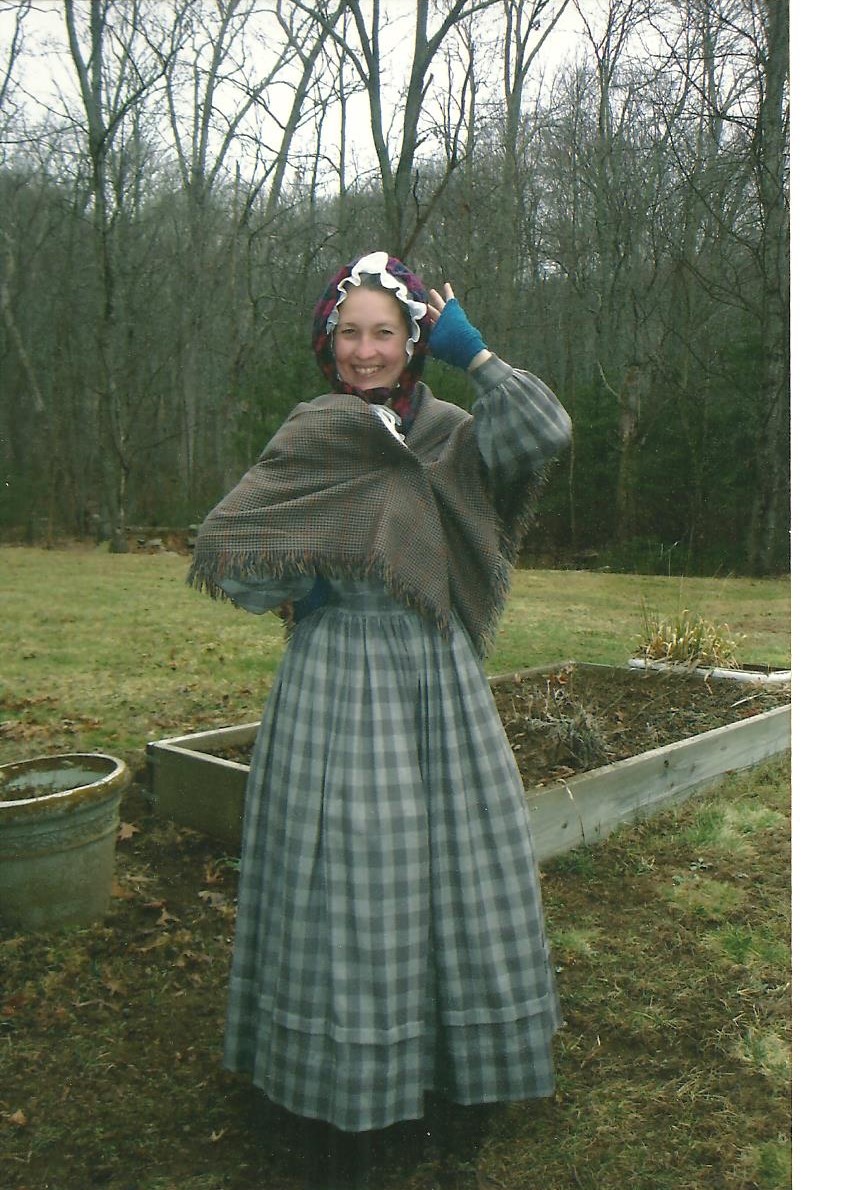
Well, there’s certainly no jewelry here; it wouldn’t be period correct. However, the clothing is, in my not-so-humble opinion, finer than anything modern that I’ve ever worn. (I could do without the white cap though…) I always feel my best when I step out in one of my work outfits. Whether that’s because it’s sort of like becoming another person in another time, or else I’ve reincarnated from this time period and this is like donning my second skin. Either way, comfort is the name of the game…and 19th century attire is extremely comfortable. And feminine. (Again, omit the frilly, white cap; I’d rather have my incredible shrinking hair loose, not bound)

This photograph was found during that trip down memory lane through my cedar chest filled with photographs and keepsakes. I’m pretty sure it wouldn’t make the cover of Vogue or Vanity Fair but c’est la vie!

May God bless you & keep you!

19th century, Appreciation, Cooking, Faith, Gratitude, History, Nature, Prayer, Religion, Scripture, Self-improvement, Spirituality

Remembering the Sabbath

“Remember to keep holy the Sabbath day. Six days you may labor and do all your work, but the seventh day is the Sabbath of the Lord, your God. No work may be done then either by you, or your son or daughter, or your male or female slave, or your beast, or by the alien who lives with you.” (Exodus 20:8-10)

Remember the Sabbath day…and leave your cellphones, your tablets, etc. at the door. Seriously. There is nothing on your device that is more important than the message being spoken in church, regardless what church/denomination we are talking. I know I’ve preached this before. At least twice, in fact. But it bears continuous repeating. The enemy of our soul looks for any and every opportunity to distract us from God, our Father. Distracted worship ought to be outlawed like distracted driving is in many states (even if, like Connecticut, it isn’t strictly enforced…). We keep taking God out of the picture…and then wonder why the world is in such chaos.

Of course, if you’re an emergency worker, leaving your cell at the door isn’t a viable option; I get that. However, it should be on vibrate and in a pocket or a purse…not in your hand while you peruse your email messages or Facebook posts. Being on emergency call doesn’t equal a “get-out-of-church-free” card. The Lord wants us there, not just physically, but mentally, emotionally, and above all, spiritually.

And, while some may argue that they listen better when they’re on their cell (I’ve heard reasons of the mind not wandering as much), the light from your cell may be a distraction to fellow parishioners. You wouldn’t like someone playing on their cellphone and lighting up the movie theater after you paid top dollar for that latest blockbuster hit.

Jesus paid with something much more valuable than that “top dollar”; He paid with His blood, with His very life for us. And His word is far more compelling and important than any movie.

In most cases, it is only an hour of your time. I am reminded of Mark, Chapter 14, when Jesus was undergoing His agony in the Garden of Gethsemane. He asked Peter, James and John to keep watch:

“When He returned, He found them asleep. He said to Peter, ‘Simon, are you asleep? Could you not keep watch for one hour? Watch and pray that you may not undergo the test. The spirit is willing but the flesh is weak.'” (Mark 14:37-38)

If one hour is too much time, be thankful this isn’t 19th century New England. Though the Puritan church of the 17th century had all but disbanded and compulsory attendance with it, 19th century Congregationalists (descended from the Puritans) spent two hours in the morning, took an hour to an hour and a half dinner break, and spent two more hours in the afternoon in worship service. There were no stoves/hearths in the church. Your meal was cold…because cooking was work and that wasn’t allowed on the Sabbath. And yet, people attended willingly. Today that may seem crazy to some but it is only one example of how the further away we get from nature and an agrarian lifestyle, the further away from Him we also get.

“Ever since the creation of the world, His invisible attributes of eternal power and divinity have been able to be understood and perceived in what He has made. As a result, they have no excuse.” (Romans 1:20)

There’s a bigger sermon growing from this…but for today, let us walk through those church doors with naught but our Bible in hand and His love on our hearts. Let us sit in comfort in a church that is typically well-heated with a modern day HVAC system…and go home to a hot meal. Let us remember the many blessings He has given us…yes, even modern technology, to enjoy after the sermon.

May God bless you & keep you!

19th century, Appreciation, Art, Cooking, Creativity, Gratitude, History, Homesteading, Minimalism

A Different Sort of Art

“Wisdom has built her house, she has set her seven columns; she has dressed her meat, mixed her wine, yes, she has spread her table” (Proverbs 9:1-2)

We hear of plenty of feasts in the Bible but the lowly cook, or baker, is seldom mentioned. Granted, cooking and baking is rather commonplace. Doubtless, there seemed little purpose in mentioning whether or not a feast was tasty or not when stacked up alongside of Jesus’ miracles, or the words of wisdom spoken by the prophets of old. Yet, we all must eat and drink to survive. Who among us, when given a choice, would not choose that fresh, vibrantly-leafed spinach salad over the pale, lifeless and wilted specimen from a can? And who hasn’t grumbled over a meal that didn’t come out “just right”? Though commonplace, the chemistry and magick that is cooking and baking is nothing short of a miracle in itself.

Today such miraculous wizardry is being lost to packaged, processed convenience. The result is unhealthy people and animals, and an unhealthy planet from all of the plastic wrappings. We have lost touch with our food. And that’s a sad thing.

I remember years’ ago, when I first got rid of the microwave once and for all, wanting a bowl of popcorn and finding only microwave popcorn in my larder. It actually set me into a bit of a quandary. I think that was my first real step away from processed foods. I bought a bag of old-fashioned popping corn (at a fraction of the cost of a box of microwavable popcorn!), heated some olive oil on the stove and gently shook the covered sauce pan back and forth until it all popped. The lifeless cardboard that is microwave popcorn has never been seen–or eaten–at The Herbal Hare Homestead again.

Since then, I’ve spent a number of winters learning how to cook and bake from scratch, searching through numerous cookbooks and trying new recipes; some came out well, some not so well. But I learned. Eventually, I purchased a cookbook by Alana Chernila entitled: The Homemade Pantry: 101 Things You Can Stop Buying and Start Making; it was a gold mine. Everything from a delectable recipe for baked mac n cheese to homemade marshmallow fluff. And, before any modern folks complain about the time lost in cooking, it is time much better spent than sitting before the boob tube. In fact, for me, it became a sort of “zen” time, a time to cast aside any worry or complaint and just “be”. It recharged the mental and emotional batteries…and the end results recharged me physically. Who wouldn’t feel completely blessed sitting before a roaring wood stove with a bowl of homemade lentil soup, fresh-baked rye bread and, while it came from a local package store rather than my bees, a glass of smooth mead while the snow piles up outside your window? (I haven’t tried my hand at homemade mead yet…stay tuned for future endeavors)

Microwaves, dish washers and Keurig machines are banned here at The Herbal Hare Homestead. But I still use an electric stove, toaster oven, drip coffee machine and even a bread machine. There are no plans to replace the latter once it burns out but these are the tools of modern cooking and baking from “scratch”.

Now, as I meander through 19th century cooking and baking at my job, I’m finding a new level of zen in antiquated kitchens…and discovering a whole new meaning to the phrase “cooking and baking from scratch”. Coffee doesn’t go through the drip machine–or even the percolator my grandmothers used. Raw, green coffee beans are roasted on the fire, sending out an aroma that puts the drip machine to shame; the dough is set to rise overnight in the bread box–a long wooden vessel that resembles an infant’s cradle–and then, as the fire is lit and kept roaring in the bake oven for, roughly, 3 hours before being ready for baking, is kneaded by hand and set to bake on the bricks. I am amazed at what 19th century women accomplished with little more than a fire, a kettle or two, a “spider” (skillet with legs)…and maybe some sturdy twine to dangle your meat over the flames to slow roast. They didn’t use (or need) fancy gadgets or tools, and yet, they created small miracles, small masterpieces of art everyday. Cooking and baking claimed much of a woman’s morning and early-afternoon in the 19th century (kitchen fires were typically banked after the midday meal and cold leftovers, or bread and cheese sandwiches, served as a light repast before bed). Few women worked outside the home (though factories were changing that for a younger generation of ladies) so “convenience” food was relegated to cold pies and bread, and the beans you baked overnight on Saturday to be eaten for the Sabbath. (Any “unnecessary” work was avoided on Sundays…and that included cooking and baking.) Cooking in a kitchen where all I have to do is turn a dial to get an electric “flame” seems almost like cheating now. (I wonder if 19th century clergy would consider our modern methods “work”…)

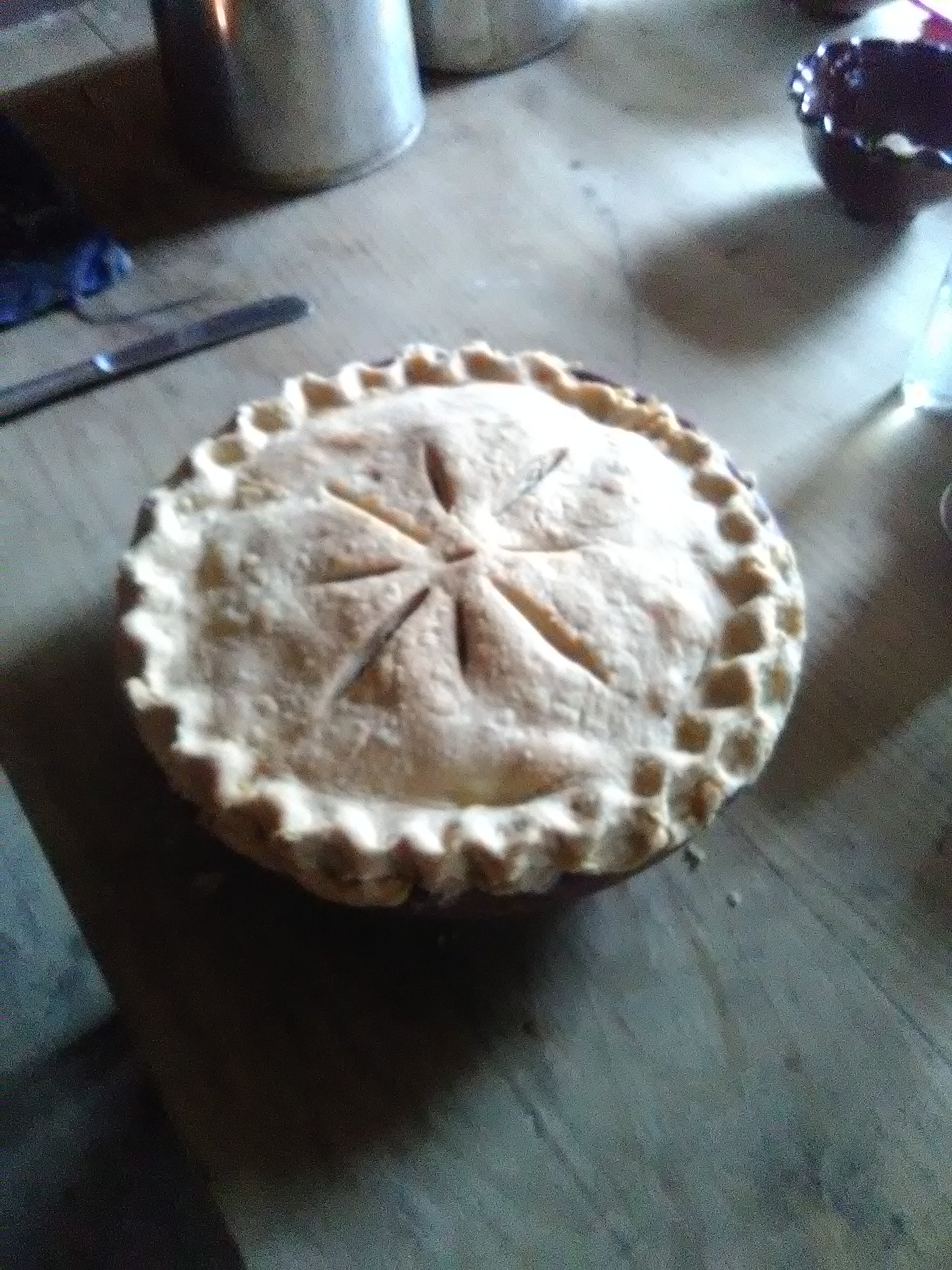
I created my own masterpiece on a 19th century hearth. This was baked in a kettle instead of a bake oven. And, while it won’t merit the term “miraculous” in any biblical terms, still, I’m claiming some bragging rights. (And, yes, I know all about the sin of pride…even we ministers have human failings…)

May God bless you & keep you!

REFERENCES

Chernila, A. (2012). The Homemade Pantry: 101 Things You Can Stop Buying and Start Making. New York: Clarkson Potter.