Abuse, Alcoholism, Art, Chronic Epstein Barr, Chronic Fatigue Syndrome, Cooking, Faith, Gratitude, Healing, Homesteading, illness, Irritable Bowel Syndrome, OCD, Prayer, Religion, Scripture, Self-esteem, Self-improvement, Spirituality, Writing

Embracing the Imperfect

“Although if I should wish to boast, I would not be foolish, for I would be telling the truth. But I refrain, so that no one may think more of me than what he sees in me or hears in me because of the abundance of the revelations. Therefore, that I might not become too elated, a thorn in the flesh was given to me, an angel of Satan, to beat me, to keep me from being too elated. Three times I begged the Lord about this, that it might leave me, but He said to me, “My grace is sufficient for you, for power is made perfect in weakness.” I will rather boast most gladly of my weaknesses, in order that the power of Christ may dwell with me.” (2 Corinthians 12:6-9)

We all have things that we could boast about without looking foolish. Maybe you’re one of the most brilliant surgeons in the country and have helped heal countless other people…or animals, if a veterinary surgeon. Maybe you’re an awesome cook. Or have a beautiful singing voice. Our gifts are countless. And, yes, since He gave you these gifts in the first place, He also uses them to heal the sick, feed the hungry, and bring joy to many.

But, guess what?

That surgeon is also late to every appointment. The cook is nipping the cooking sherry while whipping up the filet mignon. And the singer is dyslexic. Sort of makes all of their accomplishments that much more awe-inspiring, doesn’t it?

And that’s the point.

God doesn’t just use our gifts. He uses our imperfections, too. If everything ran smoothly all of the time, would we notice His miracles? Would we understand that it’s all about Him and not about us? If we were all perfect in every way, would we even think to worship God? So He uses our imperfections. He uses them to further His Kingdom. When we, who are broken, are made whole through Christ, it forces the unbeliever to take notice. Sure, they may scoff and sneer, especially if we give the credit where it’s due for our success. But they notice the accomplishment. And are amazed at the adversities overcome to achieve that success. They may not suddenly become believers. But there’s a seed planted. And God will cause it to bloom in His own time.

Do you notice something though? Despite whatever He helps us to accomplish in our lives, those thorns never really go away. I may be a minister, a writer, an artist and a homesteader. But I am also a survivor of child molestation, an eternal procrastinator and I’m perpetually running late, running behind. I’m terrified of flying. I deal with depression and anxiety, low self-esteem and confidence issues, acid reflux, Chronic Fatigue Syndrome, Irritable Bowel Syndrome, Obsessive Compulsive Disorder, Obsessive Compulsive Psychological Disorder, and Chronic Epstein-Barr. I’m showing you my brokenness…and thanking Him for all of it: the gifts and the thorns. But especially the thorns. Because that’s what people need to see. Those thorns are blessings in disguise. And there are others with those same thorns in their sides who need to hear that they are not alone. So, whatever adversities you are working with, thank Him.

Because there’s a silver lining behind that cloud. There always is.

May God bless you & keep you!
19th century, Appreciation, Cooking, Faith, Gratitude, History, Nature, Prayer, Religion, Scripture, Self-improvement, Spirituality

Remembering the Sabbath

“Remember to keep holy the Sabbath day. Six days you may labor and do all your work, but the seventh day is the Sabbath of the Lord, your God. No work may be done then either by you, or your son or daughter, or your male or female slave, or your beast, or by the alien who lives with you.” (Exodus 20:8-10)

Remember the Sabbath day…and leave your cellphones, your tablets, etc. at the door. Seriously. There is nothing on your device that is more important than the message being spoken in church, regardless what church/denomination we are talking. I know I’ve preached this before. At least twice, in fact. But it bears continuous repeating. The enemy of our soul looks for any and every opportunity to distract us from God, our Father. Distracted worship ought to be outlawed like distracted driving is in many states (even if, like Connecticut, it isn’t strictly enforced…). We keep taking God out of the picture…and then wonder why the world is in such chaos.

Of course, if you’re an emergency worker, leaving your cell at the door isn’t a viable option; I get that. However, it should be on vibrate and in a pocket or a purse…not in your hand while you peruse your email messages or Facebook posts. Being on emergency call doesn’t equal a “get-out-of-church-free” card. The Lord wants us there, not just physically, but mentally, emotionally, and above all, spiritually.

And, while some may argue that they listen better when they’re on their cell (I’ve heard reasons of the mind not wandering as much), the light from your cell may be a distraction to fellow parishioners. You wouldn’t like someone playing on their cellphone and lighting up the movie theater after you paid top dollar for that latest blockbuster hit.

Jesus paid with something much more valuable than that “top dollar”; He paid with His blood, with His very life for us. And His word is far more compelling and important than any movie.

In most cases, it is only an hour of your time. I am reminded of Mark, Chapter 14, when Jesus was undergoing His agony in the Garden of Gethsemane. He asked Peter, James and John to keep watch:

“When He returned, He found them asleep. He said to Peter, ‘Simon, are you asleep? Could you not keep watch for one hour? Watch and pray that you may not undergo the test. The spirit is willing but the flesh is weak.'” (Mark 14:37-38)

If one hour is too much time, be thankful this isn’t 19th century New England. Though the Puritan church of the 17th century had all but disbanded and compulsory attendance with it, 19th century Congregationalists (descended from the Puritans) spent two hours in the morning, took an hour to an hour and a half dinner break, and spent two more hours in the afternoon in worship service. There were no stoves/hearths in the church. Your meal was cold…because cooking was work and that wasn’t allowed on the Sabbath. And yet, people attended willingly. Today that may seem crazy to some but it is only one example of how the further away we get from nature and an agrarian lifestyle, the further away from Him we also get.

“Ever since the creation of the world, His invisible attributes of eternal power and divinity have been able to be understood and perceived in what He has made. As a result, they have no excuse.” (Romans 1:20)

There’s a bigger sermon growing from this…but for today, let us walk through those church doors with naught but our Bible in hand and His love on our hearts. Let us sit in comfort in a church that is typically well-heated with a modern day HVAC system…and go home to a hot meal. Let us remember the many blessings He has given us…yes, even modern technology, to enjoy after the sermon.

May God bless you & keep you!

19th century, Appreciation, Art, Cooking, Creativity, Gratitude, History, Homesteading, Minimalism

A Different Sort of Art

“Wisdom has built her house, she has set her seven columns; she has dressed her meat, mixed her wine, yes, she has spread her table” (Proverbs 9:1-2)

We hear of plenty of feasts in the Bible but the lowly cook, or baker, is seldom mentioned. Granted, cooking and baking is rather commonplace. Doubtless, there seemed little purpose in mentioning whether or not a feast was tasty or not when stacked up alongside of Jesus’ miracles, or the words of wisdom spoken by the prophets of old. Yet, we all must eat and drink to survive. Who among us, when given a choice, would not choose that fresh, vibrantly-leafed spinach salad over the pale, lifeless and wilted specimen from a can? And who hasn’t grumbled over a meal that didn’t come out “just right”? Though commonplace, the chemistry and magick that is cooking and baking is nothing short of a miracle in itself.

Today such miraculous wizardry is being lost to packaged, processed convenience. The result is unhealthy people and animals, and an unhealthy planet from all of the plastic wrappings. We have lost touch with our food. And that’s a sad thing.

I remember years’ ago, when I first got rid of the microwave once and for all, wanting a bowl of popcorn and finding only microwave popcorn in my larder. It actually set me into a bit of a quandary. I think that was my first real step away from processed foods. I bought a bag of old-fashioned popping corn (at a fraction of the cost of a box of microwavable popcorn!), heated some olive oil on the stove and gently shook the covered sauce pan back and forth until it all popped. The lifeless cardboard that is microwave popcorn has never been seen–or eaten–at The Herbal Hare Homestead again.

Since then, I’ve spent a number of winters learning how to cook and bake from scratch, searching through numerous cookbooks and trying new recipes; some came out well, some not so well. But I learned. Eventually, I purchased a cookbook by Alana Chernila entitled: The Homemade Pantry: 101 Things You Can Stop Buying and Start Making; it was a gold mine. Everything from a delectable recipe for baked mac n cheese to homemade marshmallow fluff. And, before any modern folks complain about the time lost in cooking, it is time much better spent than sitting before the boob tube. In fact, for me, it became a sort of “zen” time, a time to cast aside any worry or complaint and just “be”. It recharged the mental and emotional batteries…and the end results recharged me physically. Who wouldn’t feel completely blessed sitting before a roaring wood stove with a bowl of homemade lentil soup, fresh-baked rye bread and, while it came from a local package store rather than my bees, a glass of smooth mead while the snow piles up outside your window? (I haven’t tried my hand at homemade mead yet…stay tuned for future endeavors)

Microwaves, dish washers and Keurig machines are banned here at The Herbal Hare Homestead. But I still use an electric stove, toaster oven, drip coffee machine and even a bread machine. There are no plans to replace the latter once it burns out but these are the tools of modern cooking and baking from “scratch”.

Now, as I meander through 19th century cooking and baking at my job, I’m finding a new level of zen in antiquated kitchens…and discovering a whole new meaning to the phrase “cooking and baking from scratch”. Coffee doesn’t go through the drip machine–or even the percolator my grandmothers used. Raw, green coffee beans are roasted on the fire, sending out an aroma that puts the drip machine to shame; the dough is set to rise overnight in the bread box–a long wooden vessel that resembles an infant’s cradle–and then, as the fire is lit and kept roaring in the bake oven for, roughly, 3 hours before being ready for baking, is kneaded by hand and set to bake on the bricks. I am amazed at what 19th century women accomplished with little more than a fire, a kettle or two, a “spider” (skillet with legs)…and maybe some sturdy twine to dangle your meat over the flames to slow roast. They didn’t use (or need) fancy gadgets or tools, and yet, they created small miracles, small masterpieces of art everyday. Cooking and baking claimed much of a woman’s morning and early-afternoon in the 19th century (kitchen fires were typically banked after the midday meal and cold leftovers, or bread and cheese sandwiches, served as a light repast before bed). Few women worked outside the home (though factories were changing that for a younger generation of ladies) so “convenience” food was relegated to cold pies and bread, and the beans you baked overnight on Saturday to be eaten for the Sabbath. (Any “unnecessary” work was avoided on Sundays…and that included cooking and baking.) Cooking in a kitchen where all I have to do is turn a dial to get an electric “flame” seems almost like cheating now. (I wonder if 19th century clergy would consider our modern methods “work”…)

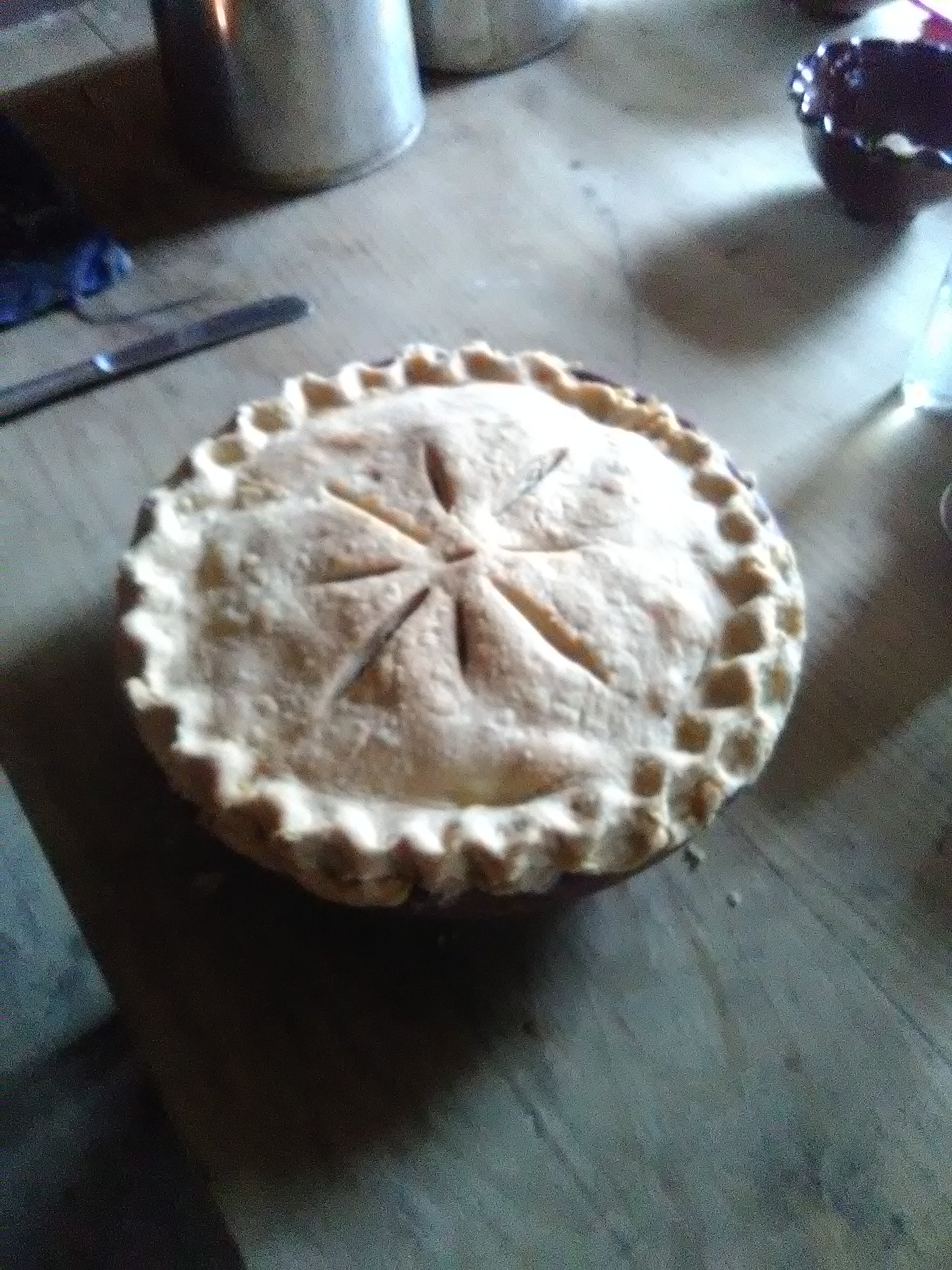
I created my own masterpiece on a 19th century hearth. This was baked in a kettle instead of a bake oven. And, while it won’t merit the term “miraculous” in any biblical terms, still, I’m claiming some bragging rights. (And, yes, I know all about the sin of pride…even we ministers have human failings…)

May God bless you & keep you!

REFERENCES

Chernila, A. (2012). The Homemade Pantry: 101 Things You Can Stop Buying and Start Making. New York: Clarkson Potter.

19th century, Abuse, Addiction, Alcoholism, Animal Rights, Animals, Appreciation, aquaponics, Biodynamic, Chronic Epstein Barr, Chronic Fatigue Syndrome, compost, Cooking, Creativity, ecosystems, Environment, Faith, Fashion, Forgiveness, Friendship, Frugality, gardening, Ghosts, Gratitude, Hauntings, Healing, Herbs, History, Holistic Health, Homesteading, Irritable Bowel Syndrome, Lasagna Gardening, Minimalism, Nature, No-dig Gardening, OCD, Organic, permaculture, Politics, Prayer, Reading, Recipes, Reflexology, Reiki, Religion, Self-esteem, Self-improvement, Spirituality, Supernatural, Touch for Health, vermicomposting, Wicca, Writing, Yoga & Fitness, Zero Waste

My Apologies for the Delay…

Good morning (or whatever time of day it is in your part of the world…)

In the middle of some major “renovations” here on this blog. As soon as they are completed, I will certainly include more information about them. For the time being, I thank everyone for their patience. New content will be added soon.

In the meantime, keep working towards that faith-filled, sustainable and compassionate future. We CAN be the change we wish to see in the world.

May God bless you & keep you!

19th century, Appreciation, Cooking, Faith, Gratitude, Homesteading, Religion, Spirituality, Writing

Time…A Precious Commodity

“He will keep in perfect peace all those who trust in Him, whose thoughts turn often to the Lord! Trust in the Lord God always, for in the Lord Jehovah is your everlasting strength.” Isaiah 26:3-4

I am bound and determined to create a new blog post this morning. Since going to work off-site full-time rather than part-time, and the two-hour round-trip commute to get to said full-time position, time has become so precious! I spend half my day with various blog posts running through my head, hoping against all reason for the chance to sit down and actually write and post them!

And finding that either I’m so dog-tired after work that I can’t string two words together to make sense, or the alarm clock has become the enemy next morning. I’ve always been an active person but, in some ways, it is like having two homesteads to care for.

Not lamenting.

Loving it.

So this a.m. I nixed my yoga practice so I could at least type a quick post. Faithful readers deserve faithful content.

There is joy in this new venture, this retreat into an earlier time period, 5 out of 7 days each week. And retreat is the operative word. It’s been over two months’ now and it still doesn’t feel like “work”, like a “job”…even a “career”. Despite working for someone else, there is little to no drudgery or routine to this gig. I am getting paid to garden, cook, bake and knit. And to talk to people about history and gardening…instead of being told to stop talking and get back to work! Every day is varied and something new. Maybe at some point in the future this will change. Maybe at some point in the future I will have learned everything it is possible to learn and the wonder will fade away.

At that point, if such a point is obtainable, it will be time to switch gigs. But, I think there is something in the air or in the water at this museum; retirees still come in a couple of days each week, either on a part-time payroll or even as a volunteer, and many who have been let go in an economic downsizing have also remained as volunteers. This living history gets under your skin, into your blood.

And doesn’t leave.

And yet, it is not all paradise…

I have made it to only one Sunday morning Mass since I started this position. That seriously bothers me. I need Mass. I need my parish. I need God.

Yes, I can talk to God anytime I want. And I DO. I spend my commute in praying the rosary, or the chaplet, and then listening to contemporary Christian music…or simply driving and allowing His love to fill my heart for the remainder of the commute. But it’s not the same as participating in Mass. I miss lectoring. I miss serving Communion. I was both Lector and Eucharistic Minister at my church. I miss singing in the choir. I miss serving Him. The perfect scenario would either allow me to go in late on a Sunday, as I did as a volunteer, or else, a few more Sundays off so that I can attend services more often.

Or else, with a heavy sigh, find another worship community.

Maybe that’s what He’s nudging me to do. Maybe He has a plan for me elsewhere…

In the meantime, I will continue to praise Him for the joy that He has brought to all of my days, to the myriad skills He is allowing me to learn. And for the new yearning for a hearth in my kitchen…along with one of those beehive ovens for baking.

Not sure how that one’s going to pan out…(chuckle)

May God bless you & keep you!

19th century, Alcoholism, Appreciation, Cooking, Fashion, gardening, Healing, Herbs, History, Holistic Health

19th Century Reality

“O my people, listen to my teaching. Open your ears to what I am saying. For I will show you lessons from our history, stories handed down to us from former generations.” (Psalms 78:1-4)

I tend to over-romanticize earlier times in history. Sure, there’s a lot to be said for a quiet, peaceful walk where no motorcars pollute the air, assault our ears with their constant rumble, and the threat of being struck down by one is non-existent. There’s something to be said for growing your own food, knowing where it came from, knowing what’s in it, and knowing how to preserve it for the winter months when nothing grows. There’s an art to cooking. Sadly, many in our society no longer take the time to learn that art. They’re too busy to slow cook anything; nuke for 3 minutes instead…and watch most, if not all, of the nutrition evaporate. And, as mentioned in yesterday’s post, the craftsmanship that went into everything! Today’s styles, whether we’re talking clothing, or furnishings, or even architecture, are–in my not-so-humble opinion–bland. There’s no attempt at individuality. Everything is churned out in a factory so that every house, every sofa, every pair of jeans is often identical to the next. The only difference may be that this house is blue and its neighbor is yellow. So, I lament the loss of such craftsmanship.

However, yesterday afternoon, I spent some time reading some of the literature in the herb garden “office”. “Office” because it’s really the basement to another exhibit, but it has been converted into a part-garden shed, part-gardening library and, yes, part-office. Some of what I read, I already knew but it was kind of sobering all the same:

Every family could expect to lose at least one child in infancy…mostly due to bacterial infections and viruses, of which infants have not developed immunity against and, of course, there’s no real hospital with today’s pre- and post-natal care.

Every family could also expect to lose at least one child before the age of 21 because one out of every five children never got the chance to grow up due to childhood diseases. I often criticize certain vaccinations–usually the flu vaccine and, in this case, I will continue to do so–but, while some of the vaccinations we received as children may cause some unpleasant conditions and/or side effects, they also save lives. I, for one, would not want to contract tuberculosis–what was called “consumption” in the 1800’s. Consumption was one of the biggest killers in the 19th century.

Diseases like malaria and cholera took the lives of hundreds of people each summer. When was the last time we heard of anyone contracting cholera? There’s something to be said for public sanitation, too.

Women between 20 and 45, their childbearing years, were always at risk of losing their lives in the birthing process.

Menstrual pain, PMS and menopause were treated with patent medicines. These were primarily alcohol-based “remedies” prescribed by doctors to suppress certain symptoms. And, as anyone knows who has had alcoholism in their family, sometimes the effect is not calming but the basis for more irrational behavior.

One could practice medicine without a license, without even a formal education. The herbalist in me says this one isn’t so bad. No, I don’t want a surgeon cutting me open without ever having received formal training to do so but I don’t mind being able to tincture a few herbs together and being allowed to call it “medicine” instead of “remedy” or “supplement”. However, doctors of the 19th century were of two extremes. Some were merely learned herbalists who, rather than just the more benign plants like chamomile, mint and fennel that nearly everyone knew and trusted, employed harsher herbs. One such fellow, Samuel Thomson, believed the body must first be purged of all ill humors and then heated up because he believed that cold was the enemy. So he prescribed, almost exclusively, first, Indian Tobacco (Lobelia inflata) to induce violent and copious vomiting and diarrhea (Lobelia inflata has since been proven to be quite toxic) and then followed it up with a heavy dose of Cayenne Pepper (Capsicum annuum). He was incarcerated for murder when one of his patients died but then acquitted when nobody on the jury panel could readily identify Indian tobacco. The other side of medicine in the 1800’s used mineral-based remedies like calomel (Mercurous chloride), which had pretty much the same effect on the patient as Lobelia inflata. Bloodletting, purging and blistering were other orthodox methods of “healing”, methods that often sped a patient on their way by further weakening the victim. Lastly, though surgeons were often quite skillful, even in the 1800’s, the risk of infection was great and I, for one, would not like to endure such surgeries without the use of anesthetics.

Lastly, as a woman, the 1830’s hold less appeal, not enough to taint my joy in learning the skills and donning the beautiful outfits of the time, but because I’m simply far too independent to leave myself at the mercy–or lack thereof–of my closest male relative for my care. There were strict boundaries between women’s work and men’s. There was little to no industry for women at all (though the rapidly-growing textile industry was changing this). A widow living alone, even if she could figure out how to manage a plow on her own, hired out for the job instead; that just wasn’t woman’s work and one might appear “unseemly”. I face some of this same discrimination today as there are certain “stations” within the museum that women are strictly prohibited from learning: tin smithing, pottery, coopering and blacksmithing are a few of them. These were men’s tasks and so, in an effort to stay true to the time period, modern women are pretty much denied these skills. (Funny how we bend that period correctness when women are needed to “clerk” at the store and for a Christmas program during a time period when Christmas would not have been commonly celebrated in New England…but that’s another post for another day…) What’s that old expression? “We’ve come a long way, baby!”

May God bless you & keep you!

19th century, Appreciation, Cooking, Creativity, History, Homesteading, Recipes, Self-improvement

Higher Education

“I, Wisdom/Sophia, give good advice and common sense. Because of my strength kings reign in power, I show the judges who is right and who is wrong. Rulers rule well with my help. I love all who love me. Those who search for me shall surely find me. Unending riches, honor, justice and righteousness are mine to distribute. My gifts are better than the purest gold or sterling silver! My paths are those of justice and right. Those who love and follow me are indeed wealthy. I fill their treasuries. The Lord formed me in the beginning, before He formed anything else. From ages past, I am. I existed before the earth began. I lived before the oceans were created, before the springs bubbled forth their waters onto the earth; before the mountains and the hills were made. yes, I was born before God made the earth and the fields, and high plateaus.” (Proverbs 8:14-26)

I love learning. Sometimes to a degree that I feel like I’ve become a Jill-of-all-trades, mistress of none. And yet, what I do isn’t usually shoddy. Again, I just love learning. And I don’t believe you can ever have too much of it.

Working at a living history museum, I am finding another aspect of this new career that suits me even better than all the other facets of this position–I’m learning something new everyday. And it’s not just some odd trivia or fact. I’m learning skills that are almost completely lost from most of society and yet, less than 200 years’ ago were known by most, if not all. As industrialization and then, automation evolved, hand skills were lost. While I can appreciate the efficiency and economy of being able churn out X-number of wing nuts per hour, I have a much deeper respect and appreciation for the craftsmanship involved with doing everything–or almost everything–by hand. I say “almost” because by the museum’s time period (1838-1840), textile mills were spread all over New England…and housewives started putting away their looms.

The enormous loom in one of the buildings is, for me, the ultimate goal. I’ve tried weaving before…brief introductions from friends and the occasional exhibitor at the local fair or craft show. It’s been enough to wet my appetite rather than the development of any skill. But that will come in time. In time, I hope to have my own loom so that I may practice at home. How cool to give someone a new shirt or skirt and know that, not only did I follow the pattern and stitch it together, but I hand-wove the fabric it was made from and set the dyes as well. Or perhaps I purchased a couple of antique chairs at an auction that needed new seats and was able to sand them, paint them and add new caned seats to them so they’re like new. Again, these are fast becoming lost arts. If I can learn some of them well enough, I can also offer workshops to teach others. And then maybe the arts won’t be lost…not entirely.

But I have to know kitchens in the 1830’s, to know how to tend the fire, to cook and to bake on a hearth before I can learn spinning and weaving. And I’m all for it.

Last week, I spent three out of four days learning cooking on a hearth, as well as the histories of two of the houses at the museum; both of them routinely have cooking demonstrations. I also milked Bonnie, one of the red Devon cows that calls the museum “home”, in the hopes of possibly becoming a milk maid. It will mean traveling in an hour earlier on the days that I’m scheduled to milk but I think I can handle it. There will be a slow training/introduction to it before they let me loose to be solely responsible for each of the cows. And, as we approach winter, they will be drying off the cows. Springtime they will calf and then the milking will begin anew. Though there isn’t a specific class or training for it, working in living history, you learn the rhythm of life that comes from working the land, working in close harmony to nature. You learn which chores are appropriate to perform in which seasons, how to schedule your day via the weather. I.e. you don’t work the earth when it’s pouring outside lest you compact the soil. And candle dipping is done in cooler months or the tapers will never harden (or firm up) in the high humidity of summer.

Sunday’s cooking lesson had me grating cheese to make potted cheese (delicious!), and mixing the spices via a mortar and pestle; kneading bread dough; tending a roast (yeah, I know…the pescetarian; I hear it was good) over an open flame; making mulled cider using a red-hot poker to carmelize the cider and spices together; heating a beehive oven and learning to test it for readiness for baking by how long one can keep their arm in it before the heat gets overbearing (this is, of course, after the fire has died down and the hot coals scooped out, the only heat being what’s given off by the bricks. I managed a full 13 seconds); fresh-squeezed lemonade and apple pie from scratch.

And, on Saturday, I sat with a group of artisans who set up an exhibit in one of the public areas and tried my hand at lace making. I also put a bug in another lead’s ear about learning how to do netting.

I’m thrilled.

And I’m itching to try my hand at everything at once. While I can appreciate my own enthusiasm, I also know I need to reign it in just a teensy bit. I don’t want to just try it. I want to achieve some proficiency at these skills so that, someday soon, I can apply them here at The Herbal Hare Homestead.

In short, along with the more “formal” education I am receiving through Southern New Hampshire University, as I earn my degree in Creative Writing with an emphasis on Fictional Writing and two minor concentrations in Environmental Science and Illustration, I am earning another sort of degree. A degree in life skills that can only serve me well for the rest of my days.

May God bless you & keep you!

Cooking, Creativity, gardening, Gratitude, Herbs, Homesteading, Nature

Violet Syrup Revisited

I should’ve blogged about this sooner as it has been over a week since I posted about harvesting the violet blooms from my yard…especially since the recipe I posted with it called for 8 cups of water, 8 cups of sugar per 1 cup of violet blossoms. Unless you have an extremely sweet tooth, you might want to cut back a little on the sugar. I followed the recipe to the letter and found it to be so sweet, it was actually painful (if that’s even possible). There was also no need for me to gather a second cup of blossoms as I now have five quarts of violet syrup…Mom and I may be eating a lot of pancakes for a while. (chuckle)

Actually, it’s funny because I’m finding that I’m not caring as much for the end product–though that’s always a plus–but it’s the whole process of watching, waiting, harvesting, preserving that keeps me homesteading. It’s the journey. The skills learned along the way. And the satisfaction I find every time I try something new.

Violet syrup? Who knew?

And with it, comes a bit of nostalgia. As a little girl, I was forever picking the violets and dandelions that graced the lawn of my paternal grandparents’ home. Though the blending of deep purple and bright yellow might be considered gaudy by many if, for example, you were to paint your house in this combination (this from the lady who painted hers black with orange doors, but that’s another story for another time…), to my 4, 5, 6 year-old self, they were a striking contrast that looked oh-so-delicate in a little Dixie cup on my grandmother’s windowsill. Sure, I felt a little sorrow the next morning when those bright blossoms shriveled and curled and turned various shades of brown in their cup and yet, the next day, I couldn’t resist picking a few more.

Today, the herbalist in me recommends dandelion greens for everything from a healthy fodder for your rabbits, goats, poultry, etc. to a valuable folk remedy for kidney and urinary infections. And I’m making violet syrup to pour over pancakes. Maybe, just maybe, I’ll pick a few extra blossoms for my own windowsill now…and come full circle.

May God bless you & keep you!

Cooking, Creativity, gardening, Herbs, Homesteading, Recipes

Violet Syrup

That name alone was enough to catch my attention last spring. I’ve heard of sugared violets before, for decorating cakes, but never violet syrup. But the blog I was reading and following added a post about gathering wild violets and making a syrup out of them. This young mother would make quite a number of quarts from them to be used on pancakes and waffles and such; her children loved it. I was intrigued.

Of course, by the time I’d read the post–perpetually always a few days to a week behind on my reading–the carpet of violets that cover a good portion of my property were out of bloom. I have been waiting patiently for this spring to gather some and give it a whirl.

And I almost missed them again.

Northeastern Connecticut has been inundated with rain. Rain. And more RAIN. I shouldn’t lament; my well is getting a good replenishing. But who wants to pick flowers in a deluge? Sure, and I could consider the adventure of it but, when the rain is pouring down like that, I’d rather curl up with a good book and a cup of tea. And I confess I’ve indulged that desire a bit over the last few days.

Today it was back to business as usual though. The sun is shining and the forecast is for upper-70’s to mid-80’s over the next few days. Suddenly, that “blah” feeling I tend to experience when it rains steady for too long, has gone away and I’m charged again.

So I picked some violets.

The recipe I have calls for 1 cup of the flower heads to 4 cups of sugar. But you have to brew the flowers in 4 cups of hot water for 30 minutes on up to 8 hours (or overnight) and then slowly melt the sugar into the heated violet “tea”. The recipe says it will not be the pretty purple you expect until you add a bit of lemon juice…a little bit at a time. Right now my “tea” is a lovely green. It even smells green…with a hint of violet. It is hard to imagine a few squirts of lemon will change that to a purple later on but we shall see…who am I to question the logic of chemistry? Or the allure of magick?

May God bless you & keep you!

Animals, compost, Cooking, gardening, Gratitude, Healing, Herbs, Homesteading, Recipes, vermicomposting

Chive Talking

“And God said, Let the earth bring forth grass, the herb yielding seed, and the fruit tree yielding fruit after his kind, whose seed is in itself, upon the earth: and it was so. And the earth brought forth grass, and herb yielding seed after his kind, and the tree yielding fruit, whose seed was in itself, after his kind: and God saw that it was good. And the evening and the morning were the third day.” Genesis 1:11-13

I’ve been spending a little time each morning, building more raised beds, adding compost to the beds and, after mucking out chicken coops and rabbit cages and such, starting some new compost. Earlier this week, as I was transferring some of that compost into the new beds, I let out a “whoop!” that brought Mom to the door with a scowl!!??! Even when I explained my elation–the discovery of dozens of red wigglers in that compost pile–I could tell she didn’t quite “get it” as she shook her head and walked away. Even my assurance that worms in the compost bin are a very good thing didn’t convince her. She still thinks I’m addled. Worms aren’t her thing.

Oh, well. I refuse to let it daunt me.

Of course, some of the already established beds also got a dressing of this composted rabbit waste…with worms. I have a small bed about equal distance between the front and the side doors of the house. And my chives are up in it.

I love chives. I love the flavor they impart in cooking, as well as their aroma. They make a nice addition to salads. And I usually eat one raw coming out of the garden. Fresh like that, they really pack a punch. But my favorite use is in my favorite winter casserole: Spinach Mashed Potatoes. The recipe calls for 2 tablespoons of chives; mine are usually “heaping” tablespoons but it’s all good. Usually I buy them dried from a local herb store as I haven’t quite mastered the art of drying them with a food dehydrator–until Tuesday of this week. It took a couple of tries; the first batch I cut and spread on the screen turned brown and lifeless using the recommended drying time. So I cut the time in half and voila! I have a half-pint jar of chives and will be drying another half-pint this weekend. So I’m feeling a little victory here. And this is one that even Mom can relate to a bit.

As I love chives so much for cooking, the herbalist in me has never really looked into them as a potential medicine. But, before writing this blog entry, I did do some research in some of my herbals. Not much there either except in Juliette de Bairacli Levy’s “Herbal Handbook for the Farm and Stable”. She recommends sprinkling some cut up chives into animal feed for the “expulsion of worms.” (Good thing the chives are well away from that wormy compost pile…)

And, unlike many cooks, I have no aversion to sharing that recipe for Spinach Mashed Potatoes; good food is meant to be shared.

SPINACH MASHED POTATOES

6 large or 8 medium potatoes, peeled and diced (if using white potatoes; if red-skinned, may leave the skins on them).
1 10 ounce package (or equivalent from garden) of spinach
8 oz. package of shredded cheddar cheese (or, an 8 oz block of cheddar and shred it yourself; usually about 50 cents cheaper (eh, I am ever the frugal fanatic…))
1 stick of butter
1/4 cup of sour cream
2 tbsp. chives
1 tbsp. olive oil
1 tsp. sugar
1/4 tsp. dill
1/8 tsp. black pepper
pinch of salt, to taste

Boil potatoes until tender. Drain. Add stick of butter, sour cream, sugar, black pepper and pinch of salt; mash (will be very creamy) In large skillet saute spinach, chives and dill in olive oil until just wilted. Fold into mashed potatoes until well mixed then fold potato and spinach mixture into casserole dish. Sprinkle cheese over the top and back in the oven for 20 minutes at 400 degrees. Enjoy!

May God bless you & keep you!

References

De Bairacli Levy, J. (1952) “The Complete Herbal Handbook for Farm and Stable.” Faber and Faber Limited, London,
England.