Abuse, Animal Rights, Animals, Christianity, Community, Culture, Diversity, Faith, Fiber Arts, God/Jesus, Herbs, History, Homesteading, Human rights, Prayer, Reading, Religion, Scripture, Straw Braiding, Tradition

A House Built on Sand

“Except the Lord build the house, they labour in vain that build it: except the Lord keep the city, the watchman waketh but in vain. It is vain for you to rise up early, to sit up late, to eat the bread of sorrows: for so He giveth His beloved sleep.” (Psalm 127: 1-2)

Yep. The same line of Scripture referenced from yesterday’s post. I addressed the latter half of it…sort of. I mentioned being tired, longing to wind down and rest. Because I am guilty of rising early, staying up late, trying to be super-lady in control of everything, over-extending myself due to anxiety, an anxiety that says I am not enough.

Nope, I’m not.

But He is.

When I first started this blog it was with a vague idea of chronicling my journey as a homesteader. I’ve always dreamed of growing my own food. Most of what lines the grocery store shelves shouldn’t qualify as a “food”. I’m also a herbalist. Growing herbs, and mixing/making my own medicines and personal care products, is another goal. Again, what’s in our so-called medicines isn’t likely of medicinal value at all. Most of it is toxic, especially with prolonged use.

I love animals and have always wanted to rescue as many as I can adequately care for from the abuses of society. As the years have gone by, and I started working in living history, wearing natural fibers, and learning how to card and spin wool, weave, knit, and braid straw for hat-making, I started becoming more conscious of what’s also in the fabrics we wear. Where do our clothes come from? And, more importantly to my mind, what is the lot of the animals pressed into service to provide some of our clothing (as well as our food…)?

And, no, spun plastics are NOT the answer as they poison our water and our soil.

This ongoing awareness, and the skills needed to address these ills in our society, are all well and good. But they mean nothing without a solid foundation underneath them.

We’ve lost our way.

I challenge anyone reading this blog post today to read any book written before World War II. I’m not 100% sure why this seems to be a turning point, but it does. Yes, you will find long, descriptive passages…but stay with it. Start with the classics: Walden by Henry David Thoreau; Little Women by Louisa May Alcott; Tom Sawyer by Mark Twain. Then pick up some lesser-known authors: Lydia Maria Child; Mary Jane Holmes; Seebohm Rowntree, etc.

Pay special attention to the vibe. What do you hear?

A solid faith in God, and the solid foundation of a culture built upon that faith. It isn’t any accident that our Declaration of Independence references a “separate and equal station to which the Laws of Nature and of Nature’s God entitle them” or being “endowed by their Creator with certain unalienable Rights.” Or that our currency states: “In God We Trust.”

Yes, yes, yes…I can hear the critics now. What about separation of Church and State? Well, you’re right…to a point. The United States of America was never meant to be a theocracy. That’s why the First Amendment states that “Congress shall make no law respecting an establishment of religion…” This was, believe it or not, to protect the church from being intruded upon by the state…to allow coaches to pray before each game; to allow the Muslim to spread their sajjada in public spaces; the Jewish to openly don their Tallit and the Catholic to openly finger their rosaries…and to prevent the closing of the doors of houses of worship during times of pandemic, for example.

Freedom of religion allows any person here on these shores to worship whomever they choose, whether that entity is called God, Allah, Goddess, Buddha, or the Great Spirit. Our government cannot prohibit you from worshipping the god of your consciousness.

Separation of Church and State, however, was never intended to remove all mention of a Christian God from U.S. society and culture. He is the Rock, the foundation of that society and culture.

Yes, the United States was founded on Christianity.

I’m Mohawk and Narragansett. When my ancestors walked these shores before the arrival of Europeans here, this was not the “United States.” To be honest, I’m not sure these shores even had a collective name used by each and every tribe. We were segregated by “territories” based upon hunting and gathering needs, as well as religious beliefs and traditions. The Iroquois and the Cherokee and the Comanche, for example, all populated different parts of the land that is now the U.S. In some cases, there might be overlap, and yes, we often went to war against each other…so much so that had we banded together as one nation, we might not have lost so much of our culture and traditions to those early-Europeans.

We became the “United States” after the Revolution. We became the “United States” after the drafting of a Constitution and a Declaration of Independence that openly admits to our Rights being given by a Christian God, a Christian God who taught us to love our neighbors as ourselves…so much so that our Founding Fathers allowed each and every person coming to these shores the Right to worship their God, or the god of their consciousness, without censure.

Unfortunately, and this is especially true since World War II, we’ve allowed new peoples coming to this land to abuse this right to worship whomever and however they please. The “abuse” is in allowing these new neighbors to hammer at that foundation, removing more and more mention of that Rock from our society, so that it is now reduced to merely sand.

I would like to stress here that this is NOT a call to do harm to anyone. In addition to reading books published before WWII, I also challenge anyone reading this blog post to pick up a copy of the Quran, the Bhagavad Gita, the Tibetan Book of the Dead and read. Learn about these new neighbors. We’re more alike than you may think (and, yes, I have read all of these myself…). But instead of hammering at our own beliefs, we should be welcoming any differences in our beliefs alongside of our own…not instead of. And, while you’re at it, pick up the Bible and read it, too. There’s a lot of misquoting going on in our society today. Get your information from the Source.

If the sign of His Cross offends you, how much more so does your insistence of its removal from our public life offend the sensibilities of the people you chose to move in next to? Would you allow me to erect that Cross in your public square…and, more importantly, remove the symbols of your faith that are such an inherent part of your identity?

What does all of this have to do with homesteading?

Everything.

Homesteading is a return to freedom: the freedom to think, worship, act, grow and create for ourselves…as well as a freedom from the toxins that destroy everything that we hold dear. It is a return to using the tools and unalienable rights endowed by our Creator. Homesteading is a form of worship in and of itself. No, it’s not a church service. But prayer, and a faith in Someone greater than ourselves, goes into the making of that homestead as surely as the proverbial blood, sweat, and tears.

We can’t go back, but we can learn from our history. It’s being repeated. The First Nations’ peoples who first populated this land gave up much as they graciously allowed others to move in…and then couldn’t prevent the take over. Again, not a call to arms, but a call to stand firm upon that Rock. This is who we are. This is how we came to be. If we forget that, if we erase the sacrifices of those who came before us, then the United States is no more.

May God bless you & keep you!
19th century, Christianity, Culture, Faith, God/Jesus, History, Holidays, Religion, Scripture, Tradition, Yoga & Fitness

December 25th

“Therefore the Lord himself shall give you a sign: behold, a virgin shall conceive and bear a son, and shall call his name Immanuel.” (Isaiah 7:14)

My Puritan ancestors did not celebrate Christmas. The Puritans took much of Scripture, if not all of it, literally. And, as there’s no actual date for the birth of Christ in the Bible, December 25th was business as usual in New England until around 1850 when Prince Albert gifted Queen Victoria with a fully-decorated Christmas tree. That fashionable trend, along with the influx of immigrants from Italy, Ireland and various other countries that followed closely the Church of Rome (Catholicism), paved the way for the religious observance of December 25th that Chrisitians, and even non-Christians, celebrate as Jesus’ birthday each year in the U.S.

Yes, it’s true that Constantine “borrowed”, “hijacked”, or however you wish to term it, certain Yule-tide practices from what we now call pagan religions. Back then, “pagan” was simply a term for a country dweller (farmer), who followed the seasons, and paid homage to the god of his or her consciousness for successful crops, and good health through the long winter ahead for family, friends and even livestock. But it’s also true that early scholars have studied Scripture and other religious documents closely…enough that they have a fair approximation of when Christ was born.

Yule, from which many “yuletide” celebrations have stemmed, is celebrated on December 21st. Kwanzaa is celebrated December 26th through January 1st. And, this year, Hanukkah is celebrated December 25th through January 2nd. Hanukkah’s dates change each year though. The celebration of Christmas does not. It is always December 25th.

In short, He is the reason that Christians celebrate December 25th. So, I will say, “Merry Christmas!” to you in passing. Not in effort to be an insensitive clod, but because this is my faith. This is what I believe. Because I am celebrating this sacred time and I want to wish you well during this season…and throughout the whole year.

If you correct me with an admonition that I should say, “Happy Holidays!” so as not to offend somebody else, guess what? For many Christians, that is offensive. Should I start correcting you in your religious practices?

That being said, I often do say “Happy Holidays!”, especially if I don’t know what you believe. Context often plays a role here. If I know you’re Jewish, I will wish you a Happy Hanukkah! If Wiccan, or today’s Paganism, I will wish you a Happy Yule! But, if I do greet you with a “Merry Christmas!”, perhaps reconsider that I’m baiting you in some way, or lavishing an insult. “Merry Christmas” means I wish you peace, joy, and love. That should not be an insult to anyone…and no conversion necessary to accept my humble blessing of peace, joy and love with grace. A simple “Merry Christmas to you, too!” will do. (Sort of like intoning “Namaste” to each other after a yoga practice…)

May God bless you & keep you!

19th century, Appreciation, Brothers & Sisters, Christianity, Community, Compassion, Culture, Family, Finances, God/Jesus, Gratitude, Healing, History, Human rights, Nostalgia, Politics, Poverty, Scripture, Self-esteem

Seeking Humility

“If my people, which are called by my name, shall humble themselves, and pray, and seek my face, and turn from their wicked ways; then will I hear from heaven, and will forgive their sin, and will heal their land.” (2 Chronicles 7:14)

Oh, it’s so easy to get caught up in the political propaganda machine! Yes, there was a political post two weeks’ ago before the election. I tried to stay middle of the road, but in my most honest moments, I did stray further to the right than the left in my commentary. These days my more conservative side is shining through over that part of me that is often liberal.

But this is neither here nor there.

The true test of my mettle has been since election night. I’ve wanted to cheer and do a happy dance (yes, me, the never-Trumper). But that’s the equivalent of rubbing salt in a wound for those whose candidate did not win. So I’ve contented myself with a simple: “Congratulations, Mr. Trump & Mr. Vance! God bless America!” on social media. Neither of these men are likely to see it, and even if they do, I’m a faceless name in a sea of posts, but I didn’t want to gloat.

Okay. Yes, I did. But, again, I chose to listen to the guy with the halo on my shoulder rather than the one with the pitchfork this time.

To make sure the point got driven home, He chose last week to cut off my wi-fi. Two rapid changes in wi-fi providers meant a billing statement got lost in the shuffle. Thankfully, it was a relatively easy fix, but it made me think about all of the people in this country for whom this wouldn’t be an easy fix.

Since last Tuesday, I’ve read a lot of posts decrying that far too many Americans chose money over morals. It’s an ugly suggestion that smacks at the biblical admonishment about the love of money being the root of all evil. Love of money is more like the character of Scrooge in Charles Dickens’ classic, A Christmas Carol: it’s where you love the coins piling up more than the good you could do with that money and piling it up becomes your only aim. It’s also where you put the earning of money before time spent with family making memories, where we value the bigger, fancier house and car, and dream vacations, over what should matter more: faith, family, friends.

That’s not what people voted for.

We live in a cash society. It’s something I lament nearly every day of my life. My years in living history taught me how much more freedom our ancestors had when they could bring a pail of old rags into a country store, have them weighed up, and receive so much credit in the store for them. (This is an example; there were many more commodities that could be bartered for what we needed) The shopkeeper would then take those rags, plus the rags delivered by other patrons, to the paper manufacturers and trade them for reams of paper to stock in his store. Very little coin was ever exchanged, but each had what they needed to survive (we manufactured paper out of cloth until 1954; many older readers might remember the rag man coming to call…). Community seemed to have a much deeper meaning then.

But that’s not the world we live in today. The first, and each subsequent, industrial revolution changed all of that. As mass-produced goods became more readily available, we chose convenience over quality…both in goods, and in life, but don’t get me started down that rabbit hole!

We live in a cash society. If we want to feed our families, instead of working our own farm and growing and/or raising our own food, most work a 9-to-5, receive a paycheck, and then go to the grocery store for our sustenance (I also won’t go down the rabbit hole about the “food” lining the aisles of that store…). We have to pay a mortgage, or rent, each month for shelter. We pay for our heating and lighting sources, and every other “extra” in our lives.

It wasn’t love of money that gave us the election results. It was the necessity of having enough money in this cash society, or of making our dollars stretch far enough in it, that we don’t go hungry…or find ourselves at risk of eviction, or foreclosure. As I was just recently hovering over the latter, I take exception to those who suggest we chose money over morals.

Our economy is tanked. GDP and unemployment numbers, as my fellow Democrats, shouted loudly and proudly during Trump’s last tenure, are NOT a true measure of how our economy is doing. The Democrats may have changed their tune in the last few years, but it doesn’t make that statement any less true. The numbers may look good on paper, per se, but if those numbers are not reflected in an improved quality of life for we the people, yes, we’re going to vote for the person promising cheaper energy, lower taxes and interest rates, better jobs, and the overall improvement of our lives as a result.

Like so many of my fellow Americans, despite being once again right-side-up on my mortgage payments–something I feel immeasurable gratitude for each and every day–I’m still robbing Peter to pay Paul.

My mishap with the internet was a result of being waylaid at Walmart by representatives from Frontier to switch to their service, then being somewhat unsatisfied with Frontier’s service, and when I called Spectrum to cancel my service with them, being offered a better deal, one that amortized my wi-fi and cellphone services into one bill that basically wiped out the cellphone service I had with T-Mobile. Hey, a savings of $90 a month (two phones) is nothing to sneeze at.

We were humbled further this month when Mom’s bank account was hacked, costing her most of her social security check.

Then the mortgage company sold my mortgage to another bank. There was an inspection fee that got added to my payment this month, another $300. (Yeah, I’m hearing the echo of Andrew Yang and Bernie Sanders both lamenting how “millions of Americans cannot afford an unexpected debt of $300…”)

It’s been a rough month. And I was humbled by another visit to the local food pantry.

It was there that true humility rippled through me. First, I was mortified to stand there again (pride goeth…). Then I saw some of my patrons to the library standing in line. Holy crap!

So many social media posts from fellow Democrats point the finger at those standing in that line as having brought their circumstances upon themselves, usually in the form of “they don’t take advantage of the opportunities they’ve been given” or “they don’t want to work”. These are the same people who attacked their Republican neighbors between 2017-2020 for pointing the same fingers. I was doing the same thing: judging others unfavorably, making assumptions that had no real grounds at all.

I was even judging myself unfavorably…how quickly we forget!

Maybe I’m not showing true humility to point out the hypocrisy of others here, especially when I share in it, but it saddens me because this shaming of those who are in need is a societal tumor. I hesitated to reach for help because of it. How many more suffer in silence, too far beaten down, afraid and ashamed to reach out to a society that judges them so unfairly?

I stand guilty as charged.

Still, and maybe it’s because I have been on both sides of this societal tumor, in my heart, I feel there is a need to call it out. There is a need to humble myself first and foremost, and to shine a light on the hypocrisy of others…and the division it causes. Will it make a difference? If it does so only in the heart of one single individual, then I’ve achieved my goal.

He reminded me of where I was just a year ago.

You see, as I stood in that line, I knew the circumstances of some of these people. I saw them everyday at work. I have talked with them. And, in my heart, I have loved them as friends and acquaintances. I know about the woman whose husband collapsed on the porch and has to have surgery. I know the man in the wheelchair, the one who was homeless until an accident took his ability to walk. I know that young mother trying to raise her children alone.

How would they handle an additional $300 this month for their shelter? How would they survive if their bank account was hacked? Most of them probably don’t even have internet or wi-fi at home. Many of those faces visit the library to use ours.

Suddenly, I felt blessed. I have so much. Yes, there is still want. There are still some needs in my life not being met. There is still a struggle going on, but I feel blessed…because the stories of my neighbors are also my story. They’re not stories of some defect of character, as those pointing the finger suggest, but the stories of a nation gone sadly awry and in need of a helping hand as much as each individual in that line. Incidentally, that line was wrapped around the building where we congregated…a 12,000 square foot building in a community of less than 9000 souls.

So, no, we didn’t vote for money over morals. Quite the opposite. We voted to help our fellow Americans, our neighbors and friends, find the means to pick themselves up by those proverbial bootstraps and the dignity that comes with earning one’s way in the world. We voted, too, for that sense of community that helps to lift those up whose circumstances won’t allow them to pick themselves up without a little help. Needing help shouldn’t be something that leaves our neighbors so ashamed that they don’t reach out for that help. It should be something that leaves those of us more fortunate ashamed for judging those who need a little–or even a lot–of help.

Because we’re all one family…God’s family. And when just one of us hurts, we all hurt. We voted to stop the hurting.

May God bless you & keep you!

19th century, Animals, Appreciation, Culture, ecosystems, Global Warming, God/Jesus, History, Homesteading, Memories, Nostalgia, Scripture, Tradition

The Comfort of Fire

“Love each other deeply. Honor others more than yourselves. Never let the fire in your heart go out. Keep it alive.” (Romans 12:11)

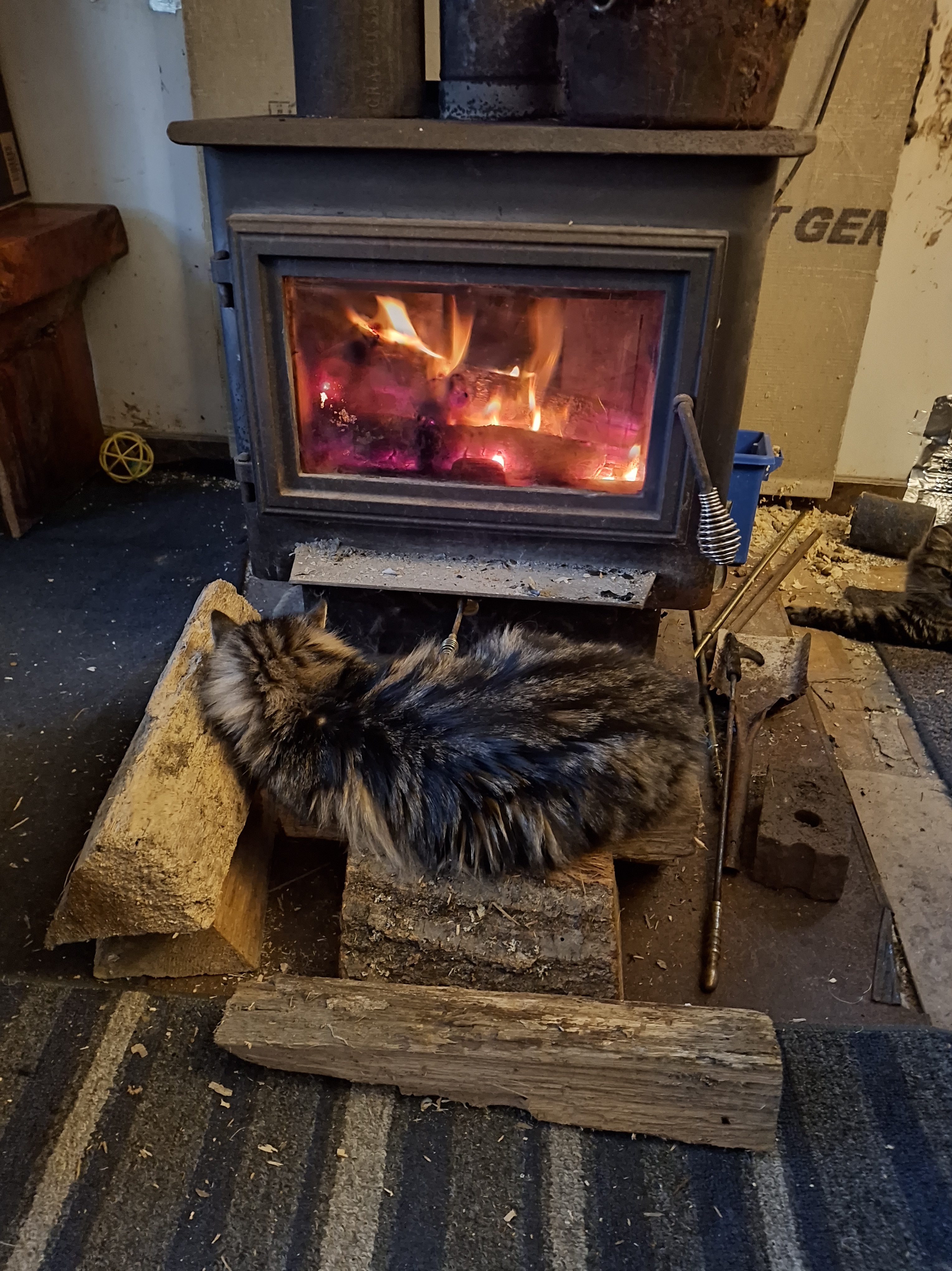
I shared the photograph below on social media over the weekend, but it bears sharing here, too. Because nothing brings about a sense of tranquility and peace like a warm fire blazing in either a fireplace, or in my case, the woodstove. It really is a comfort.

Yes, I know a few European countries have banned the use of fireplaces and woodstoves, citing climate change, pollution and air quality as the reason. But how much more is our air quality challenged by the smoke stacks of various manufacturing facilities, jet exhaust, crop dusting, and the mining for various minerals and precious metals that go into our electronics and so-called “green” energies? Even with the recycling of some of those components, it doesn’t completely offset the harm done of this last.

Yes, my minor was environmental science. I’m familiar with the science, have seen the evidence that the climate is changing, and that Mankind is responsible for this change. But it’s not you or I driving back and forth to work each week, or the woodstove you’re lighting to save money on heat each winter, that’s the cause. Both are just a drop in the bucket against corporate violations.

But that’s neither here nor there. I’m here to talk about fire…the good kind that satisfies the soul on a chilly autumn night. Can anything else compare? Surely no electric, oil, or even gas, heat soaks into the bones as readily as the fire on the hearth.

What is it about fire that soothes so much? Is it ancestral memory? Surely our ancestors spent their winters gathered around such, praying, reading, telling stories, making music together, sharing a pot of tea and a wedge of pie.

Granted, before woodstoves were invented, they wouldn’t have been warm. Houses from the 19th century and before were not insulated. And, while the fire on a true hearth (i.e. fireplace) satisfies almost as readily as that in a woodstove, much of the heat actually escapes up the chimney. It’s one of the reasons why woodstoves caught on: the heat stays locked in the cast iron, radiating throughout the house. With a fireplace, unless you’re sitting right in front of it, you cannot feel its warmth.

Perhaps the ancestral memory goes back even farther…to days of living in caves and the crackle of a fire keeping predators away. Is it that sense of safety and security that make it such a joy? While we may not need to keep a fire going to save us from being eaten by a saber-toothed tiger, perhaps there’s a transference of that safety and security onto the knowledge that, in the event of a storm and subsequent power outage, we’re still safe from freezing to death.

It’s likely we will never know the true answer to that, but what a time to mourn if we’re ever denied the comfort of that fire as some of our European neighbors have been. It truly is a gift…as Miss Zelda would agree (below).

May God bless you & keep you!

19th century, Books, Creativity, Diversity, Fashion, History, Nostalgia, Reading, Scripture, Tradition

Proud to Be A Woman

“Your beauty should not come from outward adornment, such as elaborate hairstyles and the wearing of gold jewelry or fine clothes. Rather, it should be that of your inner self, the unfading beauty of a gentle and quiet spirit, which is of great worth in God’s sight.” (1 Peter 3:3-4)

I’m going to get myself in trouble today. We have our monthly book club meeting this afternoon and this month’s selection is our own. I.e. We chose this month to read a biography, autobiography, or memoir of someone we like, or admire, and will share little bits and bobs from what we read and why we chose the person we did.

My choice?

Well, to be honest, I couldn’t decide between Tasha Tudor and Tucker Carlson. I like Tucker. I love his faith, how open he is in his belief in God, and the gentle and respectful way that he interviews those invited on his show. I also like his courage in being willing to interview those that most journalists and writers would shudder away from…such as Vladimir Putin.

But I’ve settled on Tasha for today. I’m rather tired of political debate. And, if anyone notices the Trump/Vance 2024 bumper stickers on my car, there will be enough political discourse at this book club meeting without me adding Tucker (though I may bring both books in with me anyway…who knows?)

However, for the moment, I’ve settled on Tasha because she is someone I have long admired. She chose her 1830s lifestyle at a very young age and she never wavered from her course. Her art and her creativity was infused with her gentle love for children, animals and nature and, of course, days gone by. She spun yarn, wove cloth, perused antique stores and estate sales for 1800s fashions, which she wore rather than just keep as displays (I’m guessing she was a tiny woman; my 5’8″, 190 lb. self could never fit into such clothing). She kept doves and chickens and geese and goats and birds and at one time even had a crow. She also raised Corgis, which she called Corgyn in the plural, declaring it the only proper way to do so. She cooked on both a hearth and cast iron cook stove. She lit her home with candlelight and oil lamps.

After years of working in living history museums, why wouldn’t I choose Tasha? I wish I had been so focused in my youth and lived much the same way.

But the real reason I chose Tasha is a quote from the book The Private World of Tasha Tudor by Tasha Tudor and Richard Brown:

“Why do women want to dress like men when they’re fortunate enough to be women? Why lose our femininity, which is one of our greatest charms? We get much more accomplished by being charming than we would by flaunting around in pants and smoking. I’m very fond of men. I think they’re wonderful creatures. I love them dearly. But I don’t want to look like one. When women gave up their long skirts, they made a grave error.” (Tudor and Brown, 1992, p. 63)

Having worn the long, full skirts and petticoats of the 1830s, I wholeheartedly agree with Tasha’s view here. When I’m wearing long skirts, I feel attractive and feminine. I feel confident and vital. That’s when I can truly say: I am woman. Hear me roar. It’s when I take myself seriously…so you should, too.

And, despite her love of all things 1830s, including the attire, Tasha had a long, successful, and modern career as a commercial artist, and could navigate between the two worlds quite nicely…even though, by her own admission, she wasn’t always “nice”. There was never a sign that she gave up her rights as a female to look and dress as a female. Instead, she simply celebrated being a woman.

It is something to celebrate.

But that’s just what I think. Let me know what you think (or thought?) when you read Tasha’s quote above in the comments below.

May God bless you & keep you!

Works Cited

Tudor, Tasha and Brown, Richard. The Private World of Tasha Tudor. Little, Brown & Company, 1992.

Creativity, Emergency Preparedness, Faith, Folklore, Gaia, gardening, God/Jesus, Healing, Herbs, History, Holistic Health, Homesteading, Nature, Plants, Self-esteem, Self-improvement

A Saturday Weed Walk

“The Lord is my chosen portion and my cup; you hold my lot. The lines have fallen for me in pleasant places; indeed, I have a beautiful inheritance.” (Psalm 16: 5-6)

This one is live! As in, in-person…my first!

To say that I’m not feeling a bit of that “Imposter Syndrome” would be a lie. Yes, I am a certified herbalist…and a Master Gardener. Yes, I do know how to use herbs and make medicine, health & beauty aids. I know how to use herbs for scent and I have at least a rudimentary knowledge of how to make dyes with some. And, yes, there are certain ones I can readily identify in the wild.

However, a recent walk through the nature trail that I will be working from at this live event revealed there are a lot of plants I don’t know. And, in this particular setting, there wasn’t a huge variety of plants…outside of some invasive species. That being said, I identified enough that I can put together an interesting walk.

At least I hope so…

Again, “Imposter Syndrome”–I am plagued with doubts. However, if I was too cocky and sure of myself, that would be the road to failure. A little nervousness is to be expected and, like all things, the more often I do this, the more comfortable I’ll get with it…and, in the future, I’ll make it a point to plan more “weed” walks through abandoned lots and sunny meadows rather than deep woods and dappled sunlight since most of the herbs I’m most familiar with are typically grown in sunnier locales. ;o)

Despite my nerves, I’m looking forward to the challenge of creating a fun and interesting experience for everyone who decides to join me on the walk.

If you live in northeastern Connecticut, the “weed” walk is part of an event being hosted by the Brooklyn Middle School in Brooklyn, CT between 10:00 a.m. and 12:00 p.m. on Saturday, June 3, 2023. Wear your walking shoes because the terrain is uneven, rocky in places, full of roots ready to trip you up, and steep in some areas.

May God bless you & keep you!

19th century, Animals, Christianity, Exhaustion, Faith, Family, God/Jesus, Gratitude, Healing, Herbs, History, Homesteading, Memories, Nostalgia, Prayer, Religion, Sleep Deprivation, Writing, Yoga & Fitness

Getting Back To My Roots

“O Lord, our Lord, how majestic is your name in all the earth! You have set your glory above the heavens.” (Psalm 8:1)

Sunday was Palm Sunday. I went to Mass and served as Lector, reading through Judas’ betrayal of our Lord and Savior, Jesus Christ. It’s one of those rare moments when Mass becomes almost a play, with Father Ben reading the words of Jesus; Lectors, like myself, reading the parts of the narrator and “voice”, and the rest of the congregation reading the parts labeled “crowd”.

I sometimes kick myself for not pursuing a career in acting. I studied acting in high school and, again, in community college. I’m quite good at it. And, after several years of serving as Lector, my knees no longer knock together in front of a crowd.

But I wasn’t really thinking about acting as I stood in front of the congregation on Sunday and read for the “voice”. My mind was reflecting over the last 5 weeks of Lent. I gave up junk food, at least the more popular definition of it (candy, sweets, chips, etc.). Living with the definitive junk food junkie (Mom), it’s tough to resist. However, as a measure of Mom’s sweetness and solidarity, she also gave up junk food for Lent so it wouldn’t be so hard for me. She didn’t want to eat chips and cookies in front of me.

Less mindful after Mass, I took Mom out for Chinese food and broke that Lenten vow by eating a fortune cookie (sigh!)

I also vowed to get back to reading a chapter of the Bible each morning and focusing more on my prayer life.

I’ve failed miserably on that score.

It’s amazing how hard it is to rekindle a habit once it’s been broken. It’s also amazing these epiphany moments.

Earlier blog posts have often sung the praises of working for a living history museum. It was the dream job come true. And, in many ways, that statement was true. I learned all sorts of things that will aid me on my homesteading journey, things that have been a major blessing already. Perhaps the sin of pride, but there was recognition as a herbalist…because that was my title: Herb Garden Lead. And, in many ways, I got to act. There were “scripts” to memorize (i.e. historical facts) when interpreting for visitors to the museum. There were skills to learn so we could demonstrate life in the 19th century.

It was also a very demanding position.

Prior to getting this job, I had a habit of rising everyday at 3:30 a.m. I blogged, prayed the rosary, and hit the yoga mat. Then I headed downstairs and outside to the barn to take care of the animals. I didn’t have to be to work until 3:30 in the afternoon at the dealership so I spent late-morning, early-afternoon writing. If the dealership had been a full-time position, it would’ve been ideal for this writer. I got home at 7:30 in the evening, spent some time caring for my animals again, and then went to bed.

Living history, however, demanded swing shifts. Evening programs on a Saturday didn’t see me driving over an hour home until after midnight…only to have to get up again a few hours’ later to work Sunday morning. 3:30 a.m. and writing became an impossible dream. The rides into work each morning found me playing “beat the school bus” because every route into work seemed to be a school bus route…no matter what time I left for work. I spent my mornings literally running through the barnyard, 19th century skirts hiked up over my knees as I threw hay and feed at the animals and yelled at them to get out of my way (we had to be fully dressed in period attire walking into the museum). Even changing the animals’ feeding time didn’t help because of how late I often got home at night.

And then I got my wrists slapped a few times for what few blog posts I still managed to create. I wrote about something unethical I witnessed in regard to the animals kept at the museum. I lamented being unable to attend Mass on a Sunday morning because of a conflict of hours. I own my bad on the first but, the lamentation over Mass was simply that: a lamentation. Not a dig against the museum.

I remember coming home from one of those evening programs, collapsing in the easy chair in the living room, still fully dressed in period garb, getting up 4 hours’ later and going back in, rumpled plaid still hanging from weary shoulders. I drove home the following evening praying, telling Him how I simply couldn’t do this anymore. As much as I loved interpreting, as much as I loved wearing the period clothing and learning all of these antiquated skills, I simply couldn’t devote every ounce of my being to it, as it seemed to be required.

I slipped while shoveling snow the following Tuesday so I could go into work on Wednesday and fractured my shoulder. The rest is history.

I may not have kept my Lenten vows as well as I would have liked this year. However, this Lenten season has been a time of reflection. How did I stray so far away from all that I hold dear? Writing, herbs, animals and homesteading…the things that make me, well, me. More importantly, family, friends, and above all, faith. I feel like this has been a long lesson in the sin of idolatry.

Because I truly idolized what seemed an idyllic job. If I had lived closer, if I didn’t have farm animals and pets, if, if, if…it might’ve remained a dream job–despite the grueling work schedule. But, perhaps, it was also a lesson that I’m not Supergirl. Like every other human being, I am gifted with 24 hours each day. How am I spending them?

As I continue to reflect during this Lenten season, I’m starting to go deeper. I feel like Job, questioning the why and the how. Maybe it’s time to re-read that book from the Bible.

However, for the moment, I seem caught up with the Psalms, finding balm for my spirit in shorter verses that always seem to pack a punch. It’s a reflection on my life these days: slow and steady, short and sweet. Baby steps forward, learning to take those steps and not being too hard on myself for being unable to handle anything bigger these days; it’s too overwhelming because of how far I’ve fallen behind in, well, everything. The good habits will return, or morph into something better. The life I dream of living will become a reality…or He will mold and shape it into something beyond my wildest dreams.

Amazingly, He’s been using my work at the library to teach me this very valuable lesson in taking things one step at a time. Rome isn’t built in a day but, those baby steps make a difference. It’s time to apply them at home. I can’t twitch my nose and do it all in a blink. But, each baby step will take me that much closer to that dream life…and maybe I’ll finally have time to enjoy some of that journey doing what I love, sharing it with those I love, and above all, praising Him whom I love above all else. In short, getting back to my roots.

May God bless you & keep you!

Animals, Bereavement, Brothers & Sisters, Christianity, Climate Change, Community, Cooking, Culture, Emergency Preparedness, Faith, Family, Fashion, Fiber Arts, Fleece, Frugality, gardening, God/Jesus, Healing, Herbs, History, Homesteading, Human rights, Humanity First, Introvert, Minimalism, Nature, Politics, Prepping, Wool, YouTube

The Call to Homestead

“I will lie down and sleep in peace, for you alone, O Lord, make me dwell in safety.” (Psalm 4:8)

The need to become more self-sufficient has moved from yearning to this almost panic-filled need. We’re running out of time. Both economic depression and the threat of nuclear war loom, and our leaders fly off to Davos to plot how to take everything away from the average working class citizen. There have been countless headlines quoting Mr. Schwab as saying we will own nothing and we will be happy about it. I’m probably paraphrasing a bit but, the overall gist is there. Yes, I can play devil’s advocate here a moment and say, sure, maybe it’s propaganda, a conspiracy theory. But, what if it isn’t? What if the goal really is a 15 minute city where we will own nothing for ourselves?

Would we be happier without ownership?

First of all, as a Christian, anything I own I do so by the grace of God. What I have truly belongs to Him. Would I be happier having those gifts taken away?

Despite the new position at the library, I’m still staring foreclosure in the face. It’s a lengthy and stressful process and there’s no guarantee that I will be successful in my endeavors. One could argue that, if I wasn’t a homeowner, this stress would not exist. I wouldn’t be fretting about losing everything that I have worked for in my life up to this point. And that is true. There’s also the multitude of repairs that fall on my shoulders as homeowner…repairs that have gotten out of hand in recent years. There’s the zoning issue still hovering over me like a black cloud. In short, the more you have, the more you stand to lose.

But, let’s spin this around a bit.

If we don’t own anything, what is the point of working, of setting goals? Whether we own a house, a car, etc. doesn’t change the fact that we still have to have food to eat. That is also true. But isn’t the purchasing of food a form of ownership? If you don’t own the place where you live, it is likely your landlord will not allow you to put in a garden. You won’t be able to raise livestock for eggs, for dairy, for meat…if you eat such things. I was a vegetarian for over 20 years. I know one can survive without consuming animal flesh. However, the loss of certain B vitamins, especially B-12, wreaks havoc with your nervous system. Stress, anxiety, depression often stem from a lack of these vitamins. And supplements are expensive. The purchase of such is also a form of ownership.

Now let’s go back to the garden. You can’t have one. You don’t own the land upon which your leased/rented home sits. What if you truly enjoy gardening? And what if you’re an introvert, like me, and the thought of a community garden makes you feel physically ill at times? If it’s not YOUR garden alone, you may be limited by what you can plant there. If you’re a herbalist like me, growing purely medicinal plants would likely be prohibited. Big Pharma doesn’t like competition, or a loss of control. So you don’t own the land. You can’t garden, which brings you joy. You can’t grow the types of food you enjoy eating. You can’t grow and make your own medicines, or even health and beauty aids. You’ll have to buy from big box stores, or online retailers. What’s in that food? That medicine? That skincare supplement?

Okay. You’re not a gardener. Maybe you like swimming in a pool, hosting backyard barbecues. Guess what? You can’t do that either. It’s not your land. And the people at Davos, who fly around in their private jets, just decreed that barbecues are environmentally unfriendly. The smoke produces too much CO2. As do cows. No steak. No hamburgers. No cheese to melt over that petrie dish substitute.

What if you’re not an outdoors kind of person at all? You don’t own your home. The landlord doesn’t allow pets. He/she doesn’t want you painting the walls. Your place isn’t big enough for a workshop to build things, like furniture. And your kitchen only consists of a microwave and a single induction burner. Baking, canning what you grew at the community garden, or cooking healthy meals is next to impossible (microwaves destroy all of the wholesome goodness in the food cooked in them). You can’t knit. Raising livestock is outlawed (that CO2 thing again) so no wool, angora, or mohair to work with. Acrylics will disappear, too, since we’re no longer drilling for oil.

Maybe you like taking the occasional long drive in the country. Yes, improvements in batteries for electric vehicles (EV) are happening all the time these days. But at what cost to the environment? No, oil and gasoline are not infinite resources. Neither are cadmium or nickel, or any other precious metal. Yes, drilling for oil does tremendous harm to the environment. But so does mining for these metals. Like coal, mountains are dug out, and run-off from the mining pollutes the soil and water. However, to get back on subject, you want to take that drive. But you don’t own a vehicle–EV or otherwise–and the EVs left at the community garage are all in use today. Sorry.

Does this sound like a happy existence?

If we own nothing, we also cease to own our joy. By owning nothing, we give up our right to choose for ourselves. I don’t know about you, but I don’t want some wrinkled up prune in Davos telling me I can’t pick a few dandelion leaves to feed to my rabbits, or even a salad for myself. I don’t want anyone telling me I can’t take a road trip someday to visit my brother in Tennessee because he’s outside of my 15 minute zone. I don’t want to eat synthetic, processed foods, or wear plastic clothing. I want the freedom to make truly healthy choices for me, my family, my pets, and my community.

I also don’t want to be at the mercy of the “system”. What happened in 2020 will last in my memory forever. The walk into the grocery store and seeing aisles of completely empty shelves. Companies, stores, libraries completely shutdown. Places of worship closed until further notice. Loved ones denied the right to say a proper “goodbye” to those they lost. The loss of employment for so many because they refused to become human guinea pigs in their real-world experiments. And now, watching so many young people–healthy, young athletes–dropping after accepting a jab to the arm as part of that experiment.

The less dependent on that “system” we are, the less that fabricated shortages, shutdowns, and experiments will hurt us. Even a window box will produce some food and reduce some of that dependence. It may not be enough to sustain you completely, but start there. Learn how to can food and pick up produce at a farmer’s market. Or even on sale at the grocery store. Learn how to make pet food from scratch. If you can, invest in a chest freezer. Find someone in your community who knows how to find and identify wild edibles. Visit your local library and check out books on the Great Depression. Or comb YouTube for videos on the same. What did our ancestors do to make it through? There is a sense of pride that comes with being able to make your own way in the world, in being able to cook from scratch, grow a few tomatoes and herbs in a pot, split wood for a fire in a stove.

There is a sense of pride in owning a home, too. Yes, you can become a slave to that ownership, especially during hard times. And there’s no denying the cost. Not everyone can afford homeownership and that is the real tragedy in our society today. Houses have gotten progressively bigger and more expensive. At the risk of sounding like one of those conspiracy theorists, perhaps that’s part of the plan from some of our leaders. But the freedom to live as one chooses is worth the fight.

Even Jesus gives us the right to choose.

May God bless you & keep you!

Animals, Brothers & Sisters, Christianity, Culture, Healing, History, Holidays, Nature, Religion, Spirituality, Wicca

Happy Imbolc, St. Brigid’s Day & Year of the Tiger!

“The Lord’s blessing is our greatest wealth. All our work adds nothing to it!” (Proverbs 10: 22)

First, a quick shout out to anyone reading this who celebrates the Chinese New Year, which is today. 2022 is the Year of the Tiger in the Chinese Zodiac. Anyone born in The Year of the Tiger is said to be passionate, brave, possess an unusual sense of adventure, be philanthropic and trustworthy but, also said to be stubborn, opinionated and often rebellious. In truth, I’ve found most zodiac descriptions to be quite general (i.e. many of us can claim traits like these even if we’re not born in The Year of the Tiger) but, it’s fun to read and learn, and wonder about. And greater minds than mine studied and learned and gave us the zodiac as a gift; there is also something to be said for the sometimes uncanny accuracy in these descriptions as well. Regardless, I want to wish everyone a Happy New Year today if you and yours celebrate the Chinese New Year! And, if you’d care to share, I would love to know more about how your family celebrates. Feast? Parade? Dancing? Please share in the comments section below…=)

Today is also Imbolc, Brigid’s Day, or St. Brigid’s Day. This one I know a little more about. Celebrated traditionally in Ireland, Scotland and the Isle of Man, and amongst Wiccans today, Imbolc is the first day of spring. And, if you’re paying close enough attention to nature, even here in New England where we have almost 2 feet of snow on the ground, you’ve probably noticed the days getting just slightly longer and a softness to the air that speaks of the warmer season just ahead.

Brigid, both the goddess and the saint, is said to protect homes and livestock. She is also associated with the lambing season, spring sowing, the blooming of the blackthorn, blacksmithing, healing, wisdom, poetry and, some sources, also associate her with seamstresses. Saint Brigid’s Day is a traditional Gaelic festival celebrating the midpoint between the winter solstice, or Yule, and the spring equinox, or Ostara. Brideogs–doll-like figures of Brigid–and special crosses are often fashioned out of rushes, or reeds, and displayed in the home. In earlier days, the brideogs would be paraded from house to house, and beds made, food and drink left, to welcome her blessings. Sometimes a wand made of birch may be left near the bed to represent the wand she is said to use to grow vegetation. In pagan lore, she is a fertility goddess. Along with St. Patrick, she is a Patron Saint of Ireland. In Christianity, she has the added virtue of having wet-nursed the Christ child.

Whether Brigid is goddess or saint to you, she is said to visit virtuous households and bless the inhabitants. And I pray that today, she will bless your family throughout the coming new year.

May God bless you & keep you!

https://www.gofundme.com/f/help-this-animal-sanctuary-grow-and-thrive

19th century, Animal Rights, Animals, Brothers & Sisters, Christianity, Compassion, Creativity, Environment, Faith, gardening, Gratitude, Greenhouse, Healing, Herbs, History, Homesteading, Plants, Spices, Straw Braiding, vermicomposting, Weaving, Wool, Worm castings, Worm Tea, Writing, Zero Waste

The New “About”: The Herbal Hare Tomestead and Animal Sanctuary

“A home for misfit animals and books, and makers of herbal, apian, and natural fiber products.”

Sanctuary – Focuses primarily on small livestock and pets that are being relinquished due to zoning regulation issues, foreclosure, or eviction.

Tomestead – A different sort of “rescue” or sanctuary, one that keeps used books out of the landfills.  The bulk of the books will be from donations.  Patrons will have the option of in-store credit (20% off purchase) or a check for 20% of estimated resale price.  Campus will consist of re-purposed sheds, RVs, trailers and/or mobile concession booths.  Each upcycled building will host a different genre, or subject(s) and be themed accordingly.  Additional outbuildings will host various natural fiber, herbal and apian products produced on-site and throughout the local community.  topography will include a 9000 square foot heirloom herb garden where walks and talks will be hosted; a petting zoo featuring some of the rescued animals at the sanctuary, and a cafe featuring menu items that would have been popular in the 19th century.  Proceeds from sales will be re-invested into the business, as well as providing for the care of the animals.

The Herbal Hare – Farm side of the campus will host various fiber-producing animals, in addition to rescues, such as sheep, goats, alpacas, and rabbits.  Spinning, weaving and dyeing demonstrations, herbal workshops, and “bee” school are future offerings.  Fibers will eventually expand to include basket weaving, chair caning, and straw hat making, and sericulture (silkworms).  Herb store will eventually be expanded to include a couple of greenhouses for growing heat-loving spices, such as cardamom and turmeric; mushrooms; microgreens, and sprouts.  

     Planned fiber products – primarily yarns and some woven products to start.  Straw hats, baskets, silks and linen in future.

     Planned apian products – honey, beeswax, candles

     Herbal products – seeds; dried and fresh herbs; young plants; skin care products; scent mixes and tea blends

All facilities will be zero-waste.  Reusable bags, boxes, upcycled Mason jars will be available for patrons.  We will also seek out compostable wraps, containers and utensils for our envisioned cafe. Compost will be re-purposed in the herb garden and future greenhouses.

Where is this wonderful place?  For now, it’s on the drawing board awaiting either an angel investor (or two) to help with start-ups, or a great, big pot of luck!  

What expertise do I bring to this endeavor?  Besides being a writer, I am a certified herbalist who worked in living history, both as a volunteer and as paid staff, for many years where I learned spinning, weaving and caring for natural fibers, and straw braiding for the making of hats.  I am also a Master Gardener with the University of Connecticut, and a librarian.  I have been rescuing and giving sanctuary to unwanted animals for much of my adult life–over 35 years!

This is my dream. With God’s grace, it will one day be a reality.

May God bless you & keep you!

PS The link to my Go Fund Me campaign to make this a reality:

https://www.gofundme.com/f/help-this-animal-sanctuary-grow-and-thrive