Abuse, Alcoholism, Animal Rights, Animals, Environment, Faith, Frugality, Gratitude, Herbs, Homesteading, Minimalism, Organic, Spirituality, Writing, Zero Waste

Connecting Alcoholism with Homesteading

Homesteading. The phrase conjures up images of “clean” living: home-grown organic fruits, vegetables and herbs; hand-spun yarns and woven fabrics; beekeeping; permaculture gardens; wildlife habitats; green energies; zero waste; compost–the list is endless but, again, it typically equals “clean” in most people’s minds. Alcoholism–or any kind of addiction, really–typically conjures up that stereotypical waif with the rheumy eyes living in a doorway. What our society doesn’t see is the priest/clergy, the school teacher, the lonely old woman, the star athlete, the average Joe working the deli counter in the supermarket. In short, it is an insidious disease that affects millions of people, either directly or indirectly–people who still manage to lead productive lives, who still manage to make meaningful contributions to their community. My paternal grandfather was nominated for the Pulitzer Prize while being an active alcoholic; not exactly the rheumy-eyed waif. There’s no cookie cutter definition or description.

That’s actually true for homesteading, too. I’ve read numerous newspaper and magazine articles that typically define it as simply growing your own food yet they miss the myriad goals of reducing one’s carbon footprint; the utilization of antiquated farming methods; raising animals for fiber, as well as eggs, dairy and, in many cases, meat. As a pescetarian, my homestead will never be used for raising meat and that actually raises some eyebrows because of the goats, chickens and ducks that grace the land. To me, the dairy, eggs, pest-control (chickens love bugs; slugs are duck delicacies), and rich, free fertilizer are enough.

As for alcoholism, I’m in the latter category with being indirectly affected by alcoholism. Though I enjoy a glass of mead on rare occasions, maybe a glass of wine at a toast, or, on even rarer occasions, a shot of Sambucca, overall, I’m pretty much a teetotaler. I can sit with friends who are enjoying a glass or two of Guinness or an Irish coffee after dinner and not be nervous or uncomfortable, while sipping a glass of pineapple juice or a cup of Salada tea. But as soon as the blurry-eyed stare, the loud voices, etc. rise to the occasion, I’d rather be anywhere else but. Too many frightening memories get triggered.

Growing up, the violent temper tantrums were only part of the picture. Dinner came out of a box labeled Rice-a-Roni, Noodle Roni, or Hamburger Helper; in leaner times, it was white gravy on toast (gravy made with flour, water and a little bacon grease). Dinner was often paid for with food stamps after a touching story was given that the step-father had left us high and dry. He hadn’t; he had simply lost another job due to too much time missed. Shut-off notices and bill collectors knocking on the door to which we pretended we weren’t home were part of the picture; name changes to the accounts often followed as if a new tenant had moved in–once, the electric bill was even in my name though I was only 13 or 14. Winters were always toughest. When we could get heating assistance, it was a little better. And one apartment actually had a working fireplace + a separate chimney that we were able to install a woodstove; a neighbor allowed the use of an old garage for storing wood. When my step-father was working, things were also better. But poor money management meant they didn’t stay that way. A steady paycheck meant we shopped every weekend for more “stuff” we really didn’t need. We treated every kid in the neighborhood to a trip to the zoo, an ice cream cone when the truck came down our street, or the amusement park. In many ways, as a kid, these aspects were fun and I encouraged these rare treats; I was suddenly a popular kid. I didn’t realize it for the poor management it was until many years later. And, of course, there was always money spent on beer. All of it would’ve been better spent in saving for leaner times or getting out of debt. We moved a lot. Beloved pets were disposable at the local pound, as were the endless litters of puppies and kittens because spaying and neutering was either too expensive or we could “always” find homes for them so why bother(??!?); cherished possessions were tossed or left behind for someone else to clean out–if they didn’t get destroyed during one of those temper tantrums. Beloved pets sometimes went hungry during the leaner times and were abused along with their humans when the temper tantrums started. The sound of a pop-top opening still sends me into shivers.

As a kid, I was always eligible for free lunches at school. In high school, we actually had a salad bar and I frequented it as my body craved the vitamins and minerals these fresh foods provided. I confess to often feeling guilty as I enjoyed these salads because I knew everyone at home was living on something much poorer. We often received baskets of food from local charities but it was almost always more of the same–packaged, processed foods because they retain a longer shelf life. This poor diet, as well as the stress that went with it, has led to some digestive health issues: Irritable Bowel Syndrome, gluten-sensitivity, lactose-intolerance and, in more recent years, some acid reflux. In learning about these health conditions, I’ve also learned how important a healthy, balanced diet really is. I’ve learned about food additives like High Fructose Corn Syrup and Monosodium Glutamate and how really bad they are for the body; the former being a leading culprit in the development of IBS. I learned about artificial sweeteners like Sweet N Low, which is saccharine and a leading carcinogen; Equal, which is aspartame and has its own health issues; Splenda, a by-product of the pesticide industry. In short, I learned the difference between organic foods that are grown without the use of chemical pesticides/herbicides, without any Genetically Modified Organisms (GMO’s) vs. the Franken foods that dominate most supermarket shelves. The desire to grow my own food, for homesteading, was born.

Of course, once you get started down that road to homesteading, if the itch takes hold, food production is only part of the picture. Yes, growing that food in a manner that conserves water, builds up the soil and maximizes space is a major part; canning and preserving, making everything from scratch, making one’s own bread and condiments. From there, as an herbalist, I’ve branched off into making my own medicines, health and beauty products, and even some natural cleaners. Because of all those lean years, there is also a deep desire to become more self-sufficient, to not be dependent upon the grid, to minimize the cost of living as much as possible while also taking better care of the planet. Because of the neglectful animal care, the desire to implement more humane practices–well, this is at the heart of it all because I owe it to the memories of so many pets to make sure current and future generations don’t suffer similar fates. Spaying and neutering, regular check-ups, adopting rather than breeding, and simply seeing these animals as the living, sentient beings they are complete the homesteading package. In many ways, homesteading has been the vehicle for curing the hurt and the ills created by that alcoholic upbringing. With each new skill, with each new and positive practice, with the care that goes into a homestead, my confidence and self-esteem rises. Therein lies the link.

When I started this blog, I was determined that it would only be about homesteading endeavors. Many false starts, and years of dormancy, led me to simply start writing whatever came to mind–even if it didn’t have much to do with homesteading at all. I’m finally finding my voice and the direction I’d like to take it. And, oftentimes, as I write, I find that blogging has become a sort of therapy. It is a hope that, by sharing my own experiences with alcoholism–and abuse–that I might help others to heal; knowing you’re not alone can be the most liberating experience. I have considered creating a separate blog, one that deals only with the alcoholism and abuse, and leaving this one to homesteading, animal stories, and faith-based postings but they are all part of the same world and I fear I might neglect one over the other. Besides, homesteading brings about its own liberation.

As I read back over this post, and realize where I’ve been, and how far I’ve come in life, suddenly the over-grown yard; the fact that this homestead has a long way to go before becoming a “working” homestead; the fixer-upper status; the less-than-perfect conditions that I often bemoan or shy away from fall away. Both homesteading and recovery from addiction/the affects and/or abuse from someone else’s addictions are journeys. You’re never quite done; there’s always room for improvement, always room for more growth. And as I plant those seeds for more growth, I also plant a few seeds of faith because, above all else, homesteading and recovery need a daily dose of that.

May God bless you & keep you!
Animal Rights, Animals, Environment, Faith, Homesteading, Nature, Spirituality

For the Birds

Many years ago, when I bought the present homestead, there was a bird feeding station outside the double windows over the kitchen sink. The previous owners of the property had set it up and I continued the tradition. Bird feeding–and watching–has always been a favorite pastime. I remember my paternal grandfather keeping a feeder in the backyard as well as a birdbath for his avian friends. It is a lovely sight each morning to see the variety of feathered friends zooming in and out for their daily sustenance. No matter how tired, depressed, sad or lonely I may be feeling (eh, we all have those feelings once in awhile…), the sight of their aerial antics lift me up. Sometimes I wonder if that old wives’ tale is true about them being God’s messengers–like little fluttering angels in disguise; it would seem so at times.

Of course, when I first moved in, that variety had me stymied a bit. I could recognize the mourning doves, the cardinals, robins, sparrows and the chickadees but what was that little gray bird with the crest? What about that black bird with the brown cap? And that little yellow guy is adorable but I haven’t a clue what kind of bird he is. So I bought a Peterson’s Field Guide for Eastern Birds. This book has received a lot of use.

Today, I can easily identify the titmouse, cowbird and finch (respectively, from the above paragraph). I also delight in the nuthatches, the starlings, woodpeckers, hummingbirds, and the occasional oddity. This can be a unique bird that’s come to visit or else a non-avian visitor. Toads, chipmunks, squirrels, and baby bunnies all come to dine from time to time. Of course, last week Mom and I entertained a visitor of another sort that, while not entirely unwelcome, did leave behind an unpleasant aroma. We see larger friends, too: deer, wild turkeys, the occasional fox or hawk.

Despite the noisy Interstate that runs almost through the front yard, it is particularly gratifying to know that this lonely, little acre provides a safe-haven for so many creatures. If I stay, there are plans to develop some wildlife habitats here–above and beyond the bird feeders–in the form of native plant gardens as well as bird gardens that provide food for our avian friends. I’ve added birdhouses over the years; every spring new birds are born here, providing a gift beyond measure. With so much natural habitat being destroyed by over-development–especially in northeastern Connecticut–it is important to provide a few oases in the midst of such chaos. We share this earth with so many beautiful–and sometimes not so beautiful but equally important–species; it seems selfish to the extreme to keep taking without giving back. God made all creatures. Not for us to exploit or destroy, but to share this great planet with in harmony.

If I relocate? A wildlife habitat will be created in the new digs; it’s a plan that can be readily implemented but I do worry about the creatures here, especially with so many properties on this Interstate being sold as commercial. This is a fixer-upper. There’s no doubt in my mind that, if I sold, it would be bulldozed down to make way for some sort of strip mall. And then where would these creatures go?

In the meantime, I watch their daily flight in for their breakfast. I delight in the occasional friend who finds shelter from the storm either in one of the birdhouses or else in one of my feeders (one has a rooftop). And I pray that, whatever choice I eventually make, my feathered friends will still find their oasis.

May God bless you & keep you!

Works Cited

Peterson, R. T. Peterson Field Guides: Eastern Birds, 4th Edition. Houghton Miffler: 1984.

Animal Rights, Animals, Environment, Gratitude, Homesteading, Nature

A Home-Based Business

I am hoping that “someday” my writing, artwork and, of course, the eventual development of a working homestead, will all negate the necessity of working a “job” off-site. And, with that spirit in mind, I decided to spend some time today dusting off (figuratively-speaking) the Go Fund Me campaign that I have had for several months’ now to try to raise start-up funds for a home-based business using goats to clear land.

With the first version of this campaign write-up, I used the term “goat wrangling”. I obtained this terminology from several similar businesses out West but, apparently, it has scared a lot of people off. The term wrangling seems to be conjuring up visions of a rodeo with goats instead of horses and bulls–the latter of which I would never condone, so why would anyone think I’d start a business doing the same thing with goats??? But it’s okay. I got some recent feedback bringing this concern to light so I am happy to oblige and change my future occupation to “Goat Handler” rather than “Wrangler”. No lassoing. No roping. No taunting with red capes or any other rodeo stereotypes. It’s all humane here.

I baby all of my animals. A couple of winters’ ago, Connecticut was hit with a blizzard that dumped nearly 3 feet of snow on us within a 48 hour time period. Prior to the storm’s arrival, local news stations were predicting power outages for most of the area. Knowing my only source of heat in the barn is from electric heat lamps, I cleared everything that might possibly attract a goat’s interest out of my laundry/rabbit room, set up every travel cage I own and made 30+ trips from the barn to the rabbit/laundry room, relocating chickens, ducks, and last but not least, the goats. We used a child safety gate (set on its side to make it taller) to keep said goats from straying through the rest of the house. I threw a piece of old linoleum onto the floor, covered it with wood shavings (the goats never figured out it was there…or maybe they knew they wouldn’t like the taste of linoleum), and there they stayed for several days until I could effectively shovel a decent path from house to barn, and clear a decent-sized area for daily exercise outside again. Am I loony-tunes? Maybe. But my babies were safe and that’s all that mattered. Amazingly, they gave little to no trouble throughout their stay but, I confess, they try every tactic, now that the threat of blizzards and power outages are over, to come back into the house. I guess they liked it better inside with us.

All this being said, I think it’s safe to say that these guys–if I can ever get this campaign up and running, ever get this business up and running–will be loved and cared for…even on the job clearing land of unwanted vegetation in an earth-friendly manner. I hope whoever reads this, and/or my Go Fund Me campaign page, will consider a contribution–or, at the very least, be kind enough to share it so that more will see it and, possibly, make it a success. I thank you for your support!

May God bless you & keep you!

https://www.gofundme.com/akt2hu9s

Environment, Herbs, Holistic Health, Homesteading, Nature, Spirituality

Friday’s Flora & Fauna: Basil

MMmmmm…

My first introduction to pesto sauce was atop a slice of gourmet pizza. Instead of the usual tomato sauce, or the sometimes “white” sauce many pizzerias provide, this particular restaurant slathered a rich and spicy pesto sauce over that crust. Spinach, broccoli and, of course, lots of cheese rounded it out. That first bite felt like a slice of heaven on earth; I’ve been hooked ever since.

And, of course, the main ingredient of this culinary miracle is sweet basil (Ocimum basilicum).

Basil = pesto sauce in my book. But even a little bit of basil sauteed in some olive oil with some fresh garlic and a little onion, then tossed with some pasta, makes a delicious, healthy and easy-to-prepare meal. And, of course, basil is a popular spice for more traditional pasta sauces as well.

I love basil. Even if it wasn’t a culinary miracle, that aroma is divine. I can’t help but brush my hands over the leaves whenever I see it, just to catch a bigger whiff. Amazingly, many bugs do not like the smell and, thus, it is pretty effective in keeping some of them away. Just grab a few leaves and rub them over any exposed skin. You may smell like an Italian restaurant but it beats the acrid stench of chemical sprays–and it’s safer for you, and for the environment.

I grow basil primarily for its culinary uses. It is easy to grow and it’s also an attractive plant. I’ve grown it both outside in the garden, and inside the house in a pot on the window ledge. It does need regular pruning or else it may grow quite “leggy” but this legginess doesn’t seem to affect either the flavor or the scent. However, “leggy” means there’s more stem, less leaves. And it’s the leaves you want for either pasta or pesto sauces. With regular trimming, the plant will bush out beautifully, adding a pop of bright green color, a sweet aroma, and a handy spice to any kitchen.

Medicinally, it is not a usual “go-to” for me but it does have some medicinal properties. It is said to be good for alleviating bad breath, headaches, and basil contains at least 6 compounds that help to lower high blood pressure (Duke 312). It may also be used as an expectorant, helping to expel excess mucus from the lungs and throat. I even found one reference for using basil to treat warts (Duke 549-550). This actually makes sense as basil also contains many antiviral compounds and warts, which are benign skin tumors, are caused by a family of viruses called papillomavirus. I confess, I have never tried using basil for this purpose but I also don’t have any warts to experiment with at the moment.

These statements have not been evaluated by the Food and Drug Administration. This information is provided for educational purposes only; it is not intended to diagnose, treat, cure, or prevent disease.

Whenever I think of warts, I associate them with witches and, as we are heading into the Halloween/Samhain season, I decided to look this herb up in Cunningham’s Encyclopedia of Magical Herbs. This book brings a touch of romance and whimsy to the art of herbalism and I love reading it. But the first thing that caught my eye was that it is said to “keep goats away from your property” (Cunningham 48). I’m not sure I like that use for it, as my goats are my life. They don’t seem to mind it in the garden, nor do they flee from home whenever I plant it, so maybe this is for wild goats–like in the Rocky Mountains–rather than beloved pets. Primarily, Cunningham talks about its use in love divinations and for exorcisms, the latter needing only to have basil strewn upon the floor to protect one from evil (Fr. Karras could’ve used this with Linda Blair; somebody should have told him about basil on the floor…). But, while I jest, there is a variety known as “Holy Basil” (Ocimum tenuiflorum) so maybe there’s something to it after all. Either way, at least the rooms will smell nice as you walk through them.

May God bless you & keep you!

Works Cited

Cunningham, S. Encyclopedia of Magical Herbs, 2nd Edition. Llewellyn Publications, Minnesota: 1985.

Duke, J. The Green Pharmacy. St. Martin’s Press, New York: 1997.

Abuse, Alcoholism, Animals, Creativity, Faith, Gratitude, Herbs, Homesteading, Nature, Organic, Religion, Spirituality, Writing

Is it Wasted Time or Time Well-Spent?

I have spent the better part of this morning searching through a directory of towns in Maine for a list of towns with the least amount of population. I’m looking for unorganized townships with less than 500 people. Next, will be to research their locations. If I decide to relocate, I would prefer being near the ocean. Not necessarily a waterfront property; they tend to be grossly over-priced, but I would like to be within shouting distance of the ocean…or a lake. Somewhere that I can plunk a canoe down in the water and paddle away. Is that possible with goats in tow (not in the canoe but farming in a coastal region)? Or are coastal towns all zoned into tourist trap submission? These are things I am hoping to find out. The mingled scents of clean farm animals and salty sea air would be the sweetest perfumes. And the cry of a gull amidst a chorus of bleats and neighs and cock-a-doodle-doo, the sweetest of songs. This will be my paradise here on earth. If I can find it. And if I can afford it when I do.

As I type this I am also thinking of all the improvements I’d like to make here on this little one-acre homestead in northeastern Connecticut. Being influenced by the folks at Path to Freedom (please Google for more information) in knowing that it is possible to have a sustainable homestead on a smaller piece of land–i.e. quoting Jules Dervaes in their excellent film, “Homegrown Revolution”, I decided years ago to “start with what I have”. But I worry about things like carbon monoxide from Route 6 settling on my herbs and vegetables, and the increased development of this Quiet Corner town. It’s becoming too commercial and yet the job market is scarce, public transport is so poorly planned as to be almost non-existent, and, despite being on this main Interstate, I feel like an island unto myself anyway. There is little by way of a “community” feeling.

Of course, I do little to encourage that community feeling. My yard is always overgrown. When someone knocks at the door, I seldom answer–unless I’m expecting someone. And I walk around with the feeling that I’m sitting in a fish bowl. The Thujas bordering the front of the house offer a great privacy screen but it is not enough; I’m that eternal hermit-in-the-woods. Not exactly the most encouraging attitude for an ordained minister but I crave solitude like the flowers crave sun and rain. It’s one of the reasons I’ve had such a difficult time adjusting to having a roommate–even though that roommate is Mom.

Whine, whine, whine…

Or maybe that should be wine, wine, WINE!

No, I seldom partake of the latter. Having felt the effects of alcoholism many times as a child–from watching a beloved grandfather vomiting blood each morning, and losing him all too early, to a stepfather’s drunken rampages and pedophilia–I’ll take the fruit of the vine in the form of some organic grape juice instead. (Albeit, I wouldn’t say, “No!” to a wee drop of mead though…)

As for the whining? The best remedy is gratitude. No, I am not where I really want to be. And I am feeling the shifts everywhere in my life right now, shifts that say change is coming and it is time to move on, move forward, get out of this rut that I’ve been “stuck” in for the last several years. Despite my hermit-in-the-woods mentality–which is another side effect of having grown up with alcoholism–I do desire that sense of community, that sense of connection with others. But I also want that oasis in the middle of it all, that place of quiet retreat where I can recharge my batteries–literally and figuratively speaking. We all need that.

So, as I draw a ragged deep breath and prepare to send Wendy Whiner on her way again, I make a short list of all of things I am grateful for right here and now:

I am grateful for the air I breathe, the water I drink, a roof overhead, the food on my plate and the clothes on my back.
I am grateful for my roommate, my Mom; grateful that I am fortunate enough to still have my Mom with me.
I am grateful for family and friends, my community of loved ones–whether they live in this Quiet Corner or not.
I am grateful for all of the myriad animals that share this home with me–both domestic and wild.
I am grateful for the gifts from God of being able to write, sing, play music, paint, draw, create and homestead.
I am grateful for my job, for being employed, and for the wonderful co-workers who share that part of my week with me.
I am grateful for my garden, for the herbs, fruits and vegetables growing there.

And I am grateful, most of all, for my Lord and Savior, Jesus Christ, who died for my sins and gave me everlasting life.

Now what the heck was I whining about?

May God bless you & keep you!

Works Cited

“Homegrown Revolution Quotes.” Quotes.net. STANDS4 LLC, 2016. Web. 22 Sep. 2016 .

Homesteading, Minimalism, Writing

Organizing

I am a minimalist…until it comes to paperwork/information. Then I save everything. The home office has been inundated with Post-Its and piles of books, magazines, print outs, etc. that I’m saving for “Someday”–you know that day. It never really gets here.

Yesterday morning after I hit “Publish” on my blog, I started sorting through all of the piles. And, really, just transferred them to different piles. Instead of a hodge-podge, each pile now has its own theme. One pile is nothing but file folders of information that I decided was worth keeping: recipes for everything from smoothies to DIY cat litter; how-to’s on making bio-bricks for the woodstove; sprouting; gardening tips, etc. These will go in the file cabinet. And, yes, they will be perused–or, at the very least, I will know where to find the information when I need it instead of creating a new hodge-podge going, “I know it’s here somewhere!”

Another pile is nothing but those Post-Its and I’ve decided to transfer the information to a single, spiral-bound notebook for easy reference. This one may stay on the desk as I’ve noticed most of the Post-Its are links to various websites. Some of them feature tiny houses; others, alternative building designs such as cob, straw bales or “earthships”. There’s a link for animal supplements and organic feed sources. And another for a portable solar panel. About a third of the Post-Its are books that I’d like to read, whether solely for pleasure, self-help or, in some way, related to homesteading and/or the environment. And some will have to be transposed to maybe a cheat sheet as they contain usernames and passwords I’ve created to join this group or that online. (Considering the wonder with which I’m re-finding this information, I can’t have been that enamored of the group in the first place but, who knows? Maybe the Universe is now ready for me to finally participate…)

The last is a pile of notebooks and I have little idea what is in them. I know some of them contain notes from my classes, and also, writings, character developments, etc. But they can’t all be just that. (Chuckle) Then again, you never know.

As I traverse this journey into a more organized work space, I shudder. Perhaps a neater, more sterile environment will create a short-circuit somewhere in the creative genius. Let’s hope not. There’s a whole lot more I’d like to share.

May God bless you & keep you!

Animals, Homesteading, Nature

Creatures of Habit, Beauty and Stench

Last week I posted about tearing down the mesh covering my chicken coop. Now comes breaking that “creature of habit” who automatically hunches over to avoid hitting her head and, potentially, getting her hair caught in that mesh–the mesh that no longer exists. I have spent the better part of the week reminding myself to simply walk into the coop upright; it certainly makes things easier. However, tearing down the mesh didn’t necessarily stop Ms. Kiel, the Polish hen, from roosting atop the chain-link fence. She’s still there, huddled under the over-hang of Japanese Knotweed. The only difference is I can easily pick her up and carry her into the hen house when I get home from work; before, I spent several minutes tickling her feet through the mesh until she got irritated enough to cackle and squawk, and slowly walk, stiff-legged, to the edge of the mesh, where she would finally flutter down and run into the hen house. Though you’d sometimes swear I was torturing her when I pick her up, this way is infinitely preferable. The “creature of habit” will adapt.

But not necessarily to the other creatures who have visited this week.

I thought we had another Mousecapade, volume 9…or 10…whatever sequel we are on now. However, it was an adorable flying squirrel that found its way into the house. Adorable to look at with his/her silky tan fur and the soft, stretchy webbing between his front and back paws, making “flight” possible. How he got into the house had me stymied a bit as I’m fairly certain I would’ve seen him following me indoors on one of my trips to the barn or elsewhere. Emmylou found him in the rabbit room; and I found her, batting at him with her paws, as he scaled down the back of Alys’ cage and then leaped to the back of Rhys’ cage, scaring the poor buns, and then scampering behind the feed bin. Not wanting to be bitten, I grabbed a plastic pail I have, that also has a flat lid, and then pulled out Rhys’ cage, intent on over-turning the pail on him so I could put him back outside but he was too quick. Mr/Ms. Flying Squirrel crawled under the clothes dryer instead. And there he stayed…smarter than the mice who sometimes come to visit and don’t have the sense to stay in a place where slap-happy felines are waiting without.

Was the hole under the dryer? Did he come in through the exhaust somehow? I finally gave up the “hunt” and went about my business for the day. That evening Whitney didn’t come into the kitchen for dinner. I found her sitting on the shelf behind the dryer, staring intently at the ceiling. I walked over to the dryer and followed her gaze to a small hole that now existed in my ceiling. I didn’t see our friend, the flying squirrel, but I can only assume this to be his entrance/escape route as this hole was not there the day before. A cleaned lid from a cat food can has been tacked over the hole until I can get to the store to buy some patching plaster. Let’s hope our friend found his way outside again…without eating anymore plaster, insulation, or, heaven forbid, wiring. Oi vey!

And then another creature of beauty came to visit…

Mom and I were sitting in the parlor enjoying a cup of tea together on Saturday afternoon when suddenly Mom looks up and asks, “What’s going on out there?” A cacophony of squawks, quacks and the clattering of newly-trimmed hooves over the rough boards of the back deck interrupted our afternoon tea. I looked out the picture window that overlooks the barnyard and saw all of my beloved animals huddling as close to the backdoor as they could get. All eyes were fixed towards the left of my view towards the chicken coop and back gate. Throwing on a quick pair of slip-on shoes, I ran outside to find yet another unwanted guest: a skunk.

For a brief moment, I watched in wonder. They really are beautiful animals, striking, with that stripe of white over a rich, black background, but that’s where the admiration ended as his or her musky scent filtered across the barnyard–even without any spraying! Then a little bit of fear-factor kicked in. A.) Though it was late-afternoon, the sun was only just beginning to set; I wouldn’t even consider it twilight. What was he doing out so early? Was he rabid? Or just hungry and drawn to the scent of healthy laying hens and their cache of eggs, one of his delicacies? And B.) how was I going to get him out of the yard without getting sprayed or bitten? He seemed to wonder that, too. He scooted under the hen house and then moments later, started running the back fence line, looking for a hole to crawl out. While he was still running the back fence, I ran to the barn and chicken coop and closed both doors; the last thing we needed was that lovely perfume in the barn. Then, as it was getting on to twilight, I decided to shut the animals into the barn early. Keeping an eye on our visitor, who seemed to be keeping his distance focusing solely on a way to leave, I ran inside to fill the feeders then raced back out with them. By now, our little “guest” had decided to turn up the western side of the fence, sending chickens and ducks scurrying in my wake towards the barn, only too happy to escape. Getting a headcount, I closed them safely in for the evening then turned my attention to the goats.

Felicity is a bit of my problem child. Instead of following me to the goat barn where I could shut she, Domino and Chester safely in, she had a bead on that skunk that I know well–it’s the same one she has on Mom’s dog, Max, whenever she sees Mom walking him on the other side of the western fence. She was getting ready to charge him. Thank heavens I have few, if any, neighbors–and those I do have, aren’t right on top of me. My shout of “Felicity!” did get her attention, if only briefly, but it was enough for me to reach her side and start turning her towards the barn. She’s stubborn though. It took everything I had, plus a handful of carrots, to coax the three goats into the barn where I could close them in; by the time I got them in, our visitor had found his way up onto the back deck. I watched as Mom made to open the back door to see if she could help and gave another shout, “Don’t open the door! He’s right there!” Needless to say, I spent a few moments in the barn with the goats, hoping our visitor would find his way off the back deck before I had to brave the yard again.

Dusk had officially fallen by the time I crept outside, watched him running the back fence again. I opened the back gate wide, hoping he would find his way out the way he’d come in, and then I went inside. Mom took Max out front on his leash rather than risk any chance encounters out back.

Yesterday morning I crept outside in the pre-dawn darkness to see if our visitor had left yet. The gate was open wide as I had left it the evening before and no black and white presence could be seen. I went back in, got dressed, made breakfast and then started filling the morning feeders. I took another trip outside. Still no skunks in evidence, I filled waterers, scattered grain, seeds, and the contents of the “chicken bucket” (leftovers, vegetable peelings, etc.) outside then opened up the hen house. Without a trace of fear, the ducks and chickens left the coop, the ducks plunging into the kiddie pool while the chickens scavenged my leavings for them. I let the goats out, fed them, watered them, re-filled their minerals and the little cup of baking soda I leave out free-choice (baking soda reduces gas in their rumens…i.e. bloat, which we strive not to create conditions that might lead to it but it’s good to have the baking soda on hand, just in case). Anyway, everything looked good. And all seemed back to normal.

Until around 1 p.m.

Mom and I were, again, enjoying a cup of tea together. I had just come home from a run to Agway to purchase more hay and the supermarket where I picked up fresh greens for the rabbits. Suddenly, the chickens, ducks and goats were all flocking to the deck again.

I ran outside.

This time, I didn’t see any black and white bodies running the fence line. Instead, the three goats were standing shoulder to shoulder along the edge of the deck, looking at their barn. Grabbing a shovel, I tiptoed to the barn door, peeked inside, and it appeared empty. I walked in, looked around. Nothing. I tapped the shovel on the floor, thinking maybe the skunk had crawled under the barn again and I could scare him out–if I didn’t cause him to spray underneath, which would be almost as bad as having him spray inside the barn. That’s when I heard a little high-pitched chattering behind me. I turned around and Mr. Skunk (or Ms, begging your pardon, if…) was scavenging a clutch of eggs in the corner by the barn door (I have 3-4 hens that prefer to roost overnight with the goats and use the fallen hay under their platform and in the corners for nests). I think I could’ve beaten our Olympic champions in a marathon in the time it took me to vacate that barn. I joined the goats, chickens and ducks up on the deck and waited for our visitor to have his fill of eggs and then leave.

He started running the back fence yet again as I ran to the barn and closed the door in his wake; I didn’t want him going back in and staying.

Of course, it was broad daylight. My doubts about him and why he was out so early in the day magnified. And, as it was day, the animals were not likely to want to go back in–even with two handfuls of carrots. I couldn’t leave the gate open with them free-ranging, especially the goats, so how was I going to get him to leave? To make matters worse, Felicity had that bead on him again as he angled up the western fence and crossed to the deck again. While the chickens, ducks, Domino and Chester all took their leave, Felicity didn’t just stand her ground, she put her head down then raised up on her hind legs and slammed down on the deck just behind him. No amount of shouting, calling or coaxing even phased her. And, of course, Skunky did the expected. He sprayed. Fortunately, not a full blast; he saved that until he was off the deck again and under the bathroom window as he raced back for the fence line in vain hope of a opening from which to escape (my bathroom has a very interesting aroma right now that no amount of candles or lighted matches can relieve…eew!).

By then, I had managed to get my arm around Felicity’s chest to hold her back from another attack but, it seemed, she’d gotten a whiff of what he could do and decided maybe she didn’t want to tangle with him after all. That didn’t keep her from keeping a watchful eye on him as he continued his quest to escape. And that’s when inspiration struck as a flock of chickens, ducks, and goats crowded around my ankles to stay out of his way. Running into the house, I grabbed an X-pen and then raced back outside. Skunky had just waddled under the barn again. I opened the X-pen and stretched it from the back gate to the barn. Hopefully, he would not waddle out from the other side; I’d have to form a Plan B if he did. But, thankfully, serendipity played a hand. Skunky waddled out from under the barn, to the gate, and scooted back under, revealing his hole in in the process. I filled the hole with rocks and then stretched the X-pen across the gate, hooking it on either side for added protection. So far, so good…

As for Felicity, while Skunky sprayed, only a single droplet managed to hit her on the back of the head. A washcloth dipped in vinegar and cool water quickly cleaned it up and there is little to no scent lingering on her fur. I can’t say the same about my bathroom.

May God bless you & keep you!

Animals, Environment, Herbs, Holistic Health, Homesteading, Nature, Organic

Friday’s Flora and Fauna: Eat Your Weedies!!

I’m talking about Chenopodium album, of course…or more commonly known as Lambs’ Quarters. This stuff pokes up all over the place, being almost as common as the dandelion (Taraxacum officinale). And just as nutritious:

(Values based upon a 2000 calorie diet)

Potassium………..12%
Vitamin A……….232%
Calcium………….30%
Vitamin C……….133%
Iron……………..6%
Vitamin B6……….15%
Magnesium…………8%*

As I tend to let the yard overgrow, I always have a number of these “weeds” growing wild. I often pick the leaves while weeding the garden beds and eat them straight off the plant (as always, before doing so, please be sure that no pesticides or herbicides have been used in the area). They have a mild taste, similar to spinach, kale or Swiss chard and they make a nice addition to any salad. The leaves do contain oxalic acid so raw consumption should be done in moderation. However, all of the aerial parts (leaves, stems, flowers) may be steamed; thus, removing the risk of the oxalic acid. A little pat of butter, a light sprinkling of salt and/or pepper–or perhaps a pinch of garlic powder/salt and you’ve got a nice little pot-herb to serve beside any main dish. A Google search for recipes will provide some delicious dishes as well.

Of course, you will want to be certain of positive identification.

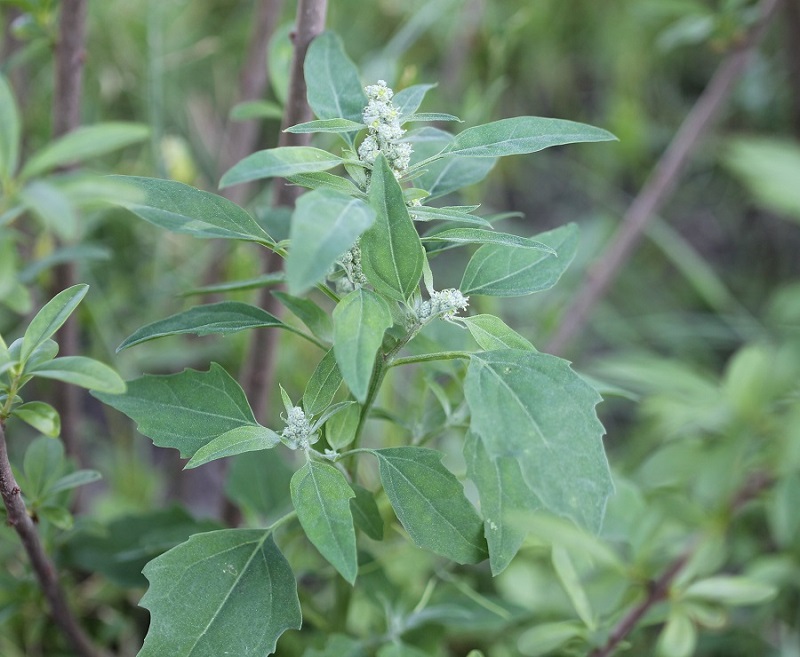
lambs-quarters2

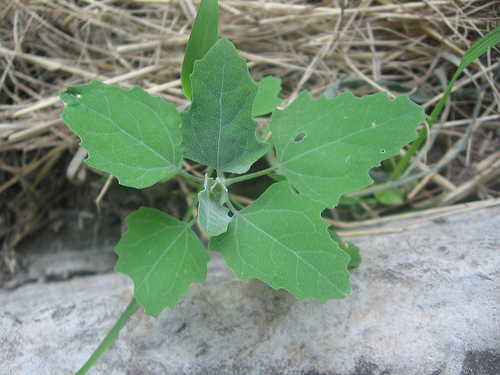
Lambs’ Quarters has grey-green leaves that closely resemble a goose foot. From a distance, they appear dusty and the plant may grow many feet tall. The flowers grow in spiky clusters of what looks like small balls of pale green (de Bairacli Levy 95-96). And, while the young plants tend to be full and lush-looking, as they mature they become more ‘leggy’. A good field guide will provide more of the particulars; I am including some photos to aid in identification.

lambs-quarters

Lambs’ Quarters gets its name from being a good fodder for sheep but other livestock enjoy it as well, including goats, chickens and geese. I often cut back some of its growth and toss it over the fence. My goats, chickens and ducks go wild over it; they know its many health benefits. Lambs’ Quarters may be used as a “pasture tonic herb” and may improve digestion as well as provide an anemia remedy (de Bairacli Levy 95-96).

As it is good for us, and for the animals, it is also good for your soil and a homesteader/gardener’s friend. Lambs’ Quarters tends to spread rather quickly wherever the soil has been contaminated by car fumes, pesticides, etc. It restores much-needed nutrients. Though we often lament its invasiveness, Lambs’ Quarters in the garden is a sign of a healthy garden bed, of soil rich in vitamins and minerals. It tends to grow wherever Gaia decides it is most needed but I’ve actually been considering creating a bed just for Lambs’ Quarters as, knowing its virtues, I can appreciate it better. I’m hoping everyone will decide to find a spot for it in their garden, too.

May God bless you & keep you!

*These statements have not been evaluated by the Food and Drug Administration (FDA). The information shared is intended for educational purposes only; it is not intended to diagnose, treat, cure or prevent any disease.

Works Cited

de Bairacli Levy, J. The Complete Herbal Handbook for Farm and Stable, 4th Edition. Faber and Faber, New York: 1991.

Wild Edible Food. Lambs’ Quarters. 16 September 2016. Retrieved from: http://www.ediblewildfood.com/lambs-quarters.aspx

Photos retrieved from: http://www.google.com

Animals, Creativity, Herbs, Homesteading, Nature, Writing

3:30 Woman

I remember many years ago, when I was dating my first husband, he painted a little soldier figure and christened him “3:30 Man”. “Is it 3:30 yet?” was the daily battle cry within the stockroom where we worked together and it was boldly painted on the side of this figure. “3:30 Man” sat on the desk that my ex shared with his then-supervisor. 3:30 p.m. was the magical time, the time when we could all go home and remember something of a life apart from the daily grind just to make ends meet.

Today his counterpart would be 3:30 Woman. But I doubt I would dress her in olive drab. 3:30 Woman is a lot more flamboyant. She’s wearing her Wellingtons in the mud and barnyard muck, raking old hay and animal waste into the compost pile after schlepping water and feed out to the barn. She’s standing in the kitchen with a bright pink apron over her clothes, measuring sugar and molasses to make her own brown sugar instead of the store-bought variety. She’s got a paintbrush in hand, dabs of paint on her hands, her arms, in her hair and is busy detailing that rocky beach gracing her office wall. She’s also pounding away furiously at the keyboard, not waiting for inspiration but writing anyway as Pearlina, Paz, Emmylou, Priscilla, Ozzy, Kirby, Whitney, Alice, Rosco and Ariel chirp and purr and chatter away in her lap, in the window, on the yoga mat. Eh, she needs a good dose of feline intervention to write. Without little paws climbing on the keyboard, the desk, begging in and out of the room and getting into jars of pens, markers and other office supplies, it would be too easy.

3:30 Woman, like 3:30 Man, is a defender of innocents but there the comparison ends.

Of course, 3:30 Woman is hailing 3:30 a.m. rather than p.m. At 3:30 p.m. she’s going into work to take pictures of cars and vans…and salivating over that Chevy High Country in a rich burgundy color, rather than going home. 3:30 a.m. is when life begins, a little blurry-eyed and incoherent, but it is a life worth living. Perhaps I should add a cuppa tea in 3:30 Woman’s hand though…a little mix of Slippery Elm (Ulmus rubra) and Echinacea (Echinacea purpurea) to soothe the vocal chords when it’s time to sing or, perhaps, a bit of green tea (Camellia sinensis) to control the asthma. When 3:30 a.m. is a bit of a challenge and she’s still slumbering away when that alarm goes off, perhaps just a cup of plain, ol’ Salada tea after the usual morning yoga practice to give her a little more “pick-me-up”. Either way, that cuppa tea belongs in her hands as much as 3:30 Man holds his rifle in defense.

And, as another alarm goes off, this one to remind me to step away–if only for a while–from the literary world and attend to homesteading matters instead, I smile and wonder, “Is it 3:30 yet?” I’ve still got a few more chapters left.

May God bless you & keep you!

Creativity, Herbs, Holistic Health, Homesteading, Nature

Friday’s Flora and Fauna: Violets are More Than Just Blue.

When I was a little girl, violets were second only to dandelions. Oftentimes, I picked both together, enjoying the striking contrast between dandelion’s fuzzy, yellow flower head and violet’s soft, velvety petals. I would bring them in to my grandmothers’ kitchens, or to my Mom’s, place them in a Dixie cup or an old tea cup of water, where they would grace the windowsill for the rest of the day; by morning, they’d be dead.

I’ve blogged about dandelions before; now it’s violet’s turn.

I don’t remember how old I was when I first learned about sugared violets. I didn’t grow up with “green” living, or even living off the land, so this was foreign information to realize that certain flowers and/or leaves may be eaten–especially the ones that much of the population considers weeds. But sweet violet (Viola odorata) is indeed an edible flower. And, being curious about how they are “sugared”, I googled it. I found this recipe from Martha Stewart: http://www.marthastewart.com/350345/sugared-flowers; next spring, I will have to harvest them and give it a try. The leaves are also supposed to be good steamed, much like spinach or kale.

Medicinally, I have found two separate references–one from Juliette de Bairacli Levy and another from Michael Tierra, both renowned herbalists worldwide–for the use of violets to treat tumors. According to “The Complete Herbal Handbook for Farm and Stable” by Juliette de Bairacli Levy, both the leaves and the flowers may be used…both internally and externally. Despite my love affair with herbs, I can’t help wondering how effective they are in such a treatment. If they are effective, why doesn’t the American Cancer Society incorporate them into their healing regime? Or do they? Has some part of the violet been isolated and made into a drug to be used in cancer treatment, similar to the pain relieving compounds in willow bark being isolated to make aspirin? Or is it simply because violets are considered by most a weed, and fall under the category of “folk medicine”, that perhaps they are pooh-poohed by orthodox medicine? Regardless, it is worth further research.

Violets have other medicinal uses, mostly involving the upper-respiratory system. They may sooth a sore throat, alleviate dry mucous membranes, ease chronic coughs and asthma symptoms (Tierra 203-204). They may also be taken internally for the treatment of inflammed liver, kidneys, bladder, and for gallstones (de Bairacli Levy 159-160). Though the latter book is aimed at the farm, they are also said to be effective for the same ailments in humans. Externally? Being emollient, they make a nice skin oil or lotion to help ease dryness and inflammation. Who knew?

Our natural world is so full of wonders, I am sometimes amazed to find myself reeling in shock over a new discovery. Violets haven’t been part of my pharmacopoeia before so it was fun doing a little research on them today. In so doing, I may have found a new friend to add to the home apothecary…or, at the very least, a new addition at the dinner table. And, if they don’t appeal to the palate? At almost 50, they still look great standing next to the dandelions on the windowsill.

May God bless you & keep you!

Works Cited

de Bairacli Levy, J. The Complete Herbal Handbook for Farm and Stable, 4th Edition. Faber and
Faber, New York: 1991 (original printing was with Faber and Faber of London, 1952…)

Tierra, M. The Way of Herbs. Simon & Schuster, Inc., New York: 1998.